

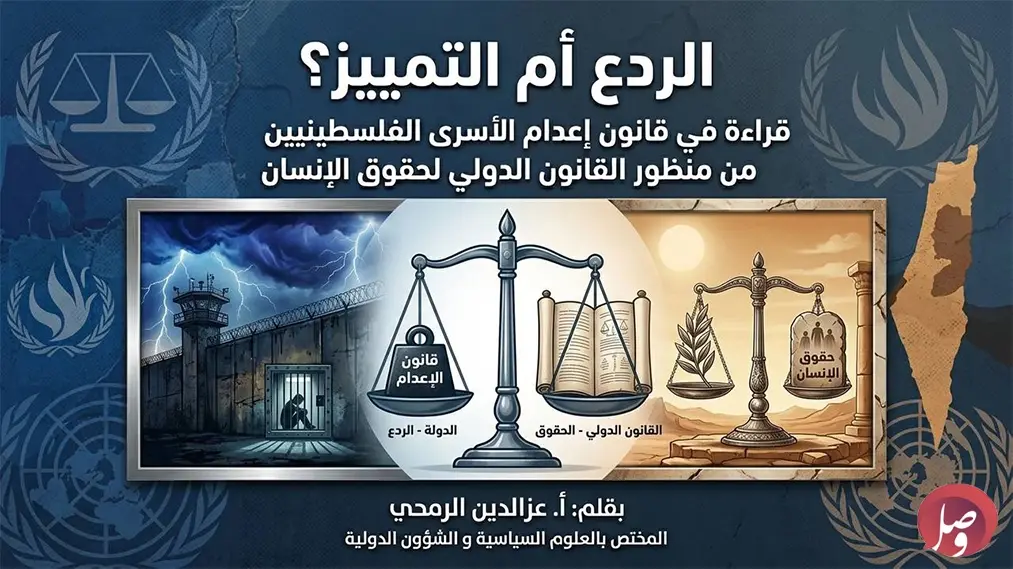
Wasl News | Opinion Article | The Palestinian Prisoner Execution Law: Deterrence or Discrimination?
\
A reading of the Palestinian prisoner execution law from the perspective of international human rights law
Deterrence or Discrimination?
By Dr. Ezzeddine Al-Ramahi, specialist in political science and international affairs
Introduction
Amid the growing punitive legislation passing through the Israeli Knesset, the law on the execution of Palestinian prisoners has emerged as one of the most contentious laws at both the domestic and international levels. While the parliamentary majority in "Israel" has marketed it as a deterrent tool against Palestinian operations, human rights organisations and international legal bodies have described it as a flagrant violation of international humanitarian law.
This article seeks to read the law on the execution of Palestinian prisoners within the framework of international human rights law, in order to answer the central question: does this law represent a legitimate deterrent under international standards, or does it reflect an organised discriminatory policy that contravenes Israel's obligations under international law?
First: The Law, From Text to Context
In February 2023, the Knesset passed an amendment to the Military Justice Law in a first reading, before it was finally adopted after approval in the second and third readings in the Knesset by the end of the outgoing month of the year 2026.
The law applies to Palestinian prisoners tried before Israeli military courts in the West Bank, the Gaza Strip and Jerusalem, while it does not apply to settlers or Israeli citizens who are tried before Israeli civil courts.
This discriminatory divide within the judicial system constitutes the first indicator of the law's discriminatory character: while it applies to Palestinian prisoners, it does not apply to settlers who commit acts of violence against Palestinians.
Also read: Executions of prisoners in Iraq escalate.
Second: The Alleged Deterrence – A Critical Reading
Proponents of the law, foremost among them National Security Minister Itamar Ben-Gvir and Prime Minister Benjamin Netanyahu, argue that the death penalty constitutes an effective deterrent against Palestinian armed operations, and that reducing judicial constraints accelerates justice for Israeli victims of "terrorism." However, these arguments collide with several facts:
First: Israel's security and military establishment, including the Mossad and the Shin Bet, warned that adopting the death penalty could complicate the prisoner file and negatively affect future prisoner exchange deals, and warned that this law could lead to an escalation of Palestinian operations rather than deterring them as a retaliatory measure. Those bodies reject this law entirely.
Second: Deterrence under international human rights law requires proportionality, necessity and procedural legitimacy. The new amendment reduces procedural obligations, which removes it from the sphere of legitimate deterrence and places it in the sphere of arbitrary and collective punishment.
Third: Systematic Discrimination – A Human Rights Reading
On another level, the execution law stands out as a model case of the systematic discrimination practised against Palestinians within the Israeli judicial system.
Discrimination on national grounds: Israeli settlers who commit aggressive acts (and even more serious ones according to human rights statistics) are tried before civil courts that do not recognise the death penalty, while Palestinians are tried before military courts subject to exceptional punitive legislation following the adoption of the execution law against Palestinians. This double standard in judicial treatment constitutes a flagrant violation of the principle of equality before the law stipulated in Article 26 of the International Covenant on Civil and Political Rights.
Discrimination in the context of occupation: Article 68 of the Fourth Geneva Convention permits the imposition of the death penalty on inhabitants of occupied territories only with strict and defined judicial guarantees, and on the condition that it is not carried out against persons under the age of 18 who have not reached the legal age. The Israeli amendment, by reducing these guarantees, contravenes these provisions.
The International Court of Justice's advisory opinion of 2004 also confirmed that the occupying power's measures in the Palestinian territories are subject to international humanitarian law, which does not permit discriminatory penalties, including apartheid and discrimination on national grounds or a duality of laws governing the judiciary and penalties.
Discrimination as a systematic policy: International human rights organisations, including Amnesty International and Human Rights Watch, have documented that Israeli law reproduces a pattern of institutional and racial discrimination against Palestinians. The 2023 report of the B'Tselem organisation stated that the military judicial system in the West Bank hands down rulings against Palestinians with conviction rates of up to 99%, in stark contrast with the conviction rates in civil courts for settlers who engage in hostile acts against Palestinian civilians in villages and towns in the West Bank and Jerusalem.
Fourth: The Execution Law Under International Law
When analysing the execution law against international standards, a number of flagrant violations emerge that conflict with international humanitarian law, including:
- Violation of the right to life: Article 6 of the International Covenant on Civil and Political Rights prohibits the imposition of death sentences except in very specific cases and with full judicial guarantees. The Israeli amendment breaches these standards.
- Violation of the principle of non-discrimination: The International Convention on the Elimination of All Forms of Racial Discrimination (CERD) requires States Parties to take measures to eliminate discrimination in all fields. Legislating an execution law against Palestinian prisoners but not against settlers contradicts this, constituting discrimination based on national origin, in violation of the Convention.
- Violation of the obligations of the occupying power: Israel, as the occupying power, is bound to apply international humanitarian law in the occupied territories. Article 75 of Additional Protocol I to the Geneva Conventions requires fair judicial guarantees for inhabitants of occupied territories, which the new Israeli amendment undermines.
Conclusion
The law on the execution of Palestinian prisoners, marketed as a deterrent measure, appears under human rights analysis as a discriminatory measure that violates international human rights law and international humanitarian law and disregards them entirely.
Continued application of this law will lead to further tension in the conflict, undermine prospects for a political settlement and peace, and expose Israel to growing international accountability. Repealing this law is the essential step toward restoring a minimum of justice in the penal system applied to Palestinians in the occupied Palestinian territories.
Sources and references:
- Knesset of Israel: text of the amendment to the Military Justice Law, 2023.
- B'Tselem: "Execution Without Trial: The New Amendment to the Military Justice Law," 2023.
- Human Rights Watch: "Israel: Death Penalty Law for Palestinian Prisoners a Serious Violation," 2023.
- Amnesty International: "Report on the Human Rights Situation in the Occupied Palestinian Territories," 2024.
- International Court of Justice: Advisory Opinion on the Wall, 2004.
- International Covenant on Civil and Political Rights, 1966.
- Fourth Geneva Convention relative to the Protection of Civilian Persons in Time of War, 1949.


