


This article was originally published by journalists Nour Khalil and Sara Creta
Othman Yaqoub Mansour, who left Darfur for Egypt more than a decade ago and later founded the African Vision School for Sudanese Education, a grassroots initiative in Cairo that provided classes for Sudanese children and adults, including refugees, said: "[Security forces] threatened me, my wife and even my family by phone and in the street."
Mansour said authorities raided his premises last summer and detained him on fabricated charges that he had taught students that a disputed piece of land between Sudan and Egypt belongs to Sudan. He said he contacted the United Nations High Commissioner for Refugees, but was simply told to "keep moving," as the threats forced him to relocate from place to place across the capital.
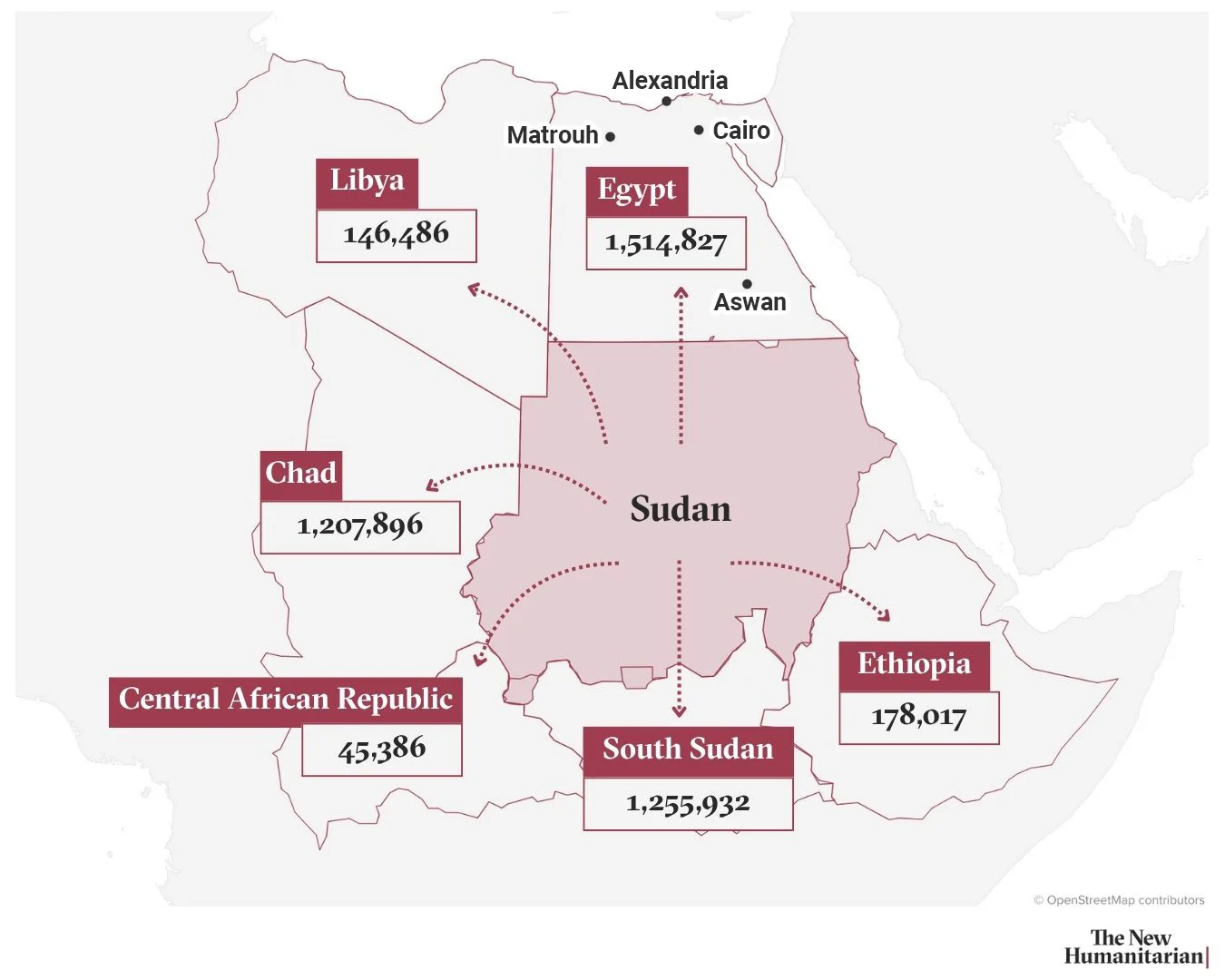
Some 1.5 million Sudanese have crossed into Egypt since the war between the Sudanese Army and the paramilitary Rapid Support Forces began more than two and a half years ago.
However, these refugees, who represent part of the 11.5 million people displaced by the escalating conflict, have been used as scapegoats by politicians amid a worsening economic crisis.
An investigation conducted last year revealed large-scale illegal deportations of thousands of Sudanese, carried out secretly in violation of the international refugee conventions that Egypt has long ratified.
The investigation also revealed the locations of appalling facilities that security agencies used to detain people.
Subsequent reporting — based on newly obtained material from local refugee organisations, leaked Egyptian government documents, and testimonies from dozens of refugees and lawyers collected over more than a year — reveals further escalation in the deportation campaign.
The number of refugees being detained and deported has risen sharply, as security agencies carry out inspections and arrests not only in border areas where people enter the country, but also deep within major cities. Authorities have also targeted refugee-led initiatives, including the closure of dozens of schools run by Sudanese.
This repressive measure comes as the European Union has pledged substantial sums to Egypt in exchange for curbing migration to Europe — a deal that mirrors similar agreements with other transit countries, and which would make the bloc complicit in the abuses of the Egyptian government, which did not respond to a request for comment.
The United Nations High Commissioner for Refugees receives substantial funding from European governments, which critics say creates political pressure on the agency to avoid criticising deportations in Egypt and other policies that increase refugees' vulnerability and limit the UN's ability to support them.
Other sources have accused UNHCR of being subject to direct pressure from Egyptian security agencies. They said UNHCR's operations were vulnerable to pressure that led some staff to conceal refugee complaints or prevent the reporting of arrests and deportations.
UNHCR spokesperson Babar Baloch said donors are an essential element in sustaining the agency's activities, but its work "is guided by the core principles of humanity, integrity, impartiality and independence."
He added that UNHCR "regularly engages" with the Egyptian authorities to discuss concerns about abuses faced by refugees. Baloch said: "Given the brutal ongoing conflict in Sudan, UNHCR believes that people who have been forced to flee Sudan are likely to be in need of international protection and, as such, should not be forcibly returned to their country."
A record number of deportations
Even before the current war and displacement crisis, Sudanese and other refugee communities in Egypt faced deportations and other abuses by security agencies, including arrests and, in some cases, killings.
However, deportations began to rise markedly in late 2023, shortly before the Egypt–EU agreement, and coinciding with an increase in Sudanese arrivals.
This trend then accelerated after Egypt passed its first national refugee law last year. Although it has not yet been fully implemented, sources reported that it encouraged authorities by granting them broad powers to revoke refugee protection for unclear reasons, such as respecting unspecified Egyptian values.
Precise numbers of deportations are difficult to establish, as the government does not allow the UN and other humanitarian agencies access to detention centres and border areas, and it does not share any of its own data. Nevertheless, some reports from local organisations supporting refugees point to the scale of the campaign.
In the first three months of this year, a prominent local refugee rights organisation, in an internal research document shared with journalists, reported a "record number" of deportations. Like many sources cited in this report, the organisation's director asked that he not be identified — nor the organisation — for fear of government reprisals.
In total, the organisation documented more than 850 deportations of mostly Sudanese refugees — more than half of the 1,546 deportations it recorded in the whole of 2024, a figure which itself represents a small part of the more than 20,000 Sudanese refugees likely deported last year.
The case archive of the Refugees in Egypt platform, which includes incidents reported by refugees and lawyers, documented the detention of 687 Sudanese asylum seekers between April and August in three main areas — Greater Cairo, Alexandria and Matrouh — in addition to 1,560 others detained and deported since August.

An internal list issued by Egypt's Passport, Immigration and Nationality Authority on 30 September 2025 recorded the names of 24 Sudanese nationals transferred from prison detention for deportation procedures.
Reporters also gathered visual evidence of arrests and deportations. One video, geolocated and verified, shows a uniformed officer carrying a baton confronting refugees outside the UNHCR building in Cairo. Other footage shows security forces carrying out arrests at police checkpoints and in residential areas.
Two Egyptian security officials described how deportations had become routine. One officer from Greater Cairo said his police station deports around 200 people a week, while another said more than 2,000 Sudanese are moved each week from police stations in Cairo to Aswan, a city near the Sudanese border.
An Egyptian human rights activist described the scale of deportations as "unprecedented" in Egypt's modern history, while a senior official at an international non-governmental organisation said refugee protection was "shrinking by the day", trapping families between two impossible choices: "endure detention and deportation, or risk their lives trying to reach Europe".
Legal protection revoked
Most refugees who spoke to journalists said they had been detained and deported for not holding a valid residence permit — a legal requirement that applies to all foreign nationals, but which is difficult for refugees to meet because the government has huge registration backlogs, with some appointments postponed until 2029.

An appointment notice directs a Sudanese refugee to the Egyptian authorities to apply for residency, but the appointment was set for March 2028. The accumulation of applications has left many refugees without legal status and exposed them to the risk of detention and deportation.
Refugees said they were arrested and deported despite holding documents issued by UNHCR, which are supposed to protect them from forced return. Some described cases in which Egyptian authorities confiscated their cards at the time of arrest, depriving them of proof of their legal status.
A government document obtained by journalists ordered the deportation of six refugees, most of them from Sudan, four of whom were registered with UNHCR. The document directed authorities to confiscate UNHCR cards and ensure the refugees signed declarations confirming their "voluntary" departure.
While the confiscation of UNHCR cards and forced "voluntary return" procedures have long been flagged by human rights groups in Egypt, the fact that this is recorded in an official government document may indicate that these are not isolated abuses but part of a broader strategy.
A lawyer working for a local refugee organisation, with more than a decade of experience in deportation cases in Egypt, said: "It is a systematic attempt to revoke their legal protection. Once their documents are confiscated, it becomes nearly impossible for them to defend their right to remain."
The director of a local refugee rights organisation said the situation had deteriorated because of the "blank cheque" the European Union gave Cairo to curb irregular migration. He added that this partnership "gave Egyptian authorities absolute freedom to violate their international obligations".
The agreement may also have proven counterproductive, as the deterioration of conditions for Sudanese refugees pushed them towards Libya. While some remain there, reports indicate that the number of people travelling to Europe rose markedly in the first months of 2025.
During this period, hundreds of Sudanese who attempted to reach Libya were arrested, with detainees and their lawyers describing to journalists severe overcrowding; their detention for months without due process, healthcare or access to asylum; and eventual deportation to Sudan.
An internal document issued by the Egyptian Ministry of Interior showed that some 200 Sudanese, including women and children, were deported from Matrouh, a northern town near Libya, in a single day during September.
Lawyers confirmed that these deportations occur regularly and are likely to involve much larger numbers.
Targeting community leaders and children
Last year's investigation focused on refugees detained along the border after entering Egypt irregularly — which is necessary because obtaining visas takes months — and while travelling to Cairo. Recent cases show how the security campaign has extended into cities, with arrests at security checkpoints, metro stations and in residential areas.
A Sudanese refugee said she was arrested in Cairo in January after police confiscated her UNHCR document, leaving her with no proof of her legal status. She added that, lacking residence papers, she was taken to a detention centre, where officers falsified her file to claim she had been apprehended near the border without any documents.
In January, authorities also deported a 17-year-old Sudanese boy who was registered with UNHCR and lived in Giza, according to a case published by a refugee advocacy organisation. He was arrested on his way home from school for lacking a residence permit. Five days later, his deportation led to his separation from his parents.

A leaked government document revealed directives to the authorities to coordinate the deportation of two Eritrean women and four Sudanese nationals, and to prevent their return to Egypt. Some information in the document was redacted to protect the identities of the refugees concerned.
In another recent incident, also published by a refugee advocacy organisation, a 15-year-old Sudanese boy who had lived in Egypt since childhood was detained and deported after being arrested with a group of students celebrating their school graduation in a Cairo park. Although at least two of them held Sudanese nationality, they were all deported to South Sudan.
Sudanese refugee institutions have also been targeted. According to research by a refugee advocacy organisation, Egyptian authorities ordered the closure of at least 46 schools run by the Sudanese community last year, often confiscating furniture, books and other resources. Closures continued this year, according to local media reports.
Community leaders from Sudan and elsewhere — who cannot be named due to the risk of reprisals — told journalists that they are increasingly being targeted by security agencies and pressured to report on other refugees under threat of detention or deportation.
One leader arrested in January in Greater Cairo said: "We were detained without any legal procedures, and threatened with deportation if we refused to report on our communities. We had no choice: either betray our communities or face abuse."
Four other refugee leaders said they had recently been summoned by National Security officers — in some cases by the same person — to report on developments within their communities, such as activists' activities, initiatives and planned gatherings.
Community leaders said they are also interrogated after publishing human rights reports or media articles on refugee issues — particularly if there is suspicion that they contributed to, or were in contact with, the journalist or organisation concerned.
One Sudanese community leader said: "Sometimes they summon me to the office or the police station, and at other times they ask me to write a report on a specific incident. If I don't respond to their calls, they send threatening messages to my phone."
A local community leader told journalists about a phone call he had with an official. In it, a National Security officer questioned the leader about a recent community initiative, asking who ran it, whether it received donations, and what services it provided to the community.
Weak data and bribery allegations
UNHCR has faced criticism from refugees, lawyers and civil society groups over its response to deportations, although many acknowledged that it operates under significant constraints.
For example, Egyptian authorities prevent UNHCR from accessing detention centres and border areas, leaving it "unable to intervene effectively", according to a former UNHCR staff member in Egypt. "They don't know who is being detained or deported until after the incident. Their ability to intervene is almost non-existent," he said.
The director of a refugee advocacy organisation described UNHCR's data on forced returns as "extremely weak". In an interview earlier this year, he said that information collected by UNHCR indicated a decline in deportations, which contradicts what many other organisations have documented.
UNHCR's limited presence along the Egyptian–Sudanese border means there is no system to register refugees on arrival, leaving many vulnerable to detention while travelling to the agency's only registration office in Cairo. Journalists have documented numerous cases of refugees being arrested on their way.
Due to the huge demand, the migrant registration centre in Cairo has struggled to meet the needs of new arrivals, particularly after two other centres recently closed as a result of funding cuts. According to two appointment-allocation statements provided to journalists, some applicants for 2024 and 2025 were given appointments in 2026.
A former UNHCR staff member in Egypt, who held various positions, described his growing sense of internal frustration. He said: "Refugees would come to me desperate for answers, and I had nothing to offer them. It got to the point where I started to feel as though they resented me. I wondered: why am I even here?"
Multiple sources said registration delays have fed a black market: refugees who can afford it pay a network of brokers who allegedly have links to UNHCR staff to secure early appointments that are then sold on to other asylum seekers.
One refugee community leader said bribery takes place outside the UNHCR office "every day, in front of the police". They accused the agency of inaction, issuing only "general warning statements" advising refugees not to pay any money to obtain registration slots.
Bloch, a UNHCR spokesperson, said protecting refugees from exploitation and ensuring the integrity of UNHCR's programmes are "key priorities". He added that the agency works "continuously" with partners and communities to raise awareness of fraud risks and to remind refugees that all UNHCR services are free of charge.
Bloch said UNHCR's funding for operations in Egypt had dropped sharply this year, but that the agency is "working hard to increase its registration capacity and introduce digital solutions". He explained that the registration waiting period had decreased from nine to ten months in 2024 to four to five months in 2025.
"Ineffective" response from UNHCR
Other sources said that, even taking into account the constraints UNHCR faces, its performance of core protection duties – such as intervening with authorities on behalf of threatened refugees and providing timely legal support – has not been good enough.
Another lawyer who has long specialised in refugee issues said: "Even when refugees are detained or deported, the system remains opaque, protection mechanisms are ineffective, and those most at risk – such as Sudanese – are left without any support."
One leader of the Eritrean community, resident in Egypt for more than ten years, said they typically receive no response when they inform community members of arrest and deportation reports. He added: "The community blames us and holds us responsible. UNHCR has put us in an extremely difficult position."
Hassan Abdullah, also a Sudanese refugee, said he emailed UNHCR after receiving death threats from an Egyptian man following a financial dispute a few years ago. Forty days later, his 12-year-old son was killed in what he described as a direct escalation of the same dispute. Hassan said the legal assistance he received from UNHCR was not effective, and that no protection measures, such as resettlement support, were offered to him until long after the incident.
Mansour, director of the Sudanese community school, said that after his arrest on 1 July, his family emailed UNHCR. He said the agency replied on 9 July, confirming receipt of the message and stating that its team was aware of the case.
A more detailed response came on 29 July, by which time his deportation process had already begun, without him being given access to a lawyer. His deportation document – obtained as part of this investigation but normally kept confidential – instructed Sudanese authorities to facilitate the issuance of emergency travel documents for his deportation.

An emergency travel document issued by the Sudanese Embassy in Cairo to facilitate the deportation of Othman Yaqoub Mansour, a Sudanese national and refugee registered with the United Nations High Commissioner for Refugees in Egypt.
Mansour also alleged that family members repeatedly contacted a specific UNHCR official, who assured them the case would be handled. But when they later followed up internally, they were told there was no record of these messages. Mansour said: "He just says, 'I'll deal with the problem,' and doesn't officially record anything."
A current senior UNHCR employee in Egypt alleged that security agencies have infiltrated the agency, and that this influence leads to some cases being neglected.
They added that some colleagues, under pressure, urged others to overlook arrest reports or blocked the internal escalation of sensitive complaints about government abuses. The whistleblower said the same staff also monitored refugee community leaders, identifying those who raised complaints or organised events on refugee issues. They added that some of these individuals were later detained on charges of visa violations or for security reasons.
Other refugees, lawyers and human rights activists also expressed concern about security services infiltrating UNHCR operations – a problem sources said affects many international organisations in Egypt – citing cases in which refugees were arrested shortly after visiting UNHCR offices.
An activist in refugee rights said he attended a meeting organised by UNHCR in Cairo in 2021, and the following day received a call from an intelligence officer who had been contacting him regularly, asking him to hold a meeting at a security facility.
The community leader said: "I was shocked to discover that he knew everything we had discussed, as if he had been present among us. It has exposed me to threats from him, because my intervention during this meeting was sharply critical of the Egyptian government."
Journalists asked UNHCR to respond to allegations that its Egypt office is influenced by security agencies, and to claims that some staff suppressed reports of arrests, but the spokesperson did not address these points directly.
Bloch said: "When UNHCR receives information about possible arrest, detention or deportation of people who may need international protection, it follows up with the Egyptian authorities and calls for due process in line with international refugee and human rights law."
Staying silent
Multiple sources accused UNHCR in Egypt of not publicly criticising deportations and not standing up to the Egyptian government, with some arguing that its silence amounts to a form of complicity.
A lawyer who has worked on deportation cases for more than a decade said: "The system is becoming more organised and aggressive. UNHCR's silence in the face of blatant violations of asylum law does not merely mean it is neglecting its mandate; it makes it complicit."
An analysis by journalists of UNHCR Egypt data over the past two years found no mention of deportations in dozens of updates on its activities concerning Sudanese refugees, nor in its annual reports.
In an interview with Egyptian newspaper Al-Masry Al-Youm last month, senior UNHCR official Rovinderini Menikdiwela said Egypt had been "wonderful in its treatment" of refugees and in allowing them to live in its cities and towns. She said nothing about mass deportations.
Menikdiwela also described Egypt's new asylum law as "very important" and "an excellent initiative", although UNHCR's official comments on the legislation noted that it does not explicitly include the principle of non-refoulement in line with its obligations under refugee conventions.
The asylum law will see the government take over responsibility for registering asylum seekers and determining refugee status from UNHCR, but critics say it opens the door to forced returns by granting authorities wide powers to revoke status and deport people on vague grounds.
UNHCR's Egypt office has supported the law's development for several years – through capacity-building workshops and discussion sessions, and currently through work on a five-year transitional plan.
Ashraf Milad, a prominent lawyer specialising in asylum cases in Egypt, questioned whether the agency should support the process given that it is "fully aware of the extent of the violations committed by the Egyptian authorities". Jeff Crisp, a refugee expert and former UNHCR official, said the Egypt office is cautious about speaking publicly on deportations and the asylum law "because doing so could jeopardise its relationship with the authorities and thereby threaten its access and operations".
Crisp said the organisation's reliance on funding from the European Union and European states also prevents it from making more forthright statements, given that these states are committed to providing billions of euros to Cairo in return for the government curbing migration to Europe.
Like UNHCR, the EU has made limited criticisms of Egyptian policies, although it privately acknowledged that the asylum law does not meet international standards, according to minutes from a meeting earlier this year between EU officials and Egyptian civil society groups that were shared with journalists. An EU official at the meeting said the bloc had asked to see the draft law in advance, but its request was refused.
However, the official said the new law would not halt cooperation with Cairo, noting that "we have to accept the reality of the type of government in Egypt".
Accepting that reality will be far harder for refugees such as Mansour, who was deported earlier this year and whose popular education initiative was shut down by the government. He said: "They erased everything I built. Now the children have nothing left."
"EXCLUSIVE: Egypt ramps up Sudanese refugee deportations with little UNHCR pushback", Sara Creta and Nour Khalil, The New Humanitarian.


