


How did Malek Bennabi reveal the historical and civilisational dimensions of the conflict?
The main axes of Malek Bennabi's thought in "The Jewish Question"
- The comprehensive civilisational perspective: Bennabi holds that the Jewish question is not an isolated religious or political issue, but an integral part of the development of Western civilisation and its influence on the Islamic world, which requires a deeper understanding of historical and social phenomena.
- The triad of Jewish power: Bennabi focuses on "the dollar, the woman and interest" as the main instruments the Jews used to shape their economic, social and political influence within Western societies.
- A call for the reform of the Islamic self: Bennabi offers solutions that go beyond passive confrontation, stressing the need to build a strong Islamic civilisational project and to reject "colonisability" as a path to meeting challenges.
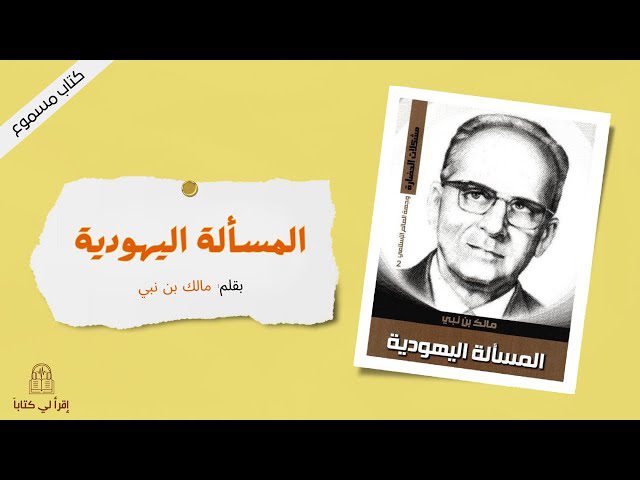
The book "The Jewish Question" by the Algerian thinker Malek Bennabi, first published in full in 2012 decades after it was written in 1952, is a unique and unprecedented study of the nature of "the Jewish question." In his analysis, Bennabi goes beyond narrow religious and political dimensions to offer an in-depth civilisational vision that links the emergence of this question to the development of Western civilisation and its influence on the Islamic world.
Bennabi was not concerned merely with describing the phenomenon, but with offering a radical analysis aimed at understanding the mechanisms of influence and power, and at laying foundations for confronting contemporary civilisational challenges. This book, which remained hidden for many years, is today regarded as one of the central texts for understanding Bennabi's broader perspective on civilisation and renaissance.
The study that later became "The Jewish Question" was written in 1951 and remained unpublished until it was included in the second part of "The Problem of Ideas in the Muslim World" (Wijhat al-Alam al-Islami).
The civilisational perspective on the Jewish question
In "The Jewish Question," Malek Bennabi rejects treating the matter as an isolated phenomenon or a mere religious dispute. Instead, he places it within its broader civilisational context, seeking to uncover its deep roots in European history and its impact on the course of Western civilisation and the Islamic world. Bennabi holds that understanding this question requires a comprehensive view that goes beyond current events to analyse the driving forces and historical determinants.
The Jewish personality and its development within Western civilisation
Bennabi begins with a historical analysis that traces the development of the Jewish personality from the Babylonian captivity until its integration into and influence on Western cultures. He asks why Jews migrated to Europe at a time when it was still backward compared with the flourishing East, and he sees in this orientation a strategic step.
According to Bennabi, the Jews found in Europe a fertile environment in which to implement their plans for dominance, exploiting Christianity in its early stages to consolidate their presence and influence. He links this development to the rise of Western civilisation, regarding the Jews as its "soul and heart" and as essential contributors to shaping its identity.
The deviation of Western civilisation and the Jewish role in it
Bennabi advances a bold idea: that Western civilisation deviated twice in its history. The first deviation was when it abandoned its Christianity and returned to paganism; the second, more dangerous deviation was when it "handed its keys to the Jews."
This handing over, according to Bennabi, led to Jewish control over the pivots of Western life, whether economic, cultural or political. This control was not carried out arbitrarily, but through specific mechanisms that Bennabi describes as "the triad of power."
The triad of power: the dollar, the woman, interest
The theory of "the dollar, the woman and interest" is central to Bennabi's understanding of how Jewish influence was built. He holds that these three elements were not merely ordinary means, but strategic instruments used with great effectiveness to achieve aims beyond material gain or limited social influence.
The dollar as a dominant economic power
Bennabi regards the dollar not merely as a currency but as a symbol of immense economic power that has succeeded in controlling the pivots of the global economy. This economic control confers political and cultural influence and allows resources and policies to be directed in ways that serve particular interests. He indicates that this economic dimension was the cornerstone in building the Jewish state and in extending its influence worldwide.
The woman as a social and cultural instrument
As for the woman, Bennabi views her as an active element in the social and cultural fabric. This does not imply any diminution of women's worth, but rather an understanding of their role as an influential force in shaping values and guiding societies. He explains that exploiting the role of women in society, whether through the media, the arts or even social relations, can be a powerful tool for influencing public opinion and steering cultural orientations towards specific paths that serve particular agendas.
Interest as a pragmatic political driver
Interest, in Bennabi's view, is the pragmatic political driver that guides international relations and political decisions. Instead of values and principles, interest becomes the basic criterion for alliances and policies. This approach makes it possible to achieve long-term goals, even if this requires sacrificing some ethical or humanitarian considerations. Bennabi holds that this focus on interest was decisive in the Jews' capacity to influence global policies.
The impact of Jewish influence on the Islamic world
Bennabi's analysis was not confined to Western civilisation but extended to the effect of this influence on the Islamic world, which he sees as suffering from deep gaps that make it vulnerable to colonisation and external influence. These gaps lie not only in weak military strength but in weak civilisational awareness and the absence of a unified Islamic project.
Colonisability and the absence of joint action
Bennabi refers to the concept of "colonisability," meaning that societies weak from within, lacking solid civilisational foundations, become prepared for colonisation and external domination. He points out that the Islamic world suffers from this colonisability, in addition to the absence of genuine joint Islamic action capable of confronting challenges effectively. This lack of cohesion and shared direction makes the region vulnerable to external influence that exploits points of weakness.
A civilisational approach to the question
Bennabi suggests that the solution to the "Jewish question" lies not in political or military confrontation alone, but in building a strong Islamic civilisational project. This project must focus on self-reform, the cultivation of awareness and the strengthening of the self-capacities of the Islamic society, affirming that this is the only way to absorb the challenge and turn it into an opportunity for renaissance and progress.
Lessons for future generations
"The Jewish Question" was not merely a historical or political analysis; it was a forceful call addressed to future generations. Malek Bennabi wished Muslims to learn from their history and to understand the mechanisms of civilisational conflict, so that they might be able to build a better future.
Bennabi's prophetic expectations
One of the notable features of the book is his prophetic expectations. He pointed to the possibility of a full-scale war between America and Russia, believing that America would be less affected by it. These expectations reflect his capacity to analyse historical and political data and to draw long-range conclusions, highlighting the depth of his thought.
The importance of building an Islamic civilisational project
The essential message Bennabi wished to convey is that Islamic renaissance can be achieved only through building an integrated civilisational project that focuses on self-reform, the development of ideas and the strengthening of unity. This project must be a genuine alternative to the Western model and must be capable of absorbing contemporary challenges and offering authentic solutions from within the Islamic system.
Between critique of the West and critique of the self
One of the most important aspects of reading "The Jewish Question" is that Malek Bennabi did not view civilisational conflict merely as a confrontation between a strong party and a weak one. He sought the reasons why one party had the capacity to exert influence while the other lost the capacity to take initiative.
The problem, in his view, does not begin from outside alone, but also from within, when intellectual production declines, institutions weaken, knowledge becomes separated from the project of renaissance, and societies turn into consumers of what others produce.
Thus, confronting the external challenge becomes impossible unless it is preceded by a process of internal reform that restores to society its capacity for action.
From possessing resources to producing power
The book raises, directly and indirectly, a question of great importance: why do the wealth and capacities possessed by Islamic societies not automatically turn into civilisational strength?
Money alone does not make a civilisation, and possessing land or natural resources is not enough to build sustainable influence. Power requires people, and people require an educational, intellectual, moral and institutional system capable of converting capacities into results.
This idea intersects with the essence of Bennabi's intellectual project. He holds that civilisation begins not with things but with the human being, the idea and the relations that organise society.
Hence, talk of the external adversary becomes worthless if it is not accompanied by a question about the society's ability to produce the knowledge, technology and institutions that grant it genuine independence.
War is not only military
A point that deserves attention in reading Bennabi is that he treats civilisational conflict as far broader than the traditional battlefield.
Modern wars do not necessarily begin when cannons fire; they may begin years earlier through the economy, the media, culture, politics, education and the reshaping of awareness.
Here the relevance of Bennabi's ideas becomes clear in an age when instruments of influence have grown more varied. The capacity to produce media narratives, to influence public opinion and to control knowledge and technology has become a component of power no less important than conventional weapons.
Accordingly, the renaissance Bennabi called for cannot be reduced to building strong armies; it must include building a mind capable of producing ideas, information and knowledge.
The crisis of the human being before the crisis of the system
Behind the whole book lies Bennabi's vision of the human being as the starting point of any process of change. A society that waits for solutions from outside remains a captive of the other; a society that rebuilds the human being and grants him the capacity to think, act and produce begins to recover its independence.
For this reason, reforming education, forming character, strengthening discipline and linking knowledge to work are not peripheral social issues in Bennabi's project but essential elements in building strength.
According to this logic, civilisation is not a collection of buildings, factories and universities, but an integrated system that begins with the human being and ends with his capacity to make history.
Why the book remains important today
The importance of "The Jewish Question" today lies in the fact that it opens a debate that goes beyond its direct title. The book raises questions about the meaning of power, how it is formed, and how a community, state or civilisation moves from mere human presence to a force capable of influencing the course of events.
Here "The Jewish Question" turns from a book about the past into an occasion to pose the question of the future.
Conclusion: from the question of the Jews to the question of civilisation
Ultimately, the deeper reading of Malek Bennabi's book does not stop at his discussion of Jews, the West or Zionism, but reaches the essence of his whole intellectual project: how does a nation regain its capacity for civilisational action?
The book, despite its language and historical context, sets before the reader a clear equation: an external power cannot be confronted by a society weak from within; political independence cannot be built without intellectual and economic independence; and renaissance cannot be achieved by merely consuming the achievements of others.
Hence the importance of returning to the concept of "colonisability," not as a rigid explanation of old colonialism, but as a constant question about a society's ability to protect its independence and make its own decisions.
The most important message of the book thus extends beyond conflict with a particular adversary: it is a call to rebuild the human being, liberate the mind, produce knowledge, establish institutions, and turn values and ideas into a civilisational project capable of competing.
Perhaps the most pressing question Bennabi leaves behind is: can the Islamic world move from a position of reaction to a position of action, and from consuming civilisation to producing it?
For history, in the end, does not grant power to whoever holds the greatest sense of grievance, but to whoever possesses the greatest capacity to organise resources, produce ideas, build institutions and turn their will into a project capable of enduring.
Herein lies the deeper value of "The Jewish Question": not that the book offers a final answer to a complex historical phenomenon, but that it tries to push the reader to discover the laws that govern the rise and fall of civilisations, and then to confront the harder question: what have we done to regain our place in history?


