


In a striking paradox, the first construction project linked to US President Donald Trump's plan for Gaza is not the rebuilding of homes or hospitals, but the construction of a small military base to house Moroccan troops who are expected to take part in an international stabilisation force in the Strip.
The Guardian revealed that the "Board of Peace" that Trump established in January to oversee the reconstruction of Gaza has, in principle, awarded the construction contract for the site to the US company Arkel International, based in Louisiana, to accommodate some 150 Moroccan soldiers.
Although the contract has not yet been formally concluded, the project represents the first tangible construction step by the board inside Gaza. The board had initially put forward a broad vision for rebuilding the Strip and transforming it into a modern city, before the plan was later scaled down to a limited pilot project in southern Gaza.
A small base for an international force
According to information the Guardian relayed from a informed source, the base will be built on an area of approximately 100 metres by 120 metres, inside the area directly controlled by Israeli forces, which accounts for nearly 60% of the Strip's territory.
Some 150 Moroccan soldiers will be stationed there, with the forces rotating with personnel stationed at a base inside Israel.
The base is scheduled to be about one mile from the Israeli border, with what the source described as a "fast evacuation route" that could be used if the force comes under attack.
Morocco's selection to take part in the international force comes at a time when the legal and practical details of its deployment remain incomplete, although Rabat had previously announced its readiness to send a limited unit to participate in the proposed International Stabilisation Force (ISF) for Gaza.
From reconstruction to security
The Board of Peace was founded in January under Trump's chairmanship, with his son-in-law Jared Kushner and US envoy Steve Witkoff in its leadership, with the aim of overseeing the implementation of a broad plan for Gaza's future.
At the board's first meeting, Kushner presented a vision for what he called "New Gaza", which includes a large coastal city, towers, and commercial and industrial projects.
However, the project that has so far emerged on the ground is entirely different from that ambitious picture, as the first focus has become the security infrastructure of the international force, amid the continued fragility of the situation in the Strip.
An official at the Board of Peace told the Guardian that the board and a group of Palestinian technocrats tasked with administering Gaza are close to completing several contracts, explaining that one of the proposed projects concerns facilities to support the International Stabilisation Force, which is expected to help implement the security and administrative arrangements of the plan.
A larger military project was on the table
Earlier contractual plans seen by the Guardian show that the planned Moroccan base would have formed the first phase of a larger project to build a base capable of housing some 5,000 members of the International Stabilisation Force.
Previous proposals included areas designated for armoured vehicles, a defensive berm surrounding the base, and core facilities designed to accommodate troops for short periods.
The first phase, meanwhile, would have relied on relatively basic provisions, including tents and sleeping cots, mobile toilets and handwashing stations, sufficient to make the site suitable for temporary accommodation.
This indicates that the international force, if deployed, would enter Gaza in an extremely complex security environment, not only as a reconstruction force but as a force requiring protection arrangements, evacuation routes and dedicated military sites.
Israeli forces control most of the Strip
The location of the base carries political and military significance, as it will be built in the part of Gaza controlled by the Israeli occupation forces, at a time when Israeli forces have also established an additional buffer zone beyond the areas of direct control.
This means that any deployment of Moroccan or other stabilisation forces would take place in an environment where Tel Aviv still holds the greatest military influence, while the mechanisms of coordination between the international force and the Israeli army, and the limits of the new force's powers, have not been fully clarified.
Moreover, the legal framework of the international force itself has not yet been completed, leaving fundamental questions about its mission, its rules of engagement, the authority that will command it, and how it will deal with armed factions inside the Strip.
Devastated Gaza awaits reconstruction
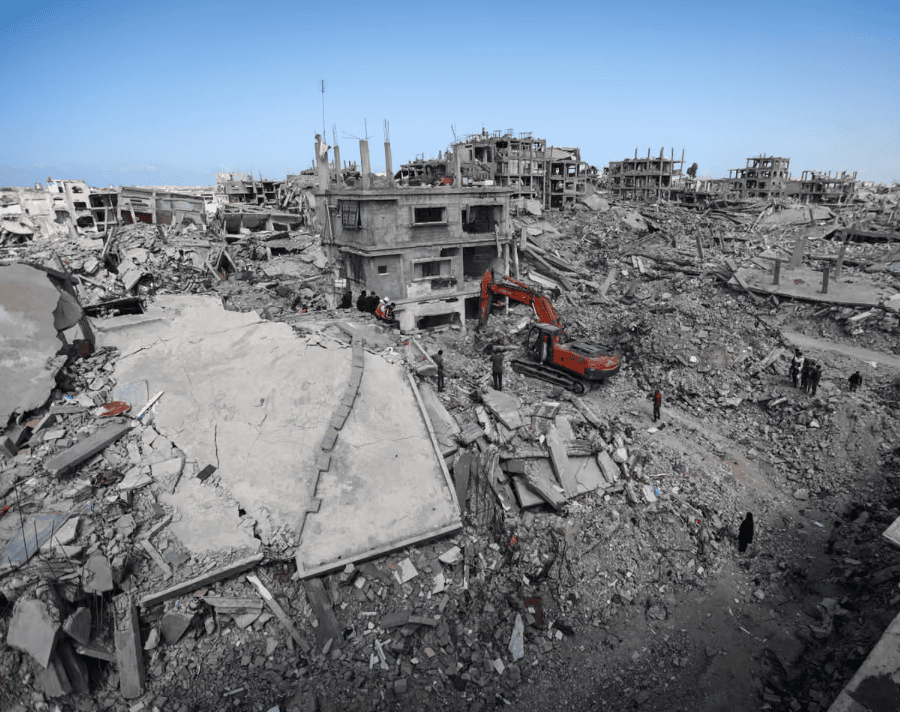
The focus on building the military base comes at a time when Gaza still faces widespread destruction left by the war.
According to the Guardian, at least 80% of the Strip's buildings have been damaged or destroyed, while some two million Palestinians still live, ten months after the ceasefire, in temporary camps that lack adequate health conditions.
Here lies the most striking paradox of the project: while residents live in harsh humanitarian conditions and the civilian infrastructure requires extensive rebuilding, the first construction project linked to the Board of Peace's plan is heading towards a facility for military forces.
This does not necessarily mean abandoning civilian reconstruction projects, as the board says other contracts are in preparation. However, the order of priorities reveals that security remains the first condition through which the new American plan for Gaza is moving.
Morocco faces a sensitive mission
The project places Morocco before a new role in the post-war phase, should its troops' participation turn into an actual deployment inside the Strip.
The presence of Moroccan soldiers within an international force in Gaza would make Rabat a direct part of security arrangements of extreme sensitivity, in an area that still witnesses military tension, while the nature of the relationship between the international force, the Palestinian factions, Israel and the authorities overseeing the Strip's civil administration has not yet been clarified.
This also comes a few days after Trump announced that Hamas had agreed to disarm, while how this commitment would be implemented remains a major question, and Israel has opposed the plan and escalated its strikes on Gaza following the announcement.
Accordingly, the construction of a base to receive Moroccan forces is not merely a limited engineering project, but may be the first indicator of a shift in Trump's plan from a political vision for rebuilding Gaza to security arrangements on the ground.
While the initial American vision spoke of "New Gaza" as a modern coastal city and economic hub, the first stone of this project appears to be heading towards a small military base being prepared to receive Moroccan soldiers, in a scene that sums up the reality of the Strip after the war: reconstruction postponed, and security still at the top of the calculations.


