


«العيد لا يدخل الخيام»: الفلسطينيون في غزة يواجهون عيداً كئيباً
Main image: Palestinians gather on a heavily damaged street to perform the dawn prayer on the occasion of the arrival of Eid al-Adha in Khan Younis in the southern Gaza Strip, on 27 May 2026.
In past Eids, the Barood family would set out in the early dawn light to begin the celebrations, moving through the streets of the Al-Shati refugee camp in Gaza City, visiting relatives' homes, and sharing the sacrificial meat among family members.
At the end of each holiday, they would take an annual family photograph, a fixed custom at every Eid, and share it with relatives abroad.
But this Eid, amid the genocide that Israel is committing against Palestinians in Gaza, Walaa Barood sits before the latest version of that photograph, holding it in his hands as the only remaining memory of a time that has passed.
Of the 22 faces that once filled the frame, 13 have died. They were killed in successive Israeli strikes that targeted the extended family, which resulted in the deaths of more than 80 members.
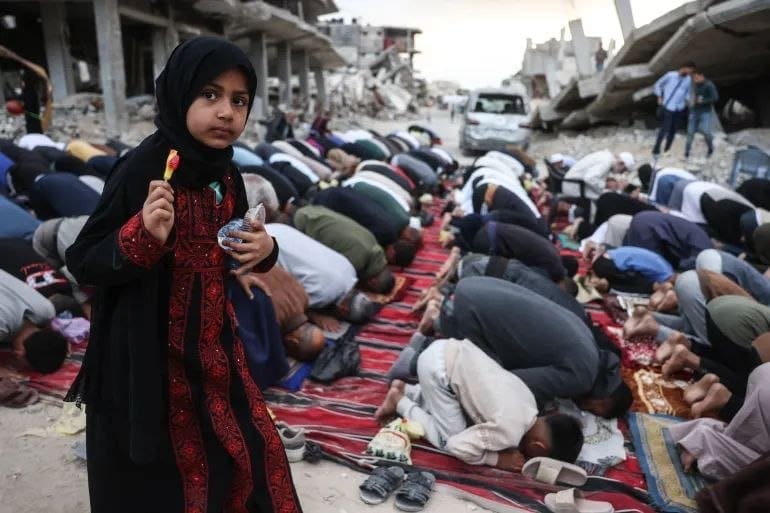
A girl holding a sweet stands among Palestinians performing the dawn prayer marking the start of Eid al-Adha on a heavily damaged street in Khan Younis in the southern Gaza Strip, on 27 May 2026.
Where the family once gathered to take a single photograph, those who remain now gather in mourning for their brother, Bahaa Barood.
Bahaa was killed days ago in an Israeli strike, leaving his relatives to mark an Eid that begins in the condolence tent set up for him and continues at the hospital, where his body still lies.
"The war has not stopped taking the lives of our loved ones, and we never expected to open a condolence tent during a truce," Walaa told Al Jazeera. "We are stuck between two eras, drowning in painful memories."
According to the Health Ministry in Gaza, the genocide committed by Israel in Gaza has resulted in the deaths of nearly 73,000 people.
"So Many Losses and Sorrows"
Widow Hajja Shama al-Zarbatli lives in a small tent on the pavement, shielded from passersby only by a hanging piece of cloth.
She has lost her husband and her home. When asked about the atmosphere of the Eid, she seemed to be hearing the question for the first time. She told Al Jazeera: "Eid does not enter the tents."
Inside her tent, there is no electricity, no telephone, no television and no internet. She is so cut off that she does not know the day or the occasion.
After watching a video of pilgrims performing the Hajj in Mecca, she could not hold back her tears.
"I have never entered the Sacred House of God. My wish is to perform the Hajj," she said. "But what kind of Hajj is this when I cannot even find food to eat?"
Al-Zarbatli, who is seventy years old, recalls the details of her Eids in the Al-Shajaiya neighbourhood of Gaza City, when she would go to the market to buy clothes for her grandchildren, bring sweets and make Eid cakes.
Today, however, she describes it as "the Eid of the martyrs, which passes without joy and with so much loss and sorrow."
She pointed to her worn-out shoe, then lifted her torn dress. "I have nothing but this one dress. I wash this one, then wear the other," al-Zarbatli said.
The War Has Crushed Us
In the tent next to hers, another elderly Palestinian, Mohammed Obeid, spends Eid alone in his tent, after the war cost him his wife, his legs and his home in Al-Shajaiya.
Obeid, a man with amputated limbs, weighed down by age and illness, sits in a wheelchair and spends his time reciting the Qur'an.
"I used to have dignity. I owned a four-storey house in the Al-Shajaiya neighbourhood, and I moved among people with the confidence of a man accustomed to plenty," he said.
But after the war, everything changed. His wife was killed, his legs were amputated, and the tent became the last place he ever imagined he would end up.
Obeid said: "Today's Eid is like any other day, nothing is different." He added: "The war has crushed us. I used to slaughter sacrificial animals and distribute their meat to my neighbours in Al-Shajaiya. Today, people are the ones distributing it and donating to me," Obeid said, running his hand over the place where his legs used to be.
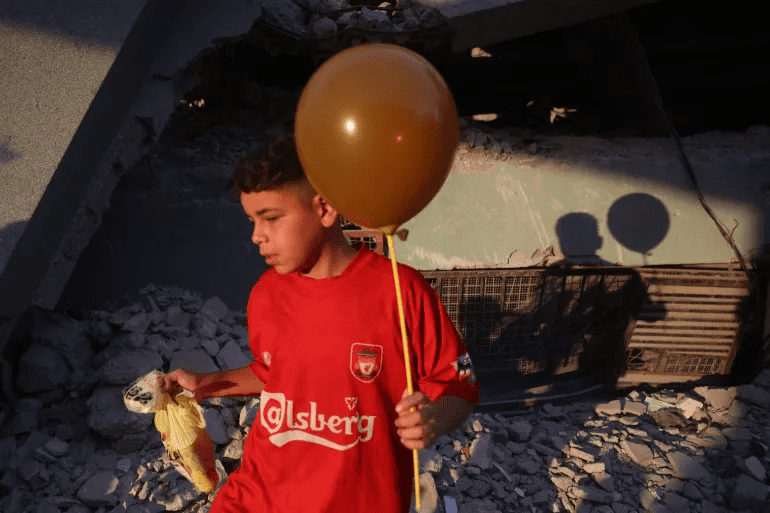
A Palestinian boy carrying a balloon walks in the shadow of a destroyed building during the dawn prayer.
No Sacrifice This Eid
The shift from slaughtering animals to their near-total absence in Gaza is not merely a personal story; it reflects the near-complete collapse of an entire system that relied heavily on charitable associations and religious organisations.
Karam Khaled, livestock project coordinator at the Ruya charitable foundation, told Al Jazeera that the sacrifice season in Gaza this year has come to a complete halt, amid the closure of crossings, a scarcity of livestock and unprecedented price rises.
He noted that before the war, the foundation would slaughter between 300 and 400 calves and sheep each season. That number fell sharply after the war broke out, before stopping altogether this year.
Khaled said the price of a single sheep in the local market has risen to between $4,500 and $6,000, compared with about $350 before the war. "Performing the sacrifice in the traditional way has become financially impossible for both institutions and individuals," he said.
Khaled reiterated that the closure of the crossings and restrictions on financial transfers from abroad have further complicated the situation and disrupted a large part of the donated projects linked to the sacrifice.
Frozen Meat
The foundation says it has resorted to an emergency alternative: distributing frozen meat instead of the live animals that would have been sacrificed, despite its high cost.
Ruya has allocated nearly 10 tonnes (10,000 kg) of frozen meat for distribution during Eid al-Adha to ease the absence of the sacrifice ritual.
Buying patterns have shifted sharply towards frozen and chilled meat, as live animals have moved out of reach for most families.
Meat trader Mohammed al-Najjar explains that around 80% of the frozen meat in Gaza's markets comes from Israel, mostly from Argentina or Uruguay. The remaining 20%, he says, enters from Egypt in large cuts, some weighing up to 5 kilograms (11 pounds), and is usually of Brazilian origin.
He added that live animals have almost disappeared from the market, revealing that the price of a kilogram of lamb has reached about 300 shekels ($105), forcing most organisations to turn to frozen meat instead.
Preparations Scaled Back
The same pattern is reflected across all shops and markets in Gaza, where preparations for the Eid have become quieter than ever.
During a tour of Gaza's main commercial streets, stalls and shops display clothes, toys and sweets, but buyers are few. With unemployment spreading and liquidity scarce, many families limit themselves to essentials only.
Amjad Akram, a trader who owns a children's clothing shop in the Al-Rimal neighbourhood, said: "Bringing goods into the Gaza Strip has become unprecedentedly expensive, which has been directly reflected in clothing prices in the markets."
Akram said shipping costs have risen to roughly eight times what they were before the war, adding that shipping a single box of clothing used to cost 250 shekels ($88).
He revealed that it now costs about 2,000 shekels ($705), which has caused retail prices in local markets to rise significantly.
Shock at Prices
Akram notes that citizens' purchasing power has fallen considerably, with priorities shifting towards securing food and essentials before buying new clothes.
He says this Eid season is unlike previous ones, with customers coming only to ask about prices, then leaving shocked without buying anything.
Apart from the sound of takbeer rising from the refugee camps, or from cars driving through the city with loudspeakers, the first Eid al-Adha since the "ceasefire" in Gaza in October passes with almost no festive scenes.
Alongside this, people live in abject poverty and relentless loss, struggling to rebuild their shattered lives, which Israel has destroyed over the course of two years.
Al Jazeera


