


Many Gazans have lost their basic jobs because of the war, and thousands of women have lost their breadwinners, whether through detention, killing, or injuries that leave them unable to move. They have no choice but to create new jobs to support themselves and their children.
We bring you this report, adapted from Mondoweiss, the independent American news site specializing in Palestinian-Israeli affairs and US foreign policy:
'I Have No Choice'
Ayman Abu Muharib, 44, spends his days in front of an oven his family built from mud and straw near a displacement camp in Deir al-Balah in central Gaza, where he bakes bread to earn a modest income to support his family of eight, including a daughter who has a heart defect.
Abu Muharib told Mondoweiss: "Doctors have repeatedly warned me against sitting for long hours in front of the smoke coming out of the oven, because I burn wood, plastic, and cloth to keep it running." "I started this work a year ago, and since then my health and physical condition have deteriorated noticeably. But I have no choice. I have to work to bring food to my family and to provide for my sick daughter."
Before the war, Abu Muharib says, he owned a supermarket and lived with his family in relative stability. Since then, the supermarket has been bombed, and the remaining goods in it were looted. His source of livelihood was completely destroyed, forcing him to look for alternative work to feed his family.
He said: "I never expected that I would one day work as a baker for people and displaced families." "But circumstances forced me to, just as they forced many to work in jobs that do not suit them in order to meet their daily needs."
Yet despite working long hours and disregarding the advice of doctors, he says there are still days when this work does not allow him to provide everything his family needs.
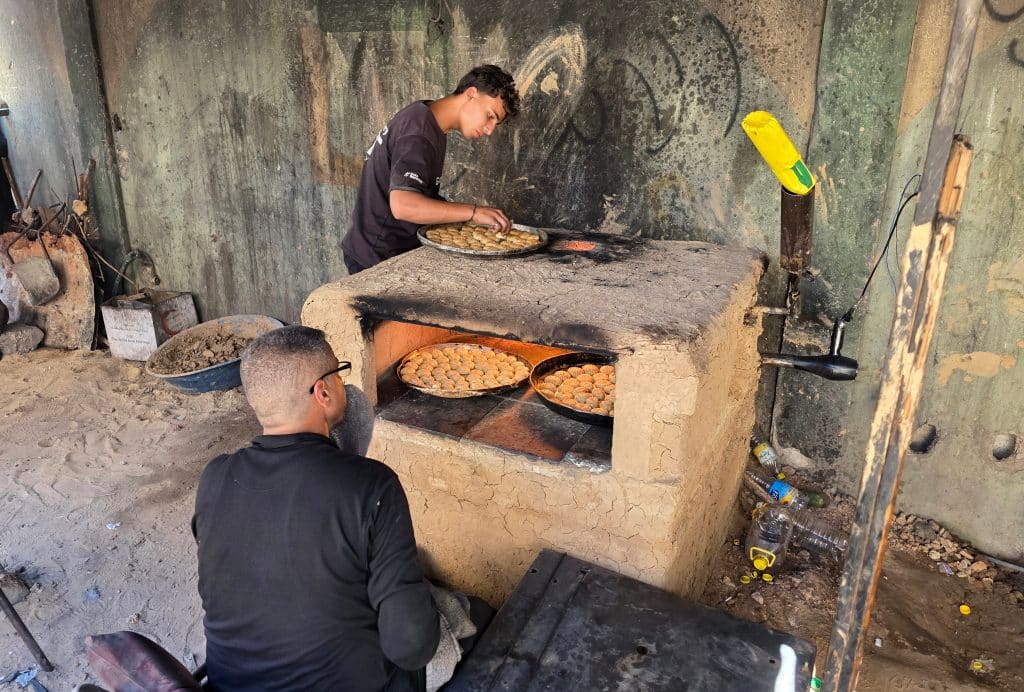
Abu Muharib is not the only person forced to practise a trade he did not choose. Across Gaza, women who had never been the sole breadwinners of their families have been compelled to suddenly search for work to support them, particularly in households where the husband or father was injured or killed.
Zeinab al-Najjar, 50, is a mother of eight children. Her husband was injured during the war and became confined to a wheelchair, leaving her responsible for supporting her large family by any means possible.
After their displacement to the seafront in Deir al-Balah, she found herself facing a heavy responsibility. She began selling lupin beans among the tents of displaced families.
She was previously a mother who prepared food for her children and cared for them while her husband worked. Now the roles have been reversed, and she is responsible for providing food for her family.


