

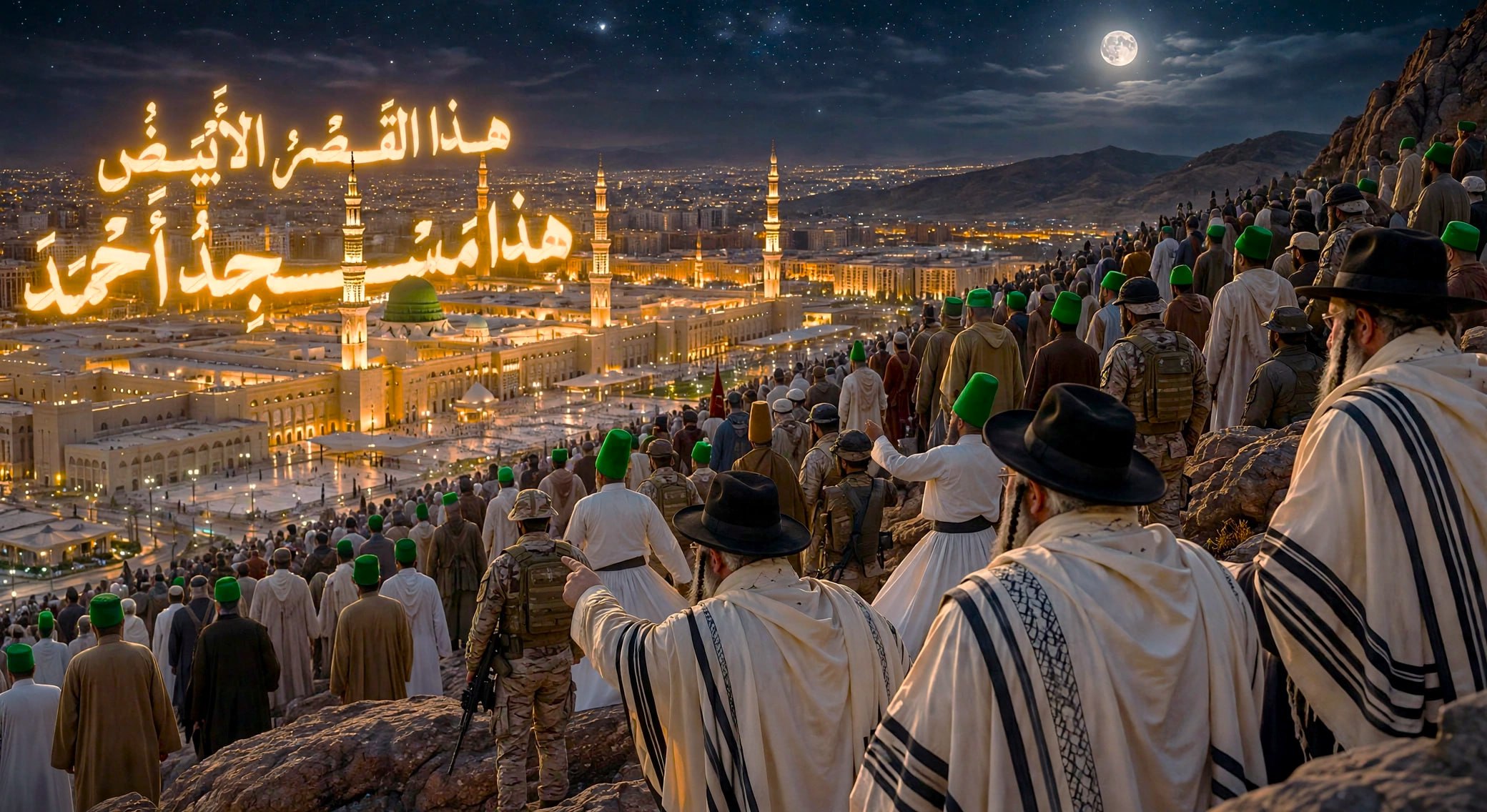
Subhan Allah wa-bihamdih! I was looking at the state of this world and asking myself: when will this world be delivered from polytheism and disbelief in God? When will it be delivered from depravity, wickedness and injustice? When will the people of Islam be delivered from this weakness, from the effects of tyrannical rule, and from the calamities of hypocrisy and corruption? And when will they unite as one heart, as the first generation of this Ummah did? When will the Day of Deliverance come?!
As I reflected on these questions, my eye fell upon a hadith of the Prophet ﷺ, and it was as if I were sitting among his companions, hearing the Messenger of God ﷺ call out:
«The Day of Deliverance, and what is the Day of Deliverance? The Day of Deliverance, and what is the Day of Deliverance? The Day of Deliverance, and what is the Day of Deliverance?» They said: And what is the Day of Deliverance, O Messenger of God?
He ﷺ said: «The Dajjal will come and ascend Uhud, and look upon the city, and he will say to his companions: Do you see that white palace? That is the Mosque of Ahmad. Then he will come to the city and find at every one of its passes an angel with drawn sword. He will come to the salt flats of al-Jurf and pitch his tent there. Then the city will quake three times, and there will not remain a hypocrite, man or woman, nor a wicked person, man or woman, but they will go out to him. That is the Day of Deliverance.»
I contemplated this prophetic hadith at length, and this great name halted me: "the Day of Deliverance"! A day on which the city of the Prophet is delivered from the impurities of the hypocrites, men and women, and the wicked, men and women, who hasten out to the Dajjal, while the people of sincere faith remain steadfast in their firmness.
This awe-inspiring scene opens before the reflective believer a wide door for contemplating God's laws regarding His servants, the reality of the faith by which its bearer stands firm when trials grow severe, and the meaning of the victory and conquest that Muslims await. I do not wish here to dwell only on the details of the Dajjal's emergence and the signs of the Hour, but to draw out the meanings that this hadith awakens in hearts. How often we preoccupy ourselves with asking about "the time of relief," while neglecting the more important question: Have we prepared ourselves for salvation? And what is the reality of the faith upon which we hope to remain firm when trials arrive?
Among God's laws is the testing of the people of faith before victory
Among the consistent divine laws in the Book of God is that trial reveals the hidden states of hearts, and that the path to empowerment and salvation is not free of testing and examination. God the Exalted says:
﴿Alif, Lam, Mim. Do people think they will be left to say, "We believe," and they will not be tried? And We had already tried those before them, and God will surely make evident those who are truthful and will surely make evident the liars.﴾
It was recited by Ali ibn Abi Talib, may God be pleased with him: ﴿فَلَيُعْلِمَنَّ اللَّهُ الَّذِينَ صَدَقُوا وَلَيُعْلِمَنَّ الْكَاذِبِينَ﴾ (with a damma on the yaa' and a kasra on the lam in both verbs: yu'limanna, from ʿilm/i'lam, meaning that He will make known to each person before himself whether he is truthful or a liar). This is an irregular reading (qira'a shadhdha), and it conveys a sublime meaning: what matters is not merely affiliation with faith, nor the uniting of tongues around slogans, nor the wishing for victory and empowerment. Rather, the effect of faith must appear in inward states and deeds, and at the places of testing the truthful must be distinguished from the pretender.
This law appears clearly in the stories of the prophets with their peoples, for salvation was tied to the inward reality of faith, not to mere outward affiliation or kinship:
In the story of Noah, peace be upon him, God the Exalted says: ﴿Until when Our command came and the oven overflowed, We said: Load into it two of each kind, and your family, except those against whom the word has already gone forth, and those who believed. And none believed with him except a few.﴾ Salvation was thus made exclusive to the people of faith, though they were few, and destruction was decreed for the people of disbelief and hypocrisy, even if they belonged to his household.
In the story of Lot, peace be upon him, this Qur'anic subtlety reaches its peak when the context varies between the two descriptions in His words: ﴿So We brought out those who were in it of the believers. But We found not in it except one house of Muslims.﴾ When He spoke of salvation and removal, He restricted it to "the believers," indicating that on the day of decision salvation is attained only by one whose faith is sound inwardly. When He spoke of the outward presence in the town, He said "a house of Muslims," because the house in its general appearance was a house of submission and Islam, yet within its walls was the wife of Lot, who acted hypocritically: she showed Islam along with them while concealing disbelief in her heart. She was counted outwardly among the Muslim household, but inwardly and in judgment she was not among the believers who were saved.
In the story of Thamud, this meaning is crowned by His words: ﴿And We saved those who believed and used to fear God.﴾ Consider this remarkable Qur'anic consistency in showing the fewness of the people of truth at the places of trial, and in linking salvation to the bond of faith and piety, so that the great truth settles in souls: that in God's sight what counts is not the multitude of those who claim affiliation, nor bare outward appearances, but the reality of faith established in the hearts and the piety and deeds manifest upon the limbs.
The intent is not that every victory must be preceded by trial in exactly the same form, but that testing is an established divine law, and that trials expose the sincerity of faith from the falsity of claim. From here we understand the greatness of "the Day of Deliverance": it is the scene in which the effect of complete testing appears, and in which the metals of people are distinguished at the greatest trial of the world.
The reality of faith by which steadfastness and election are attained
Here the essential question emerges: what faith must we work to realize in order to be among the steadfast and the saved? Is it merely intellectual knowledge that God exists and that He is the Creator and Provider? This deficient conception does not encompass the reality of the faith with which the messengers were sent, nor the reality of the great word for which creation was brought into being.
God made knowledge of monotheism the root of salvation as the Hour draws near. He said: ﴿Do they await except the Hour, that it come upon them suddenly? But its signs have already come. So when it has come to them, how will they have their reminder? Know, then, that there is no deity except God, and ask forgiveness for your sin and for the believing men and believing women. And God knows your movement and your resting place.﴾
Reflect on the placement of this verse. When times of trial and the signs of the Hour multiply, with doubts and turmoil that shake beliefs, as in the hadith: "A man will be a believer in the morning and a disbeliever by evening," the noble verse summarized the complete key to salvation in two interrelated pillars: correcting the root, and purifying the branch:
- Correcting the root (creed): through His words, ﴿so know that there is no deity except God﴾. The command begins with "know" because monotheism founded on imitation or habit may collapse before the storms of trials, whereas monotheism built on knowledge and firm certainty is the head of the matter and the only lifeline that steadies the heart when minds waver.
- Purifying the branch (action): through His words, ﴿and ask forgiveness for your sin﴾, to erase the traces of trials and sins that may obstruct the traveler toward God.
"There is no god but God" is not merely an acknowledgment that God is the Creator; it is an affirmation, belief and practice that no deity is truly worshipped except God, and that worship is the exclusive right of Him alone. Among its requirements: sincerity in supplication and in seeking aid in matters only God can accomplish; sincerity in trust, fear and hope; perfect devotional love; devoting prostration, bowing and all acts of worship to Him alone; and complete submission to the command of God and His Messenger ﷺ. Monotheism is therefore not a theoretical luxury without effect on reality, but a statement, belief and action whose implications appear in the heart, the tongue and the limbs. This is the root to which we must return whenever we speak of salvation, empowerment and victory.
The branches of faith: from the summit of monotheism to removing harm from the path
The Prophet ﷺ explained to us the comprehensiveness of this structure of faith when he said:
«Faith has seventy-odd —or sixty-odd— branches, the best of which is the statement "There is no god but God," and the lowest of which is removing harm from the road, and modesty is a branch of faith.»
Faith is not a passing word uttered by the tongue without effect on life. Rather, it consists of integrated branches that organize the beliefs and actions of the heart, and the speech and deeds of the limbs:
Among its highest and greatest is the realization of pure monotheism for God, the Mighty and Majestic.
Among them is love for the Messenger ﷺ, giving it precedence over love for all people, as he ﷺ said: «None of you truly believes until I am dearer to him than his father, his child and all people», and submission to his judgment and contentment with his decree. God the Exalted says: ﴿But no, by your Lord, they will not believe until they make you, [O Muhammad], judge concerning that over which they dispute among themselves, and then find within themselves no discomfort from what you have judged and submit in full submission.﴾
Among its moral and social branches is wishing good for the Muslims, as he ﷺ said: «None of you truly believes until he loves for his brother what he loves for himself», and guarding the tongue and honouring the neighbour and the guest, as he ﷺ said: «Whoever believes in God and the Last Day, let him speak good or remain silent; whoever believes in God and the Last Day, let him honour his neighbour; whoever believes in God and the Last Day, let him honour his guest.»
Observe how the branches of faith extend from the greatest roots of belief to the finest details of daily conduct. Here each of us should take account of himself: How much have we neglected of the branches of faith? How much have we been lax regarding the rights of God and the rights of His servants? How many great foundations do we fail to understand in their reality and their implications? Whoever seeks steadfastness in trials should not postpone building his faith until the hour of examination, nor imagine that salvation is attained merely by gathering reports about the Dajjal and his attributes. How many eloquent speakers about victory and empowerment have not yet begun to set right what lies between them and God! And how many who wish for the station of steadfastness have not striven to know the faith upon which they wish to remain firm!
No victory with the marginalisation of faith
It is here that one is struck with wonder at people who take the lead in reform, dwelling on the nearness of conquest, the unity of the Ummah, and the return of glory and empowerment, yet do not place the realisation of faith and monotheism at the forefront of their call! You find one who calls for unity of word and for widening the circle of gathering, yet avoids speaking of the doctrinal foundations upon which people must unite. Indeed, he may consider clarifying truth from falsehood as a division of ranks, and treat distinguishing monotheism from polytheism, Sunnah from innovation, and obedience from disobedience as matters to be deferred until the ranks are united! What gathering is this that is built upon no clear foundation? And what unity is this whose price is the sidelining of the very purpose for which the messengers were sent?
This does not mean that the Muslim should become a propagator of enmity and discord, or occupy himself with tracking faults and stirring disputes over matters of no benefit. Rather, it means that we must understand that the unity of the Ummah does not stand upon demolishing the foundations of religion, that the reform of the ranks does not come through concealing the truth, and that the call to gathering must not become a pretext for neglecting monotheism and the Sunnah. Sincerity in worship to God was the cornerstone of the call of all the prophets. How, then, do we seek from God victory and empowerment while neglecting the condition upon which God conditioned His true promise, when He said:
﴿Indeed, We will surely support Our messengers and those who believe in the life of this world and on the Day when the witnesses will stand.﴾
Reflect on the restriction of the promise to: ﴿and those who believe﴾, so that it becomes clear that victory is tied to the realities of faith, not merely to affiliation and slogans. This does not mean that every delay in victory is proof of the corruption of the faith of all who claim affiliation with the Ummah, nor that every calamity befalling Muslims is due to one single cause. God has in His creation laws and profound wisdoms. Rather, what is meant is that we should not seek the fruits of faith while neglecting its roots, nor make empowerment an aim separate from the servitude for which we were created.
The jurisprudence of tyrannical rule: what do we do in times of trials?
Among the matters a Muslim must understand is the nature of the age in which he lives, and knowledge of what God asks of him when conditions are disordered and trials surge. Al-Nu'man ibn Bashir reported from Hudhayfah ibn al-Yaman, may God be pleased with them both, that the Prophet ﷺ mentioned the stages through which the Ummah passes, and said:
«Prophethood will be among you for as long as God wills it to be, then He will lift it when He wills to lift it. Then there will be a caliphate upon the way of prophethood, and it will be for as long as God wills it to be, then He will lift it when He wills to lift it. Then there will be a biting kingship, and it will be for as long as God wills it to be, then He will lift it when He wills to lift it. Then there will be a tyrannical kingship, and it will be for as long as God wills it to be, then He will lift it when He wills to lift it. Then there will be a caliphate upon the way of prophethood.»
This meaning is supported by what al-Tabarani narrated from Salih ibn Abi Maryam (Abu al-Khalil) or another, with a prophetic attribution, concerning the succession of caliphs, then rulers, then kings, then tyrants, before God permits the return of justice.
This prophetic sequence opens a profound door for reflection on the shifting conditions of the Ummah, and it affirms the necessity of "understanding the stage" and of how to deal lawfully with each phase. A person may spend his life trying to change an entire reality that has not been decreed for him to change, whereas what is decreed for him, and what is required of him in his stage, is patience, readiness, and reform within the sphere of his capacity. By confusing these, a servant may neglect the individual duties he is able to perform, and occupy himself with tracing events and conflicts, forgetting that God only obliges him with what he can bear, and that he must know the duty of his time in every condition.
The Prophet ﷺ guided us to two models of the best of people in times of trial, when he said:
«The best of people in times of trial is a man who takes the bridle of his horse in pursuit of the enemies of God, frightening them and being frightened by them, or a man who withdraws in the desert, fulfilling the right of God that is upon him.»
Consider these two models:
The first model: he withdraws from trials by engaging in striving against the pure enemies of God. The meaning of this hadith is not to open the door to uncontrolled individual initiatives in fighting. It is understood within the framework of the rulings of the Shari'ah and its general principles, for desires and individuals do not independently determine the obligations of confrontation and its general rulings.
The second model: he withdraws from ambiguous trials and devotes himself to fulfilling the right of God upon him of worship and obedience. Trials did not distract him from the right of his Lord, nor did the turmoil of people make his worship and obedience vulnerable to loss.
What unites these two models is that neither made trials an end that cuts them off from servitude to God; each performed what he was obliged to do according to his condition and capacity. Here the virtue of knowledge becomes evident. How can a person know what is obligatory upon him in times of trial without knowledge? How can he distinguish the place of advance and action from the place of restraint and abstention, and the place of a sharia duty from the place of emotional impulse, if he has not learned his religion or understood its rulings? Among the greatest deficiencies is that a person becomes absorbed in every event, takes the lead in every issue, yet has no share of the knowledge that disciplines his zeal, nor a portion of righteous action that reforms his heart.
The trial of the Dajjal: do not postpone reforming your faith!
We return now to the trial of the Dajjal, that great trial against which the Prophet ﷺ repeatedly warned his Ummah, seeking refuge in God from its evil, and guiding his companions to what God would protect them with when it occurred. Muslim reported in his Sahih from Abu al-Darda', may God be pleased with him, that the Prophet ﷺ said:
«Whoever memorises the first ten verses of Surat al-Kahf will be protected from the Dajjal.»
The Prophet's instruction here is among the most striking points for a reflective reader, for God has placed in His Noble Book a fortress that protects the believer from the greatest trial that will pass over the face of the earth. When we consider the aims of Surat al-Kahf, we find that they revolve around the great pillars of protection: affirming monotheism, steadfastness upon the truth, warning against being deceived by the adornments of this world, and clarifying the nature of righteous deeds and sincerity toward God. Whoever reflects on the story of the People of the Cave sees a model of young men who believed in their Lord and held firmly to their monotheism. Fear of opposing their people did not drive them to flatter falsehood or to give up their religion; rather, they declared the truth, saying:
﴿إِذْ قَامُوا فَقَالُوا رَبُّنَا رَبُّ السَّمَاوَاتِ وَالْأَرْضِ لَن نَّدْعُوَ مِن دُونِهِ إِلَٰهًا ۖ لَّقَدْ قُلْنَا إِذًا شَطَطًا﴾
Then the closing of the surah gathers the criterion of acceptance into two inseparable principles: righteous deeds, and sincere worship of God, in His saying, Exalted is He: ﴿فَمَن كَانَ يَرْجُو لِقَاءَ رَبِّهِ فَلْيَعْمَلْ عَمَلًا صَالِحًا وَلَا يُشْرِكْ بِعِبَادَةِ رَبِّهِ أَحَدًا﴾
Yet the "preservation" mentioned in the hadith should not be reduced to the common notion today, which is memorising the letters while neglecting the limits. The true believer combines memorising the verses, contemplating their meanings, acting upon their clear injunctions, and remaining steadfast upon their guidance. This does not mean that the hadith made a particular interpretation a condition for attaining protection; rather, it refers to the reality of benefiting from revelation in general: that the servant receives it as knowledge, conviction, and action.
Acting before the onslaught of trials
Here a decisive Prophetic principle becomes evident in his ﷺ saying:
«بَادِرُوا بِالأَعْمَالِ فِتَناً كَقِطَعِ اللَّيْلِ المُظْلِمِ، يُصْبِحُ الرَّجُلُ مُؤْمِناً وَيُمْسِي كَافِراً، أَوْ يُمْسِي مُؤْمِناً وَيُصْبِحُ كَافِراً، يَبِيعُ دِينَهُ بِعَرَضٍ مِنَ الدُّنْيَا».
This prophetic warning cuts off procrastination. The wise person does not wait for trials to arrive before beginning to learn monotheism, realise faith, and devote worship to God alone. The moment the Dajjal emerges and trials surge is not a suitable time to begin searching for the foundations of belief, reviewing what is taken for granted, or discovering the reality of faith. Rather, the Muslim must prepare his provision before the onslaught of affliction.
When trials approach, they leave a person no room for the reflection that was available in times of ease. They sweep over hearts with doubts, desires, interests, and pressures that expose the inner depths of souls and reveal what has settled within them:
Some people monopolise worldly interest and prefer it over the truth.
Some exaggerate regarding the righteous or the leaders they follow, to the point of justifying falsehood for them.
Some dissolve into general slogans that adorn for them the abandonment of the foundations of religion.
Some place their bare desires above the judgment of God and His Messenger ﷺ.
The purpose of mentioning these pitfalls is not to pass judgment on specific individuals or to determine their fates with certainty. Rather, it is a warning about diseases of the heart that must be treated today, before trials grow severe tomorrow. Whoever has not learned monotheism in ease, has not understood the reality of worship, and has not trained himself to submit to revelation and to hold fast to the truth, on what basis will he hope for steadfastness when the storms grow fierce? Indeed, it is a great abandonment for a person to examine the reports about the Dajjal and memorise the details of his descriptions, yet neglect to set right what lies between him and God!
The flood is coming... so where is the ark of salvation?
When trials follow one another and grow dark, some surge into others, matters become confused for people, the affliction becomes great, and at that point none stands firm except those whom God makes firm. Perhaps the most eloquent image that brings this meaning close to minds is the image of the flood.
When the flood of Noah peace be upon him came, salvation was not by vast hopes, nor by mere outward affiliation with the people of truth. It came first by the mercy of God, and then by responding to His command and boarding the ark that was built under His eyes and by His revelation. Likewise, salvation from the flood of trials is not attained by wishful thinking, nor by much talk of victory, nor by mere fascination with reports of the end of times. It is attained by holding fast to God, realising monotheism, following revelation, and acting upon the laws of religion.
Today we are in dire need of the ark of monotheism and faith, the ark of holding fast to the Book and the Sunnah, not the ark of wishes and empty slogans. We need to implant in ourselves and our children the reality of faith, sincere worship of God, love for His Messenger ﷺ, veneration of his commands, patience upon the truth, and acting upon all the branches of faith. It is not valid for us to seek empowerment while neglecting monotheism and the Sunnah, nor to be absorbed in reforming the conditions of people while being heedless of reforming what lies between us and our Lord.
Whoever desires salvation should hasten to set right his inner intention, gain understanding of his religion, and present his belief and actions to the measure of the Book and the Sunnah. What agrees with them is by the grace and mercy of God; what contradicts them, he should hasten to repent from and abandon, without being deceived by long hopes or relying on the soundness of the days. A person does not know when a trial will overtake him, or what state his heart will be in when it descends. The successful one is he who hastens to repentance and righteous deeds before he is prevented from what he desires, bearing in mind the words of God, Mighty and Majestic, in the sacred hadith:
«يَا عِبَادِي إِنَّمَا هِيَ أَعْمَالُكُمْ أُحْصِيهَا لَكُمْ ثُمَّ أُوَفِّيكُمْ إِيَّاهَا، فَمَنْ وَجَدَ خَيْراً فَلْيَحْمَدِ اللَّهَ، وَمَنْ وَجَدَ غَيْرَ ذَلِكَ فَلَا يَلُومَنَّ إِلَّا نَفْسَهُ».
So do not wait until the trials surge before searching for the root of faith, do not wait until doubts intensify before seeking knowledge, and do not wait until you see those who have fallen along the way before asking about the causes of steadfastness. Hasten, hasten to realise faith in word, deed, and belief, before days come in which regret will be of no benefit!
The reality of salvation and victory
Whenever I reflect upon the "Hadith of the Day of Deliverance," I grow more certain that the question that should trouble our hearts is not merely: When will victory come? When will the conditions of the Ummah change? When will injustice and corruption end? Rather, the more pressing and more dangerous question is: Are we among the people of faith who stand firm when trials descend? Have we set right what lies between us and God? Have we realised the monotheism for which we were created, and followed our Messenger ﷺ in belief and action?
The greatest "deliverance" is for hearts to be sincerely devoted to God, and for people to be freed from servitude to anything other than Him, so that the servitude of the servants to their Lord becomes sound. The greatest "victory" is not merely a change in political conditions, nor a transfer of authority, nor the mere gathering of bodies; the true victory is that people return to the reality of religion, devote worship to the Lord of the worlds, and that the people of faith remain firm upon the straight path.
This is the deliverance we should seek, and this is the victory we must work for. O God, make us among the people of monotheism and faith, keep our hearts firm upon Your religion, do not test us in our religion, protect us from trials, both those apparent and those hidden, employ us in Your obedience and in the support of Your religion, and grant us steadfastness until we meet You well-pleased with us.
By the pen of: Ibn al-Athil.


