

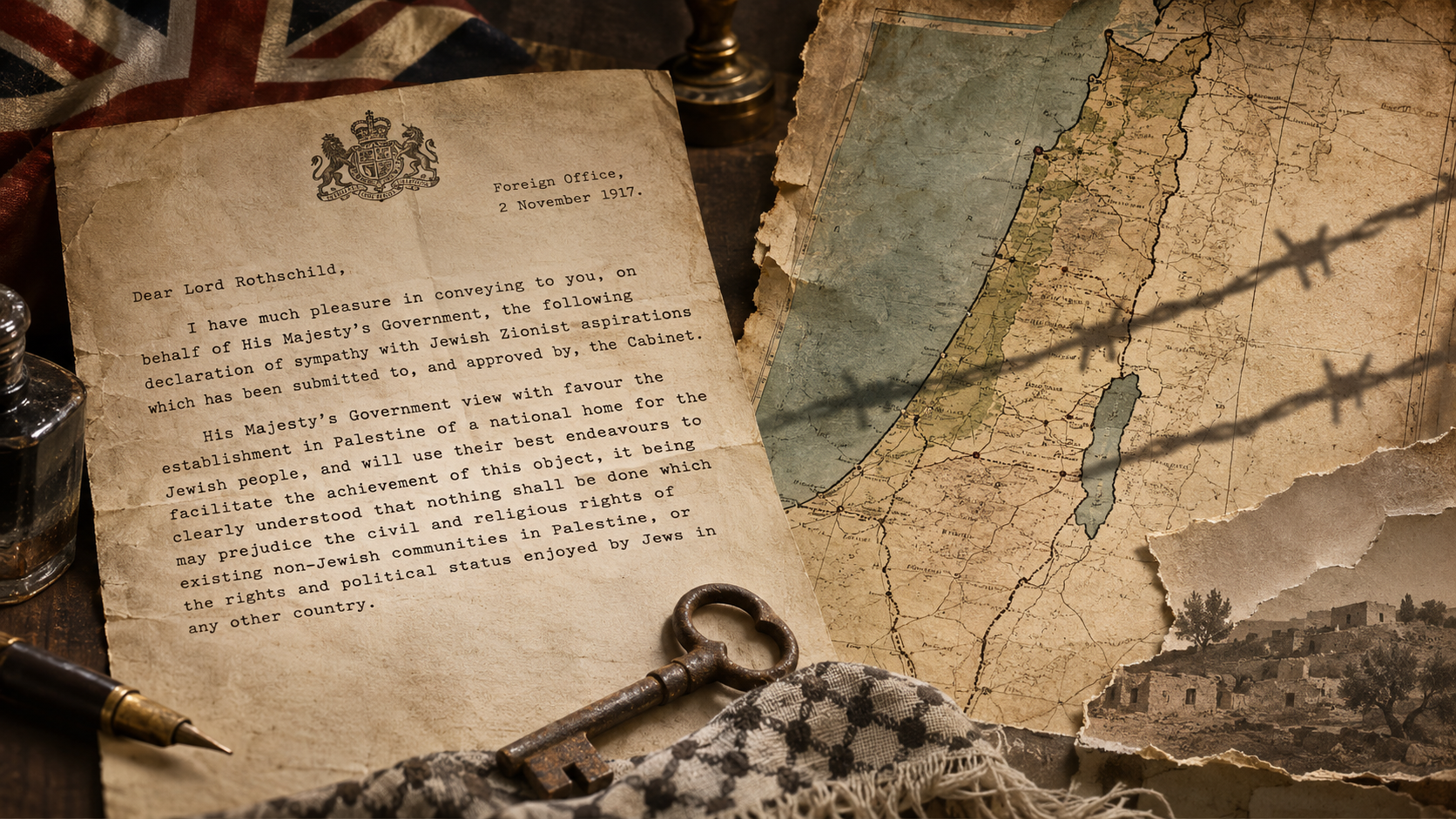
109 years after its issuance, the Balfour Declaration remains one of the most pivotal moments that changed the history of Palestine: from a British pledge to establish a national home for the Jewish people, to a Mandate that paved the way for the expansion of the Zionist project, then the Nakba of 1948 and the occupation of what remained of Palestinian land in 1967, leading to today's reality of settlement and displacement that threatens what is left of the Palestinian geography.
On 2 November 1917, while the First World War was redrawing the borders of the Arab East, British Foreign Secretary Arthur James Balfour issued a letter whose essential words did not exceed a few lines, yet left effects that lasted for more than a century.
The letter carried a commitment from the British government to support the establishment of a national home for the Jewish people in Palestine, at a time when the country was still under Ottoman rule and Arab Palestinians constituted the overwhelming majority of its population.
Britain at that time was not sovereign over Palestine, and it did not consult the people of the land about determining their future; yet it pledged to facilitate a political project that would change the future of their land and its demographic composition.
From here began one of the most complex issues in modern history, as Palestine turned from a homeland whose people aspired to independence into an arena where colonial interests and the Zionist project intersected, before becoming a land whose people live between occupation, exile and displacement.
What was the Balfour Declaration, and who issued it?
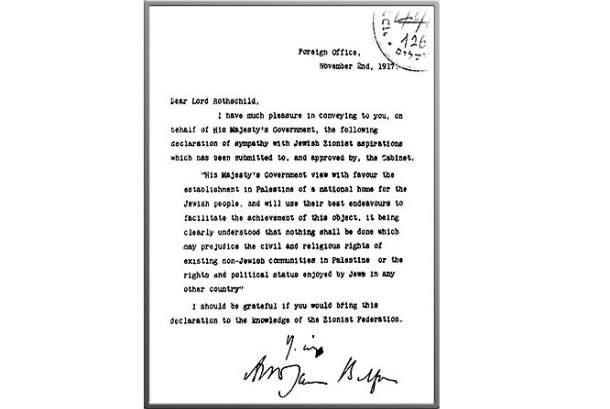
The Balfour Declaration is an official letter dated 2 November 1917, addressed by then British Foreign Secretary Arthur James Balfour to Lord Lionel Walter Rothschild, one of the most prominent British Jewish figures supporting the Zionist movement, requesting that its content be conveyed to the Zionist Federation.
The most important paragraph read:
"His Majesty's Government view with favour the establishment in Palestine of a national home for the Jewish people, and will use their best endeavours to facilitate the achievement of this object".
The letter included a proviso stating that nothing should be done that might prejudice the civil and religious rights of existing non-Jewish communities in Palestine, or the rights and political status enjoyed by Jews in any other country.
Notably, however, the wording of the pledge recognised the Jewish national project, while it did not recognise the Palestinians as a people with a comparable political right to self-determination, referring to them instead as "the existing non-Jewish communities in Palestine".
Thus the disparity appeared at the core of the document: a national political commitment for one party, and only civil and religious guarantees for the inhabitants who constituted the majority of the country.
Why did Britain issue the Declaration?
The Declaration was issued in the context of the First World War, when Britain was fighting the Ottoman state and seeking to strengthen its influence in the Middle East.
Strategic and diplomatic considerations, prevailing political ideas and religious beliefs among some British officials were intertwined in the decision, alongside the efforts of the Zionist movement, which sought the support of a major power to establish a national home for Jews in Palestine.
Chaim Weizmann was among the most prominent Zionist figures who worked to win British support for the project.
At that time, Britain had also entered into other understandings and correspondence concerning the future of the Arab East, including the McMahon–Hussein correspondence and the Sykes–Picot Agreement, which made the question of Palestine part of a network of conflicting promises and arrangements regarding Ottoman territories.
The Zionist movement regarded the Balfour Declaration as a historic diplomatic achievement, while Palestinians regarded it as the foundation of a policy that disregarded their will and their right to independence.
From a political letter to a Mandate policy
The Balfour Declaration did not remain an isolated diplomatic statement.
After British forces occupied Jerusalem in December 1917, and with the end of the First World War, Palestine gradually came under British administration, before the League of Nations adopted the British Mandate over it in 1922.
The content of the Balfour Declaration was incorporated into the Mandate document, and Britain became responsible for facilitating the establishment of the Jewish national home, alongside other obligations relating to the rights of the country's inhabitants.
During the years of the Mandate, Jewish immigration to Palestine expanded, and the political, economic and military institutions affiliated with the Zionist movement grew, while competition over land, resources and authority intensified.
In contrast, Palestinian opposition to British policies, to immigration and to settlement increased, and the country witnessed protests and uprisings, most notably the Great Palestinian Revolt between 1936 and 1939.
The pledge, issued before Britain controlled Palestine, became one of the political foundations of the administration that governed it later.
Over the years, the gap widened between the aspirations of Palestinians for independence and the project that the Mandate authorities were facilitating on their land.
How did the map of Palestine change?
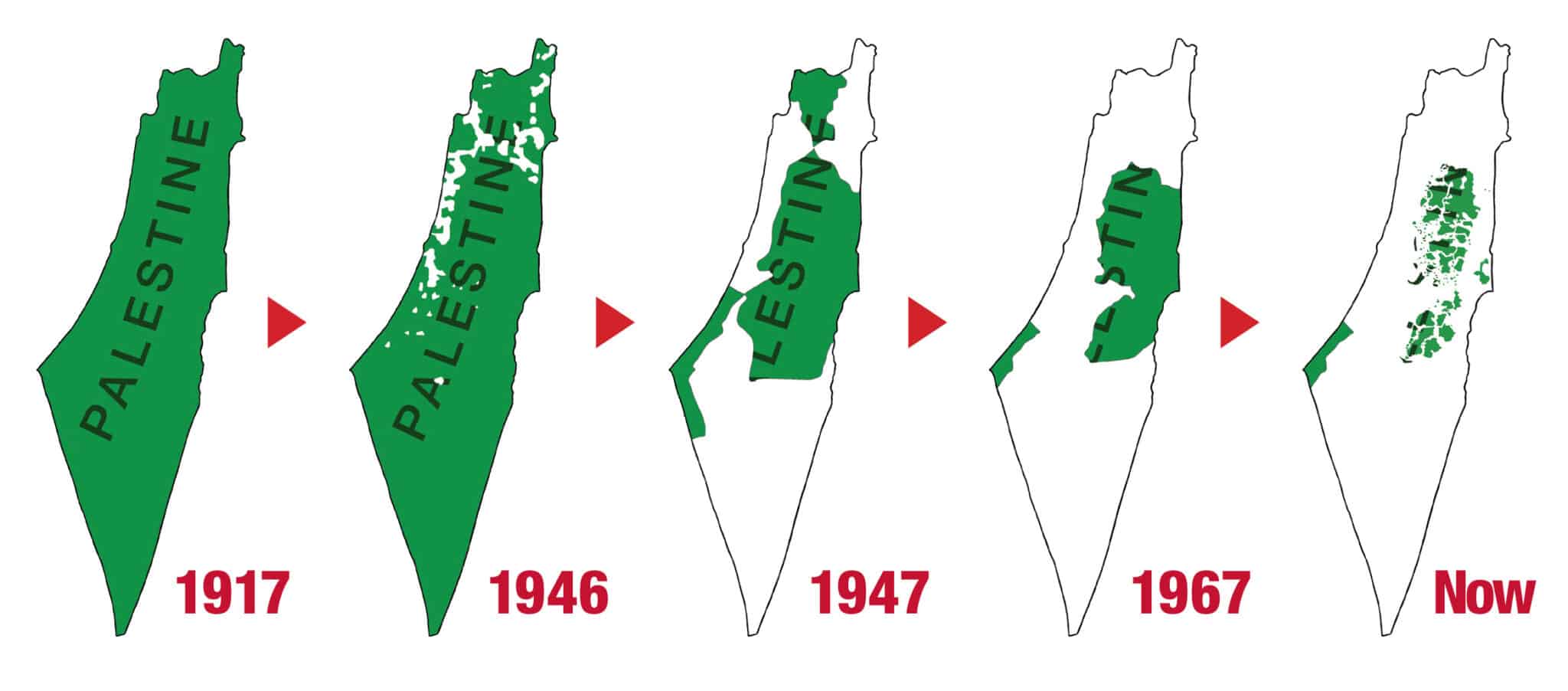
Historical figures reveal the scale of the transformation that Palestine underwent during the three decades following the Balfour Declaration.
According to a historical study published by the United Nations, Jews constituted about 9% of Palestine's population in 1917, and their proportion rose to about 32% by 1947, due to large-scale immigration, particularly from Europe.
In the same period, the share of land owned by Jews rose from about 2.5% to about 6.2% of Palestine's area.
Yet the greatest transformation did not occur in land ownership alone, but in the political decisions and wars that redrew the boundaries of control over the country.
1947: The Partition Resolution
On 29 November 1947, the United Nations General Assembly adopted Resolution 181, which recommended dividing Palestine into two states, Arab and Jewish, and placing Jerusalem under a special international regime.
Under the plan, about 56% of Palestine's area was allocated to the proposed Jewish state, and about 43% to the Arab state, while Jerusalem and its surroundings were allocated to a separate international regime.
Jews then constituted about a third of the population and owned about 6.2% of the land, according to historical UN estimates.
Arab Palestinians and Arab states rejected the partition plan, considering that it granted the Zionist movement an area far exceeding what it owned, and disregarded the right of the majority of the country's inhabitants to determine their future.
The Zionist leadership accepted the plan in principle, before the subsequent war led to borders entirely different from those proposed by the resolution.
1948: The Nakba and the establishment of "Israel"
As fighting escalated in Palestine and the British Mandate ended in May 1948, the State of "Israel" was declared, and war broke out with neighbouring Arab states.
The war resulted in "Israel" controlling about 77% of the area of Mandatory Palestine, a much larger area than that allocated to it by the partition resolution.
As for the Palestinian people, they faced one of the greatest tragedies of their modern history.
Hundreds of thousands of Palestinians fled or were expelled from their cities and villages during the war, large population centres were destroyed or emptied, and many families became refugees in the West Bank, the Gaza Strip and neighbouring countries.
The United Nations Relief and Works Agency for Palestine Refugees (UNRWA) states that it began its work in 1950 to provide assistance to some 750,000 Palestinian refugees.
This was the Nakba; its impact was not limited to the loss of political control over the land, but extended to uprooting people from their homes, scattering families, and losing property and sources of livelihood.
Since then, the keys of old houses, ownership documents and the names of depopulated villages have become part of Palestinian memory, and a testament to a cause that remains unresolved to this day.
1967: The occupation of what remained of Palestine
After the 1948 war, the West Bank, including East Jerusalem, remained under Jordanian administration, and the Gaza Strip under Egyptian administration.
However, the June 1967 war changed this reality, as "Israel" occupied the West Bank, East Jerusalem and the Gaza Strip, along with other Arab territories.
Thus all the territories of former Mandatory Palestine came under Israeli control, although the status of these areas differed legally and administratively.
From that date, a new phase of military occupation and settlement began in the West Bank and East Jerusalem.
While the international community recognised the right of Palestinians to self-determination, the dispute over land, borders, sovereignty and the right of return continued.
From historic Palestine to fragmented lands
Looking at the successive maps of Palestine reveals a profound shift in control over the land.
Palestine, which was a single geographic unit under Ottoman rule and the British Mandate, became after 1948 divided between Israel, the West Bank and the Gaza Strip.
The 1967 occupation then placed what remained of Palestinian territory under Israeli control, before settlements, roads, checkpoints and the separation barrier further fragmented the Palestinian geography.
With the Oslo II Accord in 1995, the West Bank was divided into administrative zones known as "A", "B" and "C".
Area C, which constitutes more than 60% of the West Bank, remained under almost complete Israeli control, including planning, construction and security.
By contrast, the limited powers of the Palestinian Authority were concentrated in scattered areas of the West Bank, with Israeli restrictions on movement and travel continuing.
United Nations reports have described this situation as having turned parts of the West Bank into separate enclaves, cut off from one another by settlements, checkpoints and roads under Israeli control.
Here, the shrinking of the map is no longer merely a change in colours and borders, but a reality that touches Palestinians' daily lives: land that is hard to reach, a home threatened with demolition, farms cut off from their land, and villages separated by checkpoints and security measures.
It is important to distinguish between the area of Palestinian land legally under occupation, and the area over which the Palestinian Authority exercises actual powers; the continuation of occupation does not mean the loss of Palestinian rights in that land or the transfer of its legal sovereignty to Israel.
Settlement: changing the geography and imposing facts on the ground
Israeli settlement in the West Bank and East Jerusalem has become one of the most prominent factors obstructing the establishment of a geographically contiguous Palestinian state.
The establishment and expansion of settlements, the construction of roads linked to them, and the imposition of restrictions on Palestinian construction are all measures that affect the distribution of the population, land use and access to resources.
The impact of these policies is not limited to the areas where settlements are built, but extends to the Palestinian communities around them, and to their capacity for urban and economic expansion.
On 19 July 2024, the International Court of Justice issued an advisory opinion in which it concluded that the continued presence of Israel in the Occupied Palestinian Territory is unlawful, and that Israel is under an obligation to bring that presence to an end as rapidly as possible.
The Court affirmed that Israeli settlements in the West Bank and East Jerusalem were established and are maintained in breach of international law, and that policies of annexation and fragmentation of land hinder the Palestinians' exercise of their right to self-determination.
This constitutes an international judicial recognition that the issue is not a dispute over borders alone, but concerns the right of a people to their land, freedom, sovereignty and future.
The Balfour Declaration after 109 years: what remains of the British pledge?
The Balfour Declaration alone was not the cause of everything Palestine has witnessed since; wars, international resolutions, colonial policies, developments in the Zionist movement and the Arab–Israeli conflict all shaped the course of events.
But it was a foundational milestone of great importance: it gave the Zionist project the backing of a major international power, before that support turned into a political commitment within the British Mandate system.
The paradox is that the document, which included a pledge not to prejudice the civil and religious rights of non-Jewish inhabitants of Palestine, has a historical trajectory linked to a reality that witnessed the uprooting of hundreds of thousands of Palestinians, the loss of their homes and lands, and the continuation of occupation, displacement and dispute over their national rights.
Israel and supporters of Zionism, by contrast, regard the Balfour Declaration as a historic milestone in the realisation of the Jewish national project, a fundamental difference in reading the event, its meaning and its consequences.
For Palestinians, the Declaration has remained a symbol of a period in which a colonial power took decisions about their homeland without their consent, a period that ended with the partition of the country and the Nakba of its people.
After more than a century, the effects of this era remain present in the lives of generations of Palestinians: refugees awaiting a just solution to their cause, residents of Jerusalem and the West Bank facing settlement and restrictions on land, and the people of the Gaza Strip who have endured war, destruction and repeated displacement.
The story began with a political pledge written in London, then passed through a Mandate, partition, war, displacement and occupation. Between the Balfour letter and the map of Palestine today stand entire generations who lost their homes or were denied the right to return to them, while the right of the Palestinian people to self-determination and to establish their state remains a subject of international demand that has not been realised on the ground.
Thus, the commemoration of the Balfour Declaration is not merely a recollection of a document that is 109 years old; it is an occasion to understand how a political decision taken by an external power about a people who were not consulted can leave effects lasting a full century, and how the question of land can turn from borders drawn on maps into the lives of people, their rights and their homelands.
109 years since Balfour.. and it was, and still is, the promise of one who does not own to one who does not deserve.
Sources: the original text of the Balfour Declaration (1917); the United Nations, history of the question of Palestine; General Assembly Resolution 181 (1947); the United Nations Relief and Works Agency (UNRWA); the United Nations Office for the Coordination of Humanitarian Affairs (OCHA); and the Advisory Opinion of the International Court of Justice (19 July 2024).


