


US Vice President JD Vance has brought renewed debate over the relationship between religion and politics in the United States to the fore, after remarks in which he discussed the "end of times," the "Antichrist," and "God's will," alongside his concerns about some of the growing uses of artificial intelligence.
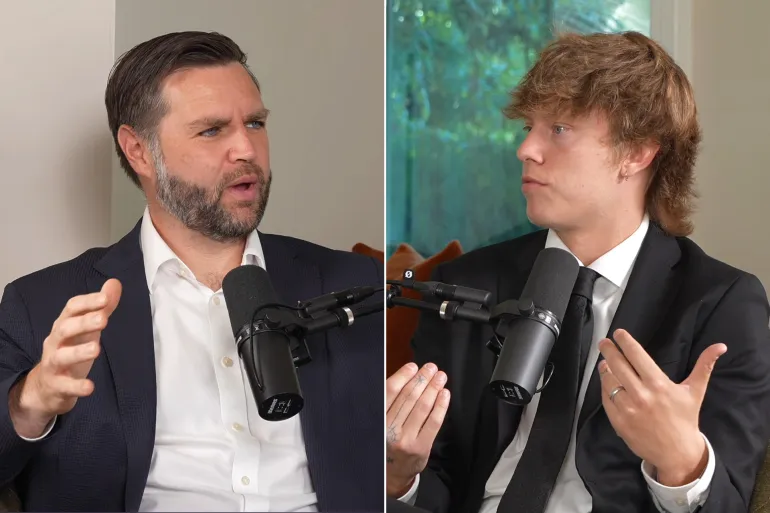
The remarks came during a lengthy interview with evangelical Christian host Price Crawford, published days ago as part of his show on YouTube. In it, Vance spoke about his Catholic faith, his conversion to Catholicism in 2019, his political career and his relationship with US President Donald Trump. He also touched on technological developments and the concept of the "end of times."
While Vance did not say he believes the end of the world is certainly imminent, he said he does not rule out that the "Antichrist" may already be present among humanity, and that some global developments make him not shocked by this possibility. He also stressed that he does not want to dwell much on this question, preferring to focus on his political and family responsibilities.
Religious talk inside the world of politics
Vance's remarks carry particular significance not only because of their religious content but because of the position of the speaker. He serves as US Vice President and speaks about matters of doctrine, prophecy and the end of the world from within the American political establishment, at a time when the conservative movement has seen a clear rise in religious and cultural discourse tied to Christian identity.
Yet Vance did not present himself as a prophet or as someone who sets a date for the end of the world.
When Crawford asked him whether the world had indeed entered the "end of times," he answered that he does not know, explaining that overthinking this question may be spiritually harmful, because he has work and responsibilities to carry out.
He then added that the end of times, according to his Christian belief, is inevitable, but the unknown is its timing: perhaps in thousands of years, perhaps in a few months.
"The Antichrist may be among us"
The most attention-grabbing part of the interview was Vance's discussion of the figure of the "Antichrist" in Christian conceptions.
The Vice President said he does not rule out that the "Antichrist" is already walking among people, but at the same time he stressed that he tries not to make this idea the focus of his attention.
This kind of thinking is linked to what some Christian currents call "eschatology," meaning the study or interpretation of events related to the end of the world, the return of Christ and the final stages of human history.
Vance said his interest in these matters is longstanding, but he does not want to turn them into a framework through which he interprets every political or international event.
"If my work leads to the end of times... then so be it"
Vance's remarks did not stop at the possibility of the end of the world approaching; he directly tied the matter to his political role. He said he tries to carry out what he sees as "God's work" as well as he can, and that if what he does leads to the end of times, then so be it, and if it instead leads to a better world, that too would be a good thing.
This phrase reveals a religious outlook that sees politics as part of a broader moral or religious responsibility, while leaving the final outcomes to God's will, as he puts it.
Yet Vance did not say he deliberately adopts policies aimed at hastening the end of the world. Rather, he spoke of his readiness to accept whatever may happen as part of a divine will, while affirming that he does not know when the end will come.
A "7 or 8" rating for entry into Paradise
In another part of the conversation, Crawford asked Vance to rate, on a scale of one to ten, how confident he is of entering Paradise.
The Vice President laughed and described the question as difficult, before placing himself at "7 or 8," affirming that his confidence is high but not complete.
This part of the interview reflects the nature of the dialogue, which was not limited to daily politics but entered personal, doctrinal and spiritual matters, in which Vance set out his views on faith, salvation and the place of the human being before God.
"Spiritual darkness" in meetings of world leaders
Vance added another element to his religious discourse when he described feeling at times what he called "spiritual darkness" during meetings with world leaders.
He said that some discussions or remarks he hears during political meetings stir in him what he described as "spiritual alarm bells."
He also spoke of a similar feeling at the Gettysburg battlefield in Pennsylvania, linking it to the amount of blood spilled there during the American Civil War.
These remarks do not describe a specific political event; rather, they reveal the way Vance describes his personal experience with certain places and situations from a religious and spiritual perspective.
Artificial intelligence enters the "spiritual darkness" discussion
The conversation shifted from religious prophecy to technology. Vance said that some practices associated with artificial intelligence give him a sense of what he called "dark spiritual energy," citing what he described as ceremonies held by more than 200 AI enthusiasts in San Francisco in 2025 (1446–1447 AH), honoring the "Claude 3 Sonnet" model after it was retired, and he said the scene left him deeply uncomfortable.
He also criticized the use of artificial intelligence to offer advice on marital and social relationships, describing this use as having a "demonic" character, and considering that separating people from the social bonds for which they were created is an extremely negative thing.
A contrast between Vance's rhetoric and the administration's policy on artificial intelligence
A notable contradiction emerges here.
A report by Axios noted that Vance himself has benefited politically from his relationships with the technology sector in Silicon Valley, which makes his position on artificial intelligence more complex than a simple rejection of technology.
Accordingly, Vance's criticism does not appear to be directed at artificial intelligence as a technology in itself, but at certain uses that he believes exceed the natural limits of human relationships.
Trump is present even in the religious conversation
Vance's relationship with Trump was not absent from the interview. He defended Trump after an AI-generated image spread in which Trump appeared in a manner resembling Jesus Christ (as Christians believe), an image that drew criticism from some Christians before it was deleted.
Vance said Trump did not intend to offend Christians or mock God, but was using his sense of humor, according to his interpretation.
This episode reveals another dimension of the interview: the religious discussion was not separate from politics, but intertwined with a defense of the president and of the image of the political movement to which Vance belongs.
Why Vance's remarks stand out
These remarks gain their significance from the convergence of three elements in the speaker's profile: a senior political post, a publicly declared Catholic identity, and frequent appearances in a conservative cultural space with a high sensitivity toward questions of religion, family and identity.
Over recent years, Vance has moved from being a rising conservative political figure to one of the most prominent faces of the new Republican current, and his religious rhetoric has become more visible in his public image.
But in the interview he did not offer a political vision based on predicting the end of the world, nor did he claim to know the identity of the "Antichrist" or the time of his appearance. Instead, he spoke of doctrinal possibilities and of his personal concerns about some global and technological developments.
From "the end of history" to "the end of times"
Vance's remarks also reflect an overlap between religious and political vocabulary that has become strongly present in the American right.
Phrases such as "spiritual battle," "dark forces," "God's will," and "the end of times" are, in some conservative political discourse, turned into tools for understanding cultural and political conflict.
However, it is important to distinguish between using religious concepts as a personal or cultural language, and adopting government policies on the basis of specific eschatological predictions.
Vance's interview does not prove that he endorses a political program built on a specific date for the end of the world; it shows that these ideas exist in his religious and personal background and that he is willing to speak about them publicly.
Vance: from politics to the question of destiny
The interview presents a relatively different picture of the Vice President's usual rhetoric. Instead of the economy, immigration, security and foreign policy, the conversation moved into questions of faith, salvation, the end of the world, Satan, artificial intelligence, and the relationship between technology and human nature.
At the heart of all of this, Vance appeared keen to emphasize one point: that he does not know when the end will come, and does not want to live as a prisoner of it, but wants to carry out what he sees as his duty and then leave the outcomes to God's will.
As for his remarks about the possibility that the "Antichrist" is among people, about "spiritual darkness" at some meetings, and about the dangers he sees in certain uses of artificial intelligence, they opened a rare window onto the religious side of a political figure who holds a senior position in the American power structure.
An important clarification from Wasl: the Muslim belief about the Antichrist and the descent of Jesus, son of Mary
We Muslims believe, based on authentic and established hadiths, in the appearance of the Antichrist (al-Masih al-Dajjal) at the end of time as one of the greatest trials humanity will face. However, he is not as Christians describe him, but as the prophetic Sunnah describes him: a man who displays extraordinary feats, claims for himself what is not his, misleads people, and most people on earth, especially non-Muslims, will follow him. For this reason the Prophet Muhammad ﷺ warned of his trial and commanded Muslims to seek refuge from it. Among the hadiths on this is his saying ﷺ: "There is no prophet except that he warned his nation of the one-eyed liar," and his saying that the trial of the Dajjal is among the greatest trials since the creation of Adam.
Regarding the events of the end of time, Muslims believe that Jesus, son of Mary, peace be upon him, will descend to earth before the Hour, and will kill the Dajjal and put an end to his trial. An authentic hadith from the Prophet ﷺ states: "By the One in whose hand my soul is, the son of Mary will surely descend among you as a just ruler; he will break the cross, kill the swine, and abolish the jizya."
Muslim scholars understand the descent of Jesus, peace be upon him, as the return of the prophet whom God raised up to Himself, not as the descent of a new savior with a new creed. His descent will be to establish justice and follow the law of Muhammad ﷺ, and then he will kill the Dajjal, according to the hadiths, and with that one of the greatest trials of the end of time will come to an end.
These beliefs are considered part of the major signs of the Hour in Islamic doctrine, and their details are recorded in authentic hadiths, particularly in Sahih al-Bukhari and Sahih Muslim.


