


Wasl News | Ceasefire Terms of the Agreement Between Iran and the United States and What We Know About Them
As soon as the war stopped, Iran began promoting itself as the victor and published what it called terms of the agreement, which were false. These terms, published by Iran, spread through Arab and international media, prompting the White House and US President Trump to intervene and clarify the matter.
Federal Investigation
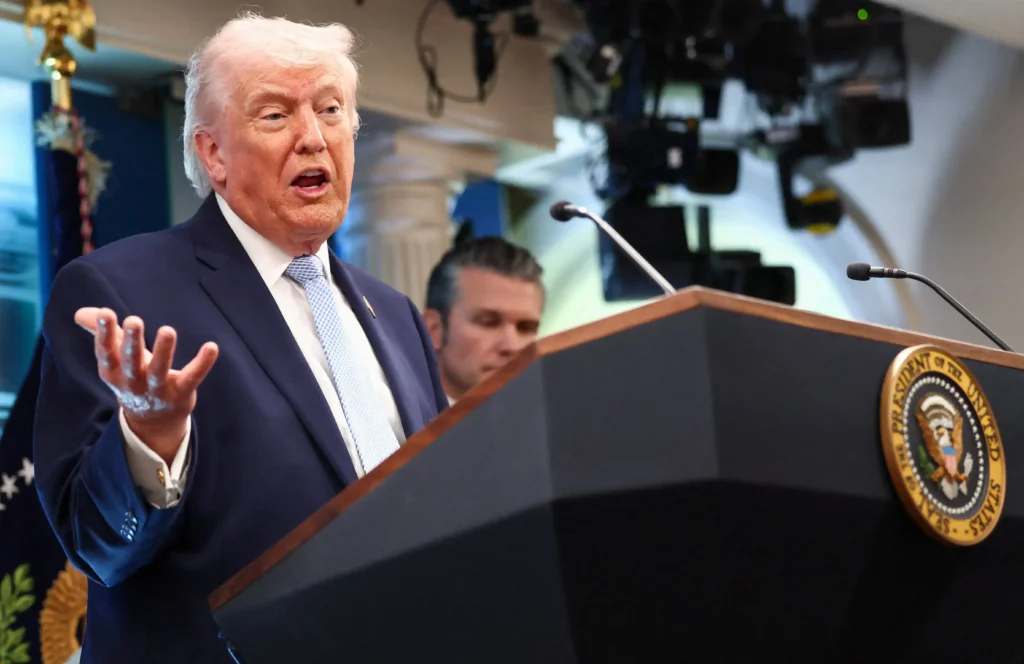
Donald Trump launched an investigation into CNN over its coverage of the ceasefire with Iran
US President Donald Trump said that the CNN network published an incorrect statement in the moments following the announcement of the ceasefire on Tuesday night-(Wednesday) (Eastern US time).
In a post on the platform X (formerly Twitter), the White House said that a main headline in CNN's breaking coverage, which read: "Iran claims victory and says it forced the United States to accept a 10-point plan," was an incorrect headline.
The White House's "Rapid Response" account on X stated: "This alleged statement from 'Iran' is a fraud! Correct it immediately!"
A CNN spokesperson told Newsweek by email on Tuesday night-(Wednesday): "The statement in question was obtained by CNN from Iranian officials and was circulated by several Iranian official media outlets. We received the statement from specific Iranian official spokespersons who are known to us."
Context
Trump announced the ceasefire with Iran only hours before a deadline set by the White House expired, abruptly ending a confrontation that had pushed global markets and foreign capitals to the brink of tension.
Trump had set a deadline of 8 p.m. (Eastern US time) on Tuesday, demanding that Iran allow navigation through the Strait of Hormuz, and warned that it could be "wiped out" in a single night, adding that "every bridge" and "every power plant" in Iran would be destroyed if Tehran refused.
What You Need to Know
Within a few hours of the ceasefire announcement, Trump posted on Truth Social that CNN had published a false statement.
He said: "The alleged statement published by CNN International News is a fraud, as CNN knows very well," adding: "The false statement was linked to a fake news site (from Nigeria), and of course CNN picked it up immediately and promoted it as a 'credible' headline."
The president continued: "Authorities are working to determine whether a crime was committed in issuing the fake CNN statement, or whether it was a bizarre act by a rogue party."
Brendan Carr, Chairman of the US Federal Communications Commission, said: "Another flagrant act of misconduct by CNN. Fake news is bad enough for the country, but publishing a false headline at a moment as sensitive to national security as this demands accountability. Iran issued an official statement that cannot be reconciled with the false headline CNN attributed to it. It is time for change at CNN."
What Happens Next
Trump said the results of the investigation would be "announced in the near future."
US President Donald Trump confirmed today, Wednesday, 8 April 2026, that talks on the Iran crisis would be held behind closed doors, noting that "only one set of core 'points'" is acceptable to the United States, without providing further details about the negotiations.
He added in a social media post: "These are the 'points' that form the basis of the ceasefire we agreed upon. They are reasonable and can be easily resolved."
What We Know About the Terms
The following are the main points published by official US sources, which differ fundamentally from what Iran publishes:
- Dismantling the nuclear programme: Iran's commitment to the complete and final dismantlement of its nuclear programme under strict international supervision, not merely its restriction.
- The missile programme: Halting the development and testing of intercontinental ballistic missiles and limiting their range.
- Securing navigation: Ensuring freedom of international navigation in the Strait of Hormuz and Bab al-Mandab without any interference by Iranian forces or their proxies.
- Permanent oversight: Granting inspectors of the International Atomic Energy Agency full and unconditional access to all sites (military and civilian).
- Ending support for proxies: Halting financial and military support for all armed groups in the region (Hezbollah, the Houthis, and factions in Iraq, Syria and Palestine).
- Release of detainees: The immediate release of all US citizens and citizens of allied states detained in Iran.
7. Regional withdrawal: Withdrawal of all Iranian advisers and forces from Syria and Yemen.
- Recognition of sovereignty: Iran's commitment to respecting the sovereignty of neighbouring states and not interfering in their internal affairs.
- "Snapback" mechanism: Establishing a mechanism to ensure the automatic reimposition of sanctions in the event of any breach of the agreement's terms.
- Technical verification: Imposing technical restrictions to prevent Iran from accessing the nuclear fuel cycle (industrial operations) for extended periods of time.
We note that these are the US terms, and it is not known whether they had been agreed upon as of the time of writing this report.
Conclusion
The agreed-upon terms are unknown and unpublished, and will be discussed behind closed doors.
Sources:
Newsweek
https://www.newsweek.com/donald-trump-launches-investigation-into-cnn-over-iran-ceasefire-11796760
Reuters
https://www.reuters.com/world/asia-pacific/trump-says-us-iran-talks-will-be-behind-closed-doors-2026-04-08/


