

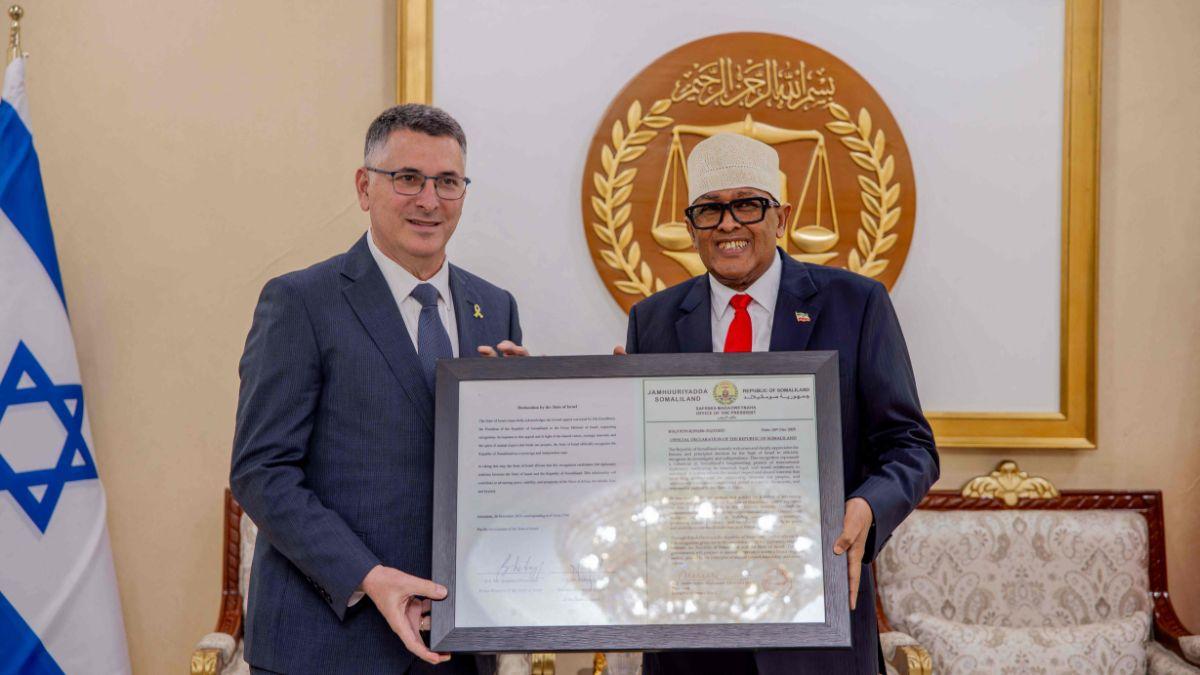
The Israeli Ministry of Foreign Affairs announced on Sunday, 1 November 2026, that Israel's first ambassador to the self-declared Somaliland region, Michael Lotem, presented his credentials to the region's president, Abdirahman Mohamed Abdullah, during an official ceremony held at the presidential palace in the city of Hargeisa. The step strengthens diplomatic relations between the two sides, amid regional disagreements over recognition of the region's independence and concerns about the expansion of Israeli military influence near the Bab al-Mandab Strait.
According to the British outlet Middle East Eye, reporting on Monday, 2 November, the credentials ceremony took place last week and included the laying of the foundation stone for the new Israeli embassy building in Hargeisa.
The Israeli Ministry of Foreign Affairs described the move as an important development in strengthening relations between the two sides, following Israel's announcement on 26 December 2025 that it recognised Somaliland as an independent state, making it the first UN member state to take this step since the region declared its separation from Somalia in 1991.
Diplomatic expansion following Israeli recognition
Israeli Foreign Minister Gideon Saar said his country is determined to develop and strengthen its relations with Somaliland, considering the exchange of ambassadors an additional stage in consolidating the relations that emerged following mutual recognition.
Saar had visited the region in January 2026, while Somaliland's authorities opened an embassy in West Jerusalem during a visit by the region's president to Tel Aviv in June.
For his part, Somaliland's president, Abdirahman Mohamed Abdullah, described the accreditation of the Israeli ambassador as an unprecedented event, noting that it is the first time a regional president has received the credentials of an ambassador from a UN member state that recognises its independence.
Abdullah affirmed his administration's commitment to developing partnership with what he called "Israel" over the long term, stressing the importance of the region's geographic location in the new relations.
Ambassador Michael Lotem, for his part, said that his country's recognition of the region represents an acknowledgement of what he described as the achievements Somaliland has made over the past three decades, and is not merely a diplomatic procedure.
The Red Sea and Bab al-Mandab at the heart of the new relations
Israel's relations with Somaliland carry strategic importance due to the region's geographic location on the Gulf of Aden, near the Bab al-Mandab Strait, which links the Red Sea to the Indian Ocean and is one of the most important maritime routes for international trade.
During the ambassador's accreditation ceremony, the regional president pointed to the importance of Somaliland's location near the Red Sea and the Gulf of Aden, saying that cooperation with the Israeli occupation carries regional and international dimensions extending beyond bilateral relations.
The coastal city of Berbera stands out as one of the region's most prominent points of strategic interest, as the Emirati company DP World manages its main commercial port within international investment partnerships, while the UAE also has a military presence in the area.
Possible talks on an Israeli naval base
Middle East Eye reported that the Israeli occupation and Somaliland are discussing the possibility of establishing an Israeli naval base on the region's coast, near the Bab al-Mandab Strait.
However, this information has not been confirmed by any officially announced agreement, and earlier statements by Somaliland officials had denied that negotiations for establishing an Israeli military base were underway.
In June, Somaliland's Minister of Defence, Mohamed Yusuf Ali, told Reuters that there is no Israeli military base or negotiations to establish one, but he confirmed the existence of Israeli cooperation in training the region's police and army forces.
This places the issue of military cooperation within the sphere of regional attention, particularly with rising tensions related to maritime navigation security in the Red Sea and the war in Yemen, which lies on the opposite shore of the Gulf of Aden.
Somali rejection of Israeli recognition
The move comes amid popular Somali rejection of Israeli recognition of Somaliland, as the region is considered an inseparable part of Somalia's territory.
The African Union, the League of Arab States and the Organisation of Islamic Cooperation have also opposed the Israeli recognition decision, affirming their support for the territorial unity of Somalia.
Despite these objections, the authorities of Somaliland and the Israeli occupation continue to expand their diplomatic, security and economic relations, benefiting from the region's strategic location overlooking one of the world's most sensitive maritime corridors.
The accreditation of the first Israeli ambassador and the laying of the foundation stone for the embassy in Hargeisa reflect the shift of relations between the two sides into a more institutional phase, while the potential repercussions of this rapprochement for Somali sovereignty and Red Sea security remain a subject of regional disagreement.


