


The story did not begin with a large institution, nor with a donation fund, nor with a campaign to raise money. It began with a Palestinian teacher whose debt weighed on her and who feared she would find herself pursued over a cheque she had been unable to honour.
The teacher called Palestinian media figure and activist Alaa Al-Rimawi asking for help. Al-Rimawi contacted the creditor, and the man agreed to cancel the debt and forgive her. The story could have ended there, with a problem resolved between two people, but what happened next turned it into one of the most widely shared social initiatives in Palestine in recent days.
Through social media, Al-Rimawi launched an initiative called "Tanazul Lillah" ("Forgiven for God's Sake"), calling on holders of debts, cheques and financial claims to consider the circumstances of those who have fallen behind on payments, and to waive the debt in whole or in part for those who are able to do so, or to grant them more time or easier terms.
Millions of shekels within days
The call did not take long to become a broad wave.
Merchants, shop owners and individuals began to announce one after another that they were forgiving people who owed them money. Some tore up cheques, others destroyed entire debt ledgers, while others waived personal loans and financial claims that had built up over years.
Half an hour after the initiative was launched, the value of the debts announced as cancelled exceeded half a million shekels; it then rose to about 7.5 million shekels within 48 hours, and reached about 12 million shekels within five days. On 11 September, Al-Rimawi said the total value of the forgiven debts was approaching 15 million shekels.
These figures reflect only what was publicly announced, as those running the campaign spoke of people who chose not to disclose their waivers, wishing their deeds to remain out of the public eye.
A debt ledger burned... cheques torn up
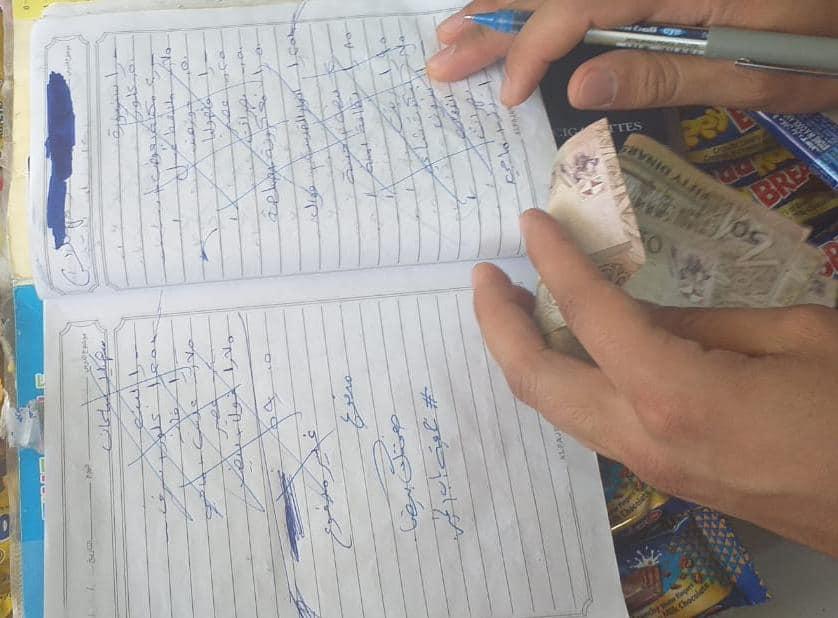
Behind those millions are dozens of small stories.
A pharmacy owner burned a debt ledger worth about 9,000 shekels, and a shop owner destroyed another ledger containing debts estimated at about 40,000 shekels. Another person waived 4,000 shekels still owed to him for the price of a car, while the owner of a simple kiosk forgave a customer a debt of just 130 shekels.
The gap between tens of thousands of shekels and 130 shekels may seem enormous, but the spirit of the initiative was not measured by the size of the figure: each person waived what they could, and each creditor decided to lift a burden from someone else.
The campaign also reached Gaza. Al-Rimawi related that a displaced woman living in a tent decided to forgive two-thirds of the debts owed to her by others, despite the displacement, the war and the need she herself was living through. He also spoke of a merchant who burned his debt ledger and dozens of cheques live on air, and of a woman who had given her neighbour a gold bracelet to help her son complete his education, and then decided to forgive its value.
According to cases circulated within the campaign, the spirit of "Tanazul Lillah" also extended into homes and families, where some wives announced they were forgiving their husbands financial claims or deferred dowries, an expression of the idea's movement from the traditional creditor-debtor relationship into wider social circles.
Not a fundraising campaign
What distinguishes "Tanazul Lillah" is that it is not fundamentally based on collecting money from others, but on waiving an existing financial right.
No one is asked to pay another person's debt. Rather, whoever holds a claim against someone who has fallen behind is invited to ask themselves: can I waive this entire right? Or part of it? Or at least give the debtor additional time?
Al-Rimawi explained that the initiative rests on three tracks: forgiving the debt, postponing it, or easing the way it is repaid.
The campaign therefore does not mean that every creditor is obliged to give up their money, since they may themselves be in need of it; rather, it addresses those able to forgive without being harmed.
Why did the campaign resonate so widely?
The initiative came at a time when broad sections of Palestinian society are living under severe economic pressure, and debt has become, for many families, a means of getting through daily expenses, but with continued default it turns into a psychological, legal and social burden.
In such circumstances, cancelling a cheque or a debt is not merely deleting a figure from an accounts book. It can mean preventing a person from being pursued, saving a family from a dispute, giving a small shop owner a chance to survive, or enabling a father or mother to start afresh.
This may explain the speed with which the initiative spread. Every published story of forgiveness encouraged another person to review their own debt ledger, and every torn cheque prompted someone else to do the same, until the initiative turned from an individual act into something resembling a social chain of forgiveness.
According to what has been published about the campaign, the number of participants exceeded one hundred when the value of the forgiven debts approached the 10-million-shekel mark.
Beyond money
But the most notable effect of "Tanazul Lillah" may not lie in the total of shekels written off.
Money, however large, remains countable. What is harder to measure is the number of homes that found relief after a debt was lifted, the number of people who woke up knowing that a financial claim that had been pursuing them no longer existed, and the number of relationships that forgiveness helped to repair.
Al-Rimawi called on the able among Palestinians, Arabs and the diaspora to contribute to supporting those who have fallen behind, orphans and the injured, and also called on companies and large institutions to consider the debts of those who are struggling and to ease their burden as far as possible.
"Tanazul Lillah" began with a call from a teacher frightened by the consequences of a debt, then passed from phone to phone, from shop to shop, and from debt ledger to debt ledger.
Within a few days, the question was no longer only: how much have the cancelled debts totalled?
It became the question the initiative carried to every holder of a right: if you are able to forgive, is there someone you can today lift a debt from their shoulders for, and say to them with full ease: "Forgiven for God's sake"?


