


After roughly a year and a half of negotiations, Syria and Russia have reached a memorandum of understanding that reorganises the Russian presence at the Hmeimim and Tartus bases on the Syrian coast. The step marks a significant shift in the nature of relations between Damascus and Moscow, and redraws one of the most prominent manifestations of Russian presence in the Middle East and the Mediterranean.
Under the agreement, the Syrian authorities will take over the administration of civilian facilities linked to the two sites, while military facilities will be converted into training and rehabilitation centres shared by the two countries. The transition is to be completed within a maximum period of three months.
From bases to Syrian administration
The most important provision of the agreement is the transfer of the administration of civilian facilities to the Syrian state.
This step includes Hmeimim Airport, in addition to the fourth commercial pier at the port of Tartus and the warehouses and facilities linked to it. The Syrian authorities say these sites will be gradually integrated into the Syrian civilian administration system, reinforcing Damascus's control over facilities that were under Russian administration.
This step comes in a broader context of the Syrian state regaining control over its coastal infrastructure, after years in which the Russian presence was a key element in the management of a number of strategic facilities.
The end of the Assad phase and the beginning of a new relationship
The agreement cannot be understood apart from the political transformation Syria underwent at the end of 2024.
Russia was the most prominent military and political ally of Bashar al-Assad during the Syrian war, intervening militarily alongside his government since 2015, while the Hmeimim and Tartus bases formed the main pillar of Russian operations in Syria and the region.
However, the fall of the Assad regime and his flight to Russia in December 2024 changed the calculations considerably. With the arrival of a transitional administration led by Ahmed al-Sharaa, Moscow found itself facing a new political reality that required redefining its relationship with Damascus.
Rather than the end of Assad's rule turning into a rupture between Syria and Russia, the two sides chose a more pragmatic course based on renegotiating Russian interests within the country.
This is what makes the current memorandum different from a mere technical agreement on two military bases. It is an indicator of the shape of relations between the two countries after the fall of the regime that had linked them for decades.
Tartus: a strategic loss for Moscow?
Tartus has particular importance for Russia. It represents its main naval facility on the Mediterranean, and its presence there gave Moscow the ability to support its naval operations in the Mediterranean and reach its theatres of operation in the Middle East and North Africa.
As for Hmeimim, since the Russian intervention in 2015 it has become the centre of Russian air operations in Syria.
Accordingly, reorganising the two sites means that Moscow is not merely facing a change in the administration of Syrian facilities, but a decline in the nature of one of its most important footholds outside its territory.
Under Assad, Russia had obtained long-term arrangements for the use of Tartus, while another agreement granted it the right of permanent and free use of the Hmeimim base.
But the political transformation in Damascus has made the continuation of those arrangements in their former form more difficult.
Moscow is not leaving entirely
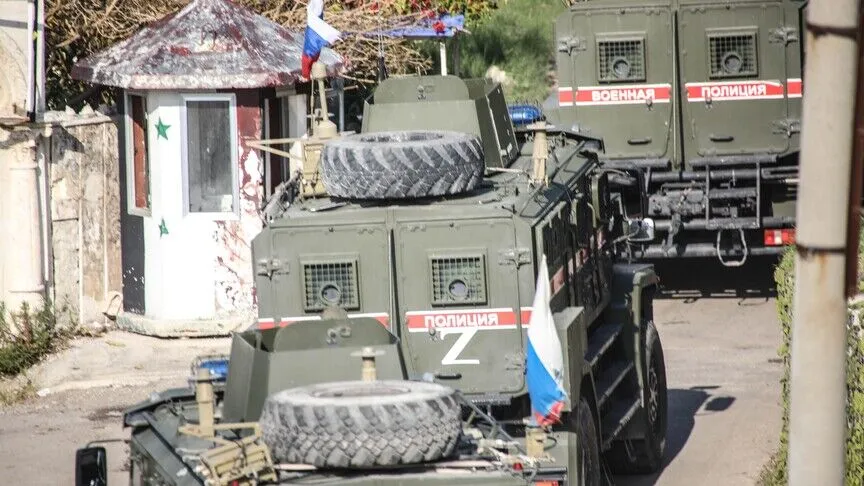
Nevertheless, it would be a mistake to read the agreement as a complete Russian withdrawal from Syria.
The new formula allows Russia to continue its presence within the two sites through the shared training and rehabilitation centres. Moscow is thus moving from a direct military presence based on bases with a clearly Russian character to a more flexible arrangement built on partnership with Syrian institutions.
This formula may be more suitable for the new phase: it allows Damascus to affirm its sovereignty and its administration of its facilities, while enabling Moscow to retain part of its influence and its military relations with Syria.
From another angle, the continuation of the military relationship gives Russia an opportunity to maintain a foothold in the Mediterranean region, even if the size of its forces shrinks or the nature of its tasks changes.
Damascus seeks a new balance
For the new Syrian government, the agreement carries gains that go beyond control of airports and ports.
Damascus seeks to build multiple external relations and not to be tied to a single axis, alongside an increasing opening to Arab and Western states.
In this context, keeping a channel of cooperation with Russia can be understood as part of a policy that seeks to redefine old relationships rather than sever them entirely.
Russia was the ally of the former regime, but it is also a major power with military, political and economic influence that cannot easily be ignored.
Therefore, Damascus appears to be attempting to reach an equation that allows it to restore its sovereignty over strategic facilities while maintaining practical relations with Moscow, without returning to the model of relations that prevailed under Assad.
Declining influence or repositioning?
The most important question raised by the agreement is: are we witnessing the end of Russian influence in Syria, or merely its shift into a new form?
Current indicators favour the second possibility.
The agreement clearly reduces the direct military character of the Russian presence, but it does not cancel military cooperation, nor does it close the door on Moscow maintaining a foothold on the Syrian coast.
Accordingly, Russia may be repositioning rather than withdrawing.
However, the scale of influence Moscow will be able to retain in the future will depend on the details of the agreement's implementation, on the ability of Russia and Syria to turn the shared training centres into a stable framework for cooperation, and on regional developments and the new Damascus government's relations with the United States, Europe and the Arab states.
A new page in Syrian-Russian relations
The Hmeimim and Tartus agreement represents a clear departure from the phase in which Russia had a wide military presence in Syria, especially during the rule of Bashar al-Assad.
Damascus is regaining administration of civilian facilities, while military bases are being converted into shared training centres. For its part, Moscow is not entirely abandoning its presence, but is trying to keep a military footprint that is less costly and more adaptable to the new political reality.
Thus, what is happening is not the end of the Syrian-Russian partnership so much as the end of one of its old forms.
Once Russian bases were a symbol of Moscow's support for the Assad regime, and they now appear to be becoming part of a new relationship between two states trying to adapt to post-Assad Syria.
The real test will not be the signing of the memorandum, but how it is implemented over the coming three months, and whether Moscow can maintain strategic influence in the Mediterranean without owning bases in the form the region knew over the past decade.


