

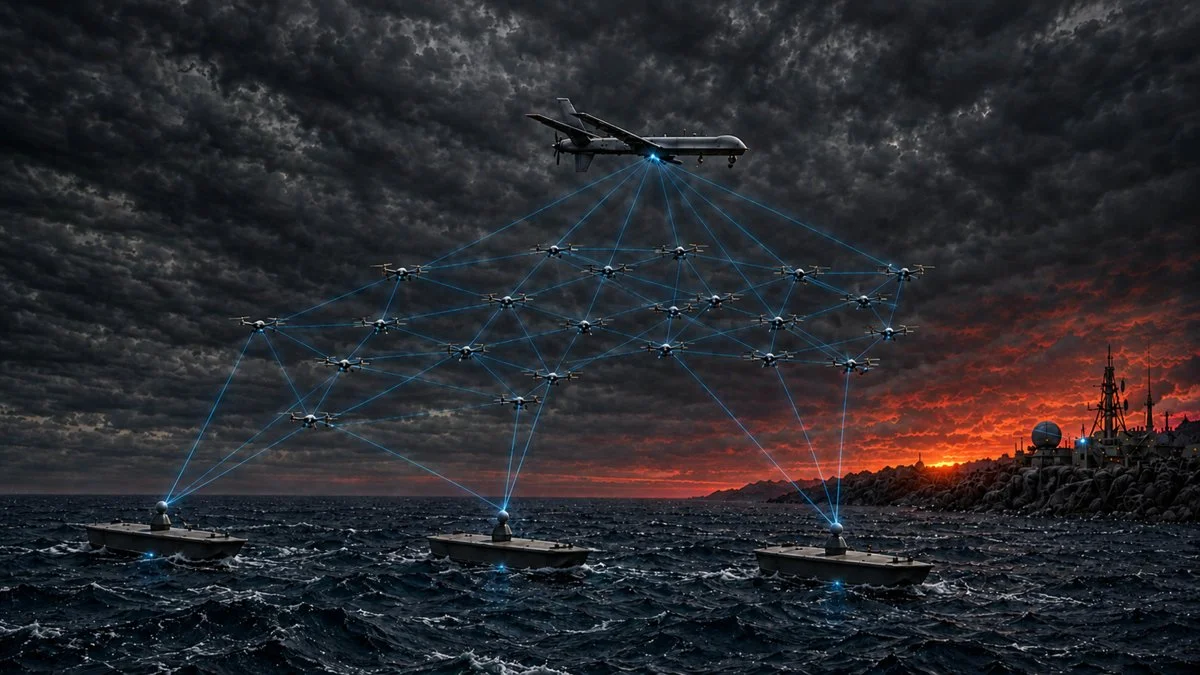
From Ukraine to the South China Sea and NATO's eastern front, a US military study proposes a shift in the concept of offensive power, based on the use of drone swarms and interconnected combat systems to carry out reconnaissance, deception, jamming and attack missions. The study argues that this technology could help armies regain their ability to manoeuvre on battlefields where troop concentrations have become easy targets for detection and strikes, but it warns that acquiring large numbers of drones alone is not sufficient to achieve this shift.
The US Center for Strategic and International Studies (CSIS) issued the study on 14 October 2026, titled The Art of Swarming: Launched Effects and the Future of Mass on the Modern Battlefield.
The study was prepared by Benjamin Jensen, Director of the Futures Lab and Senior Fellow in the Defense and Security Department at the Center. Drawing lessons from the Russo-Ukrainian War, particularly the Ukrainian offensive in the Kursk region in 2024, Jensen applies the findings to three hypothetical scenarios of military confrontations that the United States and its allies might face against Russia or China.
The study starts from a central question: how can armies launch a successful attack after drones, modern sensors and long-range artillery have made the gathering of troops and vehicles in one place more dangerous than ever?
Why have large armies become more vulnerable?
For many years, armies relied on concentrating troops, vehicles and artillery to provide significant firepower at points of attack, then exploiting military superiority to break through defences and advance deep into the adversary's territory.
However, the Russo-Ukrainian War revealed growing difficulties facing this traditional approach.
The proliferation of small drones, thermal cameras, electronic sensors and space-based reconnaissance has made detecting troop concentrations easier and faster, even when forces try to conceal their movements.
At the same time, long-range artillery, precision munitions and offensive drones have made it possible to strike these concentrations before they reach direct engagement positions.
As a result, the defending side has greater opportunities to detect attacking forces and inflict losses on them while they prepare for an assault or move towards the front.
Jensen notes that this shift has not made attack impossible, but it has raised its cost and weakened the effectiveness of methods that depend on concentrating forces in a limited area.
This is where the study's central idea begins: if concentrating forces makes them an easy target, can their military effect be concentrated without physically gathering them in one place?
What is meant by military drone swarms?
Jensen does not mean by the concept of swarms merely launching large numbers of drones at a single target.
According to the framework discussed in the study, a swarm is a group of relatively low-cost military systems operating in an interconnected manner to perform different functions within a joint operation.
These functions may include reconnaissance and information gathering, electronic deception, jamming, attack, and assessing the results of strikes.
The importance of this concept lies in the fact that the participating systems do not necessarily need to gather in one location; they can operate from different positions and platforms while coordinating the effect they produce.
The report uses the term Launched Effects, meaning unmanned systems launched from military platforms, including aircraft, ships and ground vehicles, to carry out multiple missions.
This concept allows capabilities to be distributed across a large number of systems, rather than relying exclusively on high-cost military platforms.
It also differs from using individual drones independently, as the idea is based on integration between systems and missions, not on numbers alone.
However, the study does not assume that all these drones enjoy full autonomy or operate without human intervention. Rather, it discusses a broad operational concept that may depend on varying degrees of connectivity, coordination and automation.
How can swarms change the balance between attack and defence?
The study argues that modern armies face a dilemma: the need to achieve temporary military superiority in a specific area without exposing large numbers of soldiers and equipment to the risk of being targeted.
Drone swarms are proposed as a potential way to address this dilemma, because they allow risks to be spread across multiple systems that are difficult to deal with all in the same way.
Among the most notable effects the researcher discusses is that the density of drones and the diversity of their functions may confuse enemy defences and force them to deal with both real and misleading targets.
This could lead to the expenditure of high-cost defensive munitions, or the exposure of the locations of surveillance and defence systems that are trying to keep their deployment secret.
Electronic jamming and deception operations may also affect the accuracy of the information available to the defender and make it harder to identify the direction of the main attack.
Here the study introduces an important concept: concentrating military effect without concentrating forces.
Instead of massing large numbers of vehicles and soldiers, the effects of multiple geographically dispersed systems are coordinated to achieve a shared result.
Jensen believes this model could restore some of the offensive capability that armies have lost in an environment that has become highly dangerous for large military formations.
However, the study presents this as a possibility conditioned on organisation, industrial capacity and military coordination, not as a result whose success has been proven in general across all battlefields.
Three phases of swarm warfare
The researcher presents a theoretical framework of three interconnected phases for understanding how swarms can be employed in modern military operations.
The first phase, which he calls "setting the conditions", involves preparing the operational environment in which forces can use their interconnected systems effectively.
The second phase, called "the pulse", refers to concentrating the effect of a number of systems within a limited period, allowing shared military results to be achieved despite the participating assets being deployed in different locations.
The third phase, titled "exploiting gains and transitioning", concerns the ability of forces to take advantage of the results achieved and to sustain operations, rather than settling for a single isolated action.
The study explains that the success of a swarm in carrying out a single mission is not enough to bring about a lasting shift in the balance of combat.
If forces cannot replace lost systems, renew their capabilities and continue operations after the adversary responds, the effect may remain limited and temporary.
The researcher therefore emphasises that the effective use of swarms requires a repeated ability to generate military strength, not merely possessing a large stock of drones at the start of a confrontation.
Kursk 2024: the experience on which the study draws
Jensen drew on the Ukrainian offensive that began in the Russian Kursk region in August 2024 to clarify some aspects of the framework he proposes.
The offensive was a prominent case in the Russo-Ukrainian War, as it showed that offensive operations and rapid manoeuvre remain possible despite the spread of modern reconnaissance and targeting means.
The researcher uses this experience to illustrate the importance of coordination between reconnaissance, deception and military movements, and how exploiting a period of disruption on the defending side can enable field gains.
However, the study does not present the Kursk operation as evidence that a single independent drone swarm decided an entire battle.
Nor do the initial results of the Ukrainian offensive mean that all its gains were sustained, or that the model can be repeated automatically under different conditions.
The significance of Kursk lies in its being a field experience that helps the researcher test his ideas about restoring offensive capability on a battlefield dominated by sensors and drones.
Three scenarios for future military confrontations
The report did not limit itself to reviewing the Ukrainian experience; it tested the proposed concept through three hypothetical scenarios involving areas of strategic importance to the United States and its allies.
Kaliningrad: confronting a Russian air defence network
The first scenario concerns the Russian Kaliningrad region on the Baltic Sea, located between Poland and Lithuania.
The area represents a strategic military position for Russia due to the presence of air defence capabilities and military systems linked to protecting air and maritime space.
The report examines how interconnected unmanned systems could affect a confrontation with integrated air defences, and whether they could change military calculations in a highly fortified area.
The scenario does not represent a declared American plan to attack Kaliningrad; it is an analytical exercise to test the swarm concept against advanced defence systems.
The South China Sea: the challenge to Chinese naval control
The second scenario moves to the South China Sea, where military competition between Washington and Beijing overlaps with regional disputes over sovereignty and freedom of navigation.
The researcher discusses the possibility of using swarms and unmanned systems within joint naval operations, confronting the Chinese naval force and its capabilities for surveillance and targeting.
The importance of this scenario lies in the fact that vast maritime areas pose challenges related to reconnaissance, communications, sustainability and the ability to manage simultaneous operations.
Moreover, the naval environment differs from land battlefields, meaning that the success of a particular model in Ukraine does not guarantee its success on the oceans and sea lanes.
For this reason, the report uses the scenario to show the need to adapt the concept to the nature of each operational theatre.
NATO's eastern front: breaching Russian defences
The third scenario addresses a hypothetical confrontation on NATO's eastern front, given the possibility of multi-layered Russian defences.
The report examines the ability of swarms of unmanned systems to support joint military operations in an environment where air defence, artillery, electronic warfare and reconnaissance overlap.
The study stresses that the success of this concept does not depend on drones alone, but on their integration with conventional forces and with command, communications and supply systems.
The three scenarios remain research models, not confident predictions that new wars will occur, nor announcements of decided military plans.
Why is buying thousands of drones not enough?
One of the most important features of the study is that it does not reduce the future of war to increasing the number of drones.
A state may possess a large stock of drones, yet be unable to use them effectively if it lacks the communications, coordination, maintenance and supply needed.
Low-cost systems may also become a major financial and logistical burden if they are consumed in huge numbers without a sustained capacity to replace them.
Jensen points out that the success of swarm operations requires an integrated structure, including developing operational concepts, training forces, standardising components, and adopting technical systems that can be updated and integrated.
This issue is especially important for armies that rely on equipment from multiple manufacturers or operate within military alliances comprising states that use different systems.
The reliance on digital communications and electronic coordination also poses challenges related to jamming, electronic intrusion and network disruption.
For this reason, possessing drones represents only one element of a broader military system.
Fourteen recommendations for the Pentagon and Congress
The study concludes with a set of 14 recommendations addressed to the US Department of Defense and Congress, aiming to turn swarm operations from research ideas and limited experiments into a military capability that can be used regularly.
The recommendations include establishing joint task forces specialised in swarm operations, developing military units dedicated to them, and improving cooperation among the branches of the armed forces.
They also call for adopting shared components and open, upgradeable systems, which would facilitate updating and integrating systems and reduce reliance on closed technical solutions.
The study stresses the need to develop distributed supply, maintenance and production means, so that forces can replace their losses and sustain operations during prolonged conflicts.
It attaches particular importance to interoperability between US systems and those of allied states, given that joint military operations may require operating equipment from multiple sources within a single environment.
These recommendations reflect the researcher's view that the problem is not solely about inventing a new drone, but about building a military institution capable of integrating these technologies into training, planning, operations and production.
The recommendations do not represent decisions adopted by the US Department of Defense or funding commitments approved by Congress; they are proposals put forward by the researcher on the basis of his analysis.
Will manned tanks and aircraft become obsolete?
The frequent discussion of drones may suggest that conventional armies are moving towards abandoning tanks, combat aircraft and warships.
Jensen's study does not reach this conclusion.
It focuses on redistributing roles and tasks, and on the possibility of using low-cost systems alongside advanced military platforms, rather than replacing all conventional weapons with them.
Tanks, artillery, manned aircraft and ground forces may continue to perform essential roles, with growing reliance on the information, protection and support provided by unmanned systems.
Conversely, the spread of swarms may increase the need for multi-layered defences, electronic warfare, protection of communications, and new methods for distinguishing real targets from deceptive systems.
Heavy reliance on drones also does not eliminate constraints arising from weather, terrain, electronic jamming, and the capacity for manufacturing and supply.
The transformation the study addresses therefore appears closer to a reconfiguration of the relationship between conventional means and new technologies than to the end of conventional armies.
The other side of development: risks to civilians and infrastructure
Although the study focuses mainly on the military utility of swarms, the spread of these technologies raises important questions related to international humanitarian law and the protection of civilians.
An increase in the number of systems capable of surveillance and targeting may make military operations more complex in terms of verifying targets and determining responsibility for combat decisions.
Systems that rely on automated processing of information or varying degrees of autonomy also raise questions about human oversight, the reliability of target identification, and the likelihood of errors.
The rules of international humanitarian law require distinction between military objectives and civilians, the taking of necessary precautions to minimise incidental harm, and respect for the principle of proportionality in attacks.
Neither the low cost of drones nor their ability to operate collectively alters these obligations.
Moreover, the spread of relatively cheap offensive means may allow a greater number of armed actors to acquire capabilities that previously required larger military resources, increasing the importance of controls on their use.
These are legal and humanitarian considerations related to the subject of the study, and not findings from a field test of the extent to which swarm systems comply with international law.
The future of war: strength lies in coordination, not numbers alone
The Center for Strategic and International Studies study presents a vision of a transformation that may affect how modern armies organise and fight their battles in the coming years.
With the spread of cheap sensors, precision artillery and drones, forces that concentrate in exposed positions face growing risks, which in many circumstances gives the defence an advantage.
In contrast, the author suggests that the use of interconnected swarms of unmanned systems could help restore offensive capability, by distributing military assets and coordinating their effect without the need to mass conventional forces in a single location.
However, this shift remains conditional on the ability of armies to develop their organisation, training and industrial base, and to sustain operations despite losses, jamming and the adaptation of adversaries.
The scenarios relating to Kaliningrad, the South China Sea and NATO's eastern front reveal the breadth of US military interest in these technologies, but they do not prove that their use will guarantee superiority in any future confrontation.
The most prominent conclusion of the study is that the concept of military massing itself may change: force is no longer tied only to the number of soldiers and vehicles an army can gather in one place, but to its ability to coordinate the effect of many distributed systems and to keep them working against an opponent that continually learns and adapts.
While armies race to develop drones, artificial intelligence and reconnaissance systems, the coming battle appears, according to this view, to be as much a contest of organisation, integration and sustainability as a race to acquire new weapons.
Source: Center for Strategic and International Studies (CSIS), study "The Art of Swarm Operations: Standoff Platforms and the Future of Combat Massing in Modern Battlefields," by Benjamin Jensen, 14 October 2026.


