


Surviving soldiers from the deadly attack in Kuwait dispute the Pentagon's account, saying the unit "was not ready" to defend itself.
In their first public testimony, members of the targeted unit gave CBS News a detailed account of the attack and its bloody moments from the perspective of eyewitnesses. The soldiers said that U.S. Defense Secretary Pete Hegseth's description of the attack as merely a drone that had "slipped" through the defenses does not reflect the actual situation on the ground.
One wounded soldier, who declined to be identified due to media restrictions within the military, said that talk of "a single drone that penetrated the defenses" is misleading, adding that the site was not equipped to defend itself to begin with and was not fortified as it had been portrayed to the public.
These testimonies, supported by photos and videos obtained by CBS News, reveal for the first time details of what happened on March 1 at the Shuaiba Port facility in Kuwait, which the soldiers described as having limited fortifications, when it was struck directly by an Iranian drone.
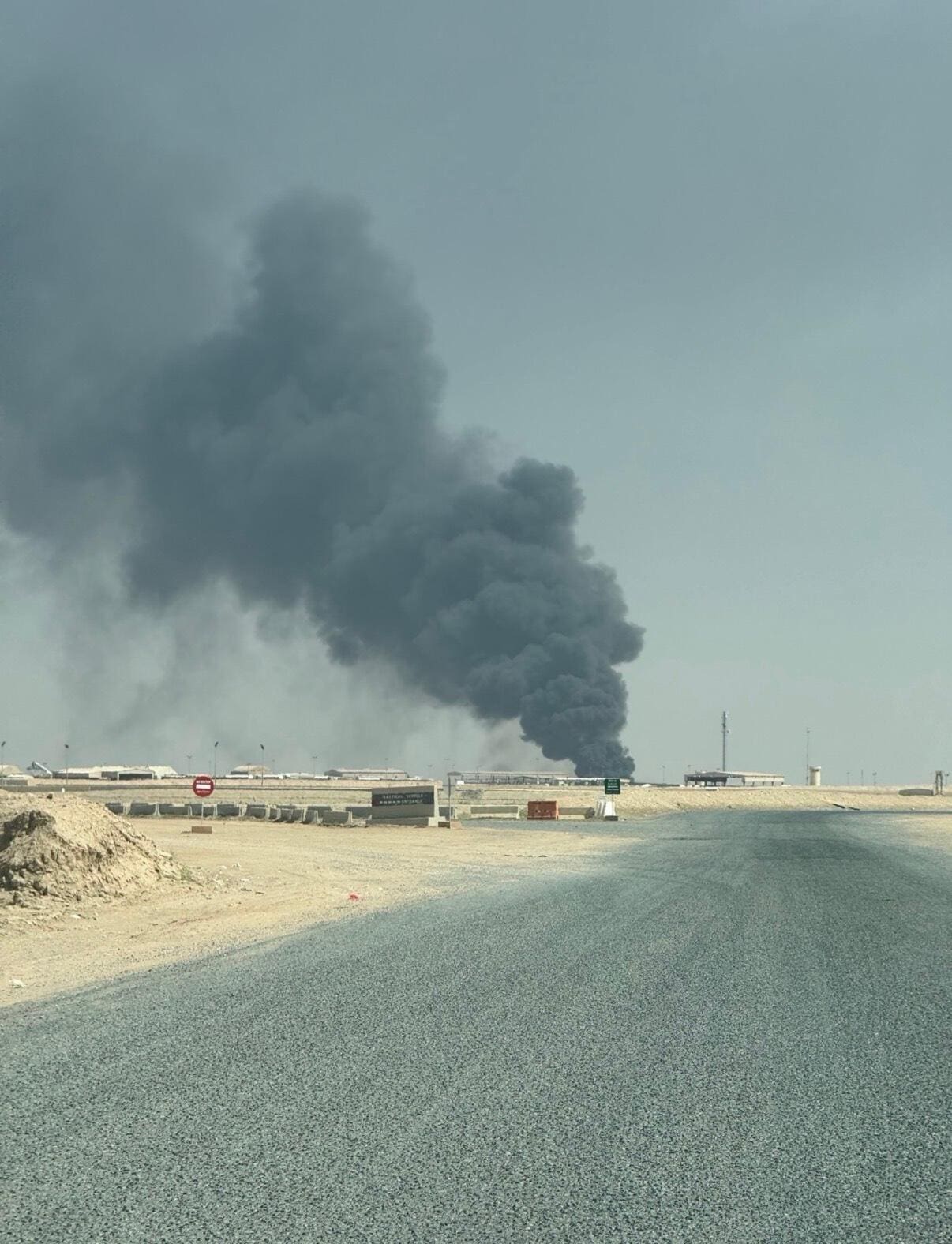
Smoke rises from the site of an Iranian drone attack that killed six members of the U.S. service in Kuwait on March 1, 2026.
According to the testimonies, some 60 soldiers had taken shelter in a concrete bunker after a warning of an incoming ballistic missile, before the all-clear was announced shortly afterward. The officers then returned to their offices, inside a temporary workspace of wood and sheet metal, and resumed managing the movement of equipment, munitions and personnel in the area.
However, only about half an hour later, the explosion came. One soldier said everything shook suddenly, and the scene seemed like something from a war film: ringing in the ears, blurred vision, dizziness, and dust and smoke everywhere.
"Get Out of the Line of Fire"
About a week before the start of Operation "Epic Fury," most of the U.S. soldiers and air force personnel stationed in Kuwait were moved to sites in Jordan and Saudi Arabia, beyond the range of Iranian missiles. Some soldiers said the instructions were clear: move out of the targeting zone.
However, dozens of personnel from Support Command 103 received different orders; they were told to relocate to Shuaiba Port, a smaller military site on Kuwait's southern coast. There, they set up a tactical operations center inside simple buildings surrounded by concrete barriers of the "T-walls" type, which provide protection from mortar shells or ground-based rockets but offer no real cover against air attacks or drones.
One soldier said the base looked like an old military facility, with some small barriers and temporary metal buildings used as offices. He added that the soldiers repeatedly asked why they were remaining within the range of Iranian missiles and drones, despite intelligence indicating that the site was on a list of possible Iranian targets.
One of them confirmed that the unit was actually moved to a location closer to Iran and more exposed to danger, without being given a convincing explanation for this. He pointed out that the fortifications available did not go beyond thin vertical barriers that provided no protection from above, stressing that the site, in terms of defense against drones, had almost no protection.
The wounded and surviving soldiers insist that what happened revealed a serious gap between the official account and the reality on the ground.
"It Was Chaotic"
With the outbreak of war, it became clear that Iran would move away from traditional defense and rely more heavily on cheap, abundant drones, an arsenal that has changed battlefield calculations in places such as Ukraine.
One of the Iranian Shahed drones exploded directly in the center of the U.S. soldiers' work site.
"It was chaos," said another wounded soldier. "There was no single line for patients to be triaged. You were either on the side of the fire or the other side of the fire."
According to witnesses, the soldiers triaged themselves with temporary bandages, splints and pressure dressings. They commandeered civilian vehicles to transport the wounded to two local Kuwaiti hospitals in the Fahaheel suburb of Kuwait City.
One survivor, describing the tense moments on the way to the hospital before other teams evacuated the remaining casualties, said: "One of the hardest things for me is that I know we didn't get everyone out, so I know that at this stage there are still soldiers inside the room who have not been identified or evacuated."
"Telling the Truth Matters"
Some survivors were not satisfied with Hegseth's description of events at a press conference in Washington. The secretary described the drone as a "fleeing target," and said it "happened to hit a tactical operations center that was fortified, but these are powerful weapons."
While many of those with knowledge of events on the ground did not agree with that description, they did not want their statements to be misunderstood.
"It is not my intention to undermine the morale of the army or to belittle the army or the Department of War more broadly, but I believe telling the truth is important and we will not learn from these mistakes if we pretend they did not happen," said one soldier.
Asked whether the attack could have been prevented, the soldier added: "In my opinion, certainly, yes."
Source: CBS News.


