


The toll of war in Sudan is no longer measured only by the number of dead and displaced or by the shifting map of military control. It now appears every day on family tables, in markets, on transport routes, in hospitals and in schools. As fighting continues between the Sudanese Army and the Rapid Support Forces, the Sudanese pound has fallen sharply, while food prices and basic necessities keep rising, leaving millions of families facing another battle no less harsh: how to secure their daily needs?
As the economic crisis deepens, attacks continue in conflict areas. On Sunday, the authorities of North Kordofan State accused the Rapid Support Forces of targeting civilian, educational and sports facilities in the city of El Obeid with drones, in a scene that reflects how the economic, humanitarian and military pressures facing Sudanese overlap.
The Pound Loses Its Value.. and Prices Consume Incomes
Before the war broke out in April 2023, the US dollar was equivalent to about 600 Sudanese pounds. By 22 September 2026, its price among black-market traders had reached about 7,500 pounds to the dollar, with the rate varying between cities and traders.
In other words, the value of the dollar against the pound has risen more than twelvefold compared with the pre-war period.
This loss is reflected directly in the purchasing power of Sudanese. An income that was sufficient for a family a few years ago is no longer able to buy the same quantity of food or cover the costs of transport, treatment and education.
Aisha, a 27-year-old young woman who sells tea and coffee in Port Sudan to support her parents and four siblings, offers an example of this crisis.
Before the war, she sold a cup of coffee for 1,000 pounds and earned about 30,000 pounds a day, an income she says was enough to cover her family's needs.
Today she sells coffee for 3,000 pounds and tea for 1,500 pounds, and her daily income ranges between 70,000 and 100,000 pounds. On the surface, her income has doubled, but what she can buy with that money has fallen sharply.
The five loaves of bread she used to buy for 1,000 pounds have become three, the price of a kilogram of sugar has risen from 4,000 to 7,000 pounds, and her daily transport cost to her workplace has quadrupled.
As for meat, it has become a distant luxury for many families: the price of a kilogram of beef has reached about 68,000 pounds, while a kilogram of lentils, the cheaper alternative, costs about 16,000 pounds.
Inflation Slows.. but Prices Do Not Fall
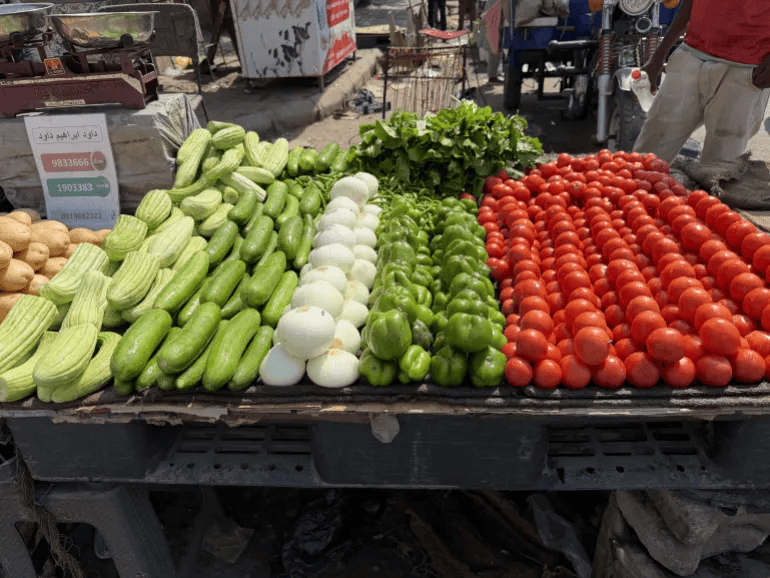
Data from the Central Bureau of Statistics in Sudan reveals another side of the picture.
Annual inflation reached more than 41% in July, after being about 51% in June.
But a decline in the inflation rate does not mean a decline in prices.
The consumer price index rose by about 1.5% between June and July, meaning prices continued to climb, but at a slower annual pace.
This distinction matters to Sudanese families. The figures may point to a "slowdown in inflation," while the citizen goes to the market and finds that his or her needs are still becoming more expensive.
An Economy That Has Lost More Than 40% of Its Size
The war has not struck the currency alone.
The United Nations Development Programme estimates that Sudan lost about $6.4 billion of gross domestic product in 2023 alone, and that the economy contracted by more than 40% during the years of war, while roughly one-third of companies were shut down.
The war has disrupted production, trade and exports, damaged parts of the banking system and reduced state revenues, at a time when individuals and companies have increasingly needed foreign currency.
As foreign currency inflows fell and demand for it rose, obtaining dollars became more costly, pushing the pound down further, which in turn affected the prices of imported goods and even domestic products whose production costs are linked to transport, fuel and imported inputs.
Gold, Smuggling and Economic Warfare
The economic analyst Muhyiddin Mohamed believes the decline of the pound is linked to a set of factors, most notably the war's disruption of productive sectors, along with what he described as "economic warfare," including accusations against the Rapid Support Forces of looting and smuggling resources such as gold and gum arabic.
Mohamed outlines two paths for confronting the crisis: urgent measures and long-term reforms.
In the short term, he calls for increasing domestic food production, supporting sectors capable of driving economic growth, improving tax revenue collection, and adopting clearer policies to channel gold revenues into official channels so as to provide foreign currency.
In the long term, he sees a need for structural reforms that support producers, particularly in agriculture and livestock, along with reforming the gold sector, reducing reliance on unregulated mining, and expanding regulated mining and partnerships with the private sector.
He also calls for reducing agricultural production costs, especially the prices of fertilisers, pesticides and other inputs, reducing dependence on imports of goods such as flour and medicines, and expanding the production of gum arabic and forest products to increase export earnings.
Families Cut Meals and Postpone Treatment
Behind the economic figures, however, lie harsher social transformations.
The economic researcher and relief worker Maryam Ibrahim says the most important effect of the currency's collapse is the erosion of households' purchasing power, as salaries and savings are no longer able to keep pace with prices.
According to her, families have resorted to reducing the number of meals, postponing treatment, taking children out of school, and borrowing money or basic goods.
These pressures come in a country already suffering from extreme levels of poverty and food insecurity.
The World Bank estimates that the rate of extreme poverty rose from 48% in 2023 to 59% in 2025.
Between February and May, about 19.5 million people, or nearly 41% of Sudan's population, faced acute levels of food insecurity, according to the Integrated Food Security Phase Classification assessment.
Among them, more than five million people faced severe, life-threatening food shortages, while 135,000 people were at risk of famine.
War Pursues Civilians in El Obeid
As families struggle with the effects of the economic collapse, the war itself continues to pose direct risks to civilians.
The government of North Kordofan State accused the Rapid Support Forces of carrying out drone attacks on civilian facilities in the city of El Obeid, the state capital.
The authorities said the targeted sites included the sports city and Shaikan University College, considering the targeting of civilian, educational and sports facilities a violation of international humanitarian law.
The authorities did not report any casualties or material damage resulting from these attacks, and the Rapid Support Forces did not immediately respond to the accusations.
Drone attacks are gaining growing importance in the course of the Sudanese war. The United Nations had said that about 1,100 civilians were killed in drone attacks between January and June 2026.
The three Kordofan states, North, West and South Kordofan, have witnessed clashes between the army and the Rapid Support Forces since October 2025, making the region one of the main battlegrounds.
A War That Goes Beyond the Front Lines
Since the war broke out in April 2023, tens of thousands have been killed and about 13 million people have been displaced, according to United Nations and international estimates.
But the real impact of the war extends beyond the lines of confrontation.
When the currency's value collapses, the cost of importing food, medicine and production inputs rises. When agriculture, trade and exports decline, foreign currency dwindles and the local currency comes under further pressure. When prices rise faster than wages, families gradually begin to give up needs that were once basic: meat first, then the number of meals, then treatment, and perhaps children's education.
Thus the war turns from a military confrontation into a crisis that touches every detail of daily life.
Maryam Ibrahim affirms that cash assistance provided by humanitarian organisations can give families room to choose their priorities, whether food, medicine or transport, but its value needs continuous adjustment to keep pace with changing prices.
She also argues that emergency aid must not remain separate from support for livelihoods, agriculture, small enterprises, and the restoration of banking and public services.
"Humanitarian aid alone cannot solve Sudan's economic crisis."
For millions of Sudanese, the crisis is no longer a question about the price of the dollar or the rate of inflation, but a simpler and harsher question: what can a family afford to buy today, and what will it be forced to do without tomorrow if the war continues and the pound falls further?


