

The military confrontations between the Sudanese army and its allied forces on one side and the Rapid Support Forces (RSF) on the other continue, amid growing concern for the safety of civilians and the expanding scope of drone attacks against residential areas and vital facilities.
The Joint Force allied with the Sudanese army announced on Wednesday, 8 Jumada al-Akhirah 1448 AH (18 November 2026 CE), that it had repelled a large-scale attack launched by RSF forces on the Karnoi area in North Darfur State, near the Chadian border.
The Joint Force's spokesperson, Mutawakil Wakil, said the battles resulted in the destruction of 31 combat vehicles and the seizure of 19 others, as well as the killing of the attack's commander and a large number of RSF personnel.
The casualty figures announced by the Joint Force could not be independently verified.
Citing military sources, the Sudan Tribune also reported that the army's air defences shot down a long-range drone over the Sulaiya area in West Darfur State, which, according to those sources, was attempting to provide support to the attacking forces in Karnoi.
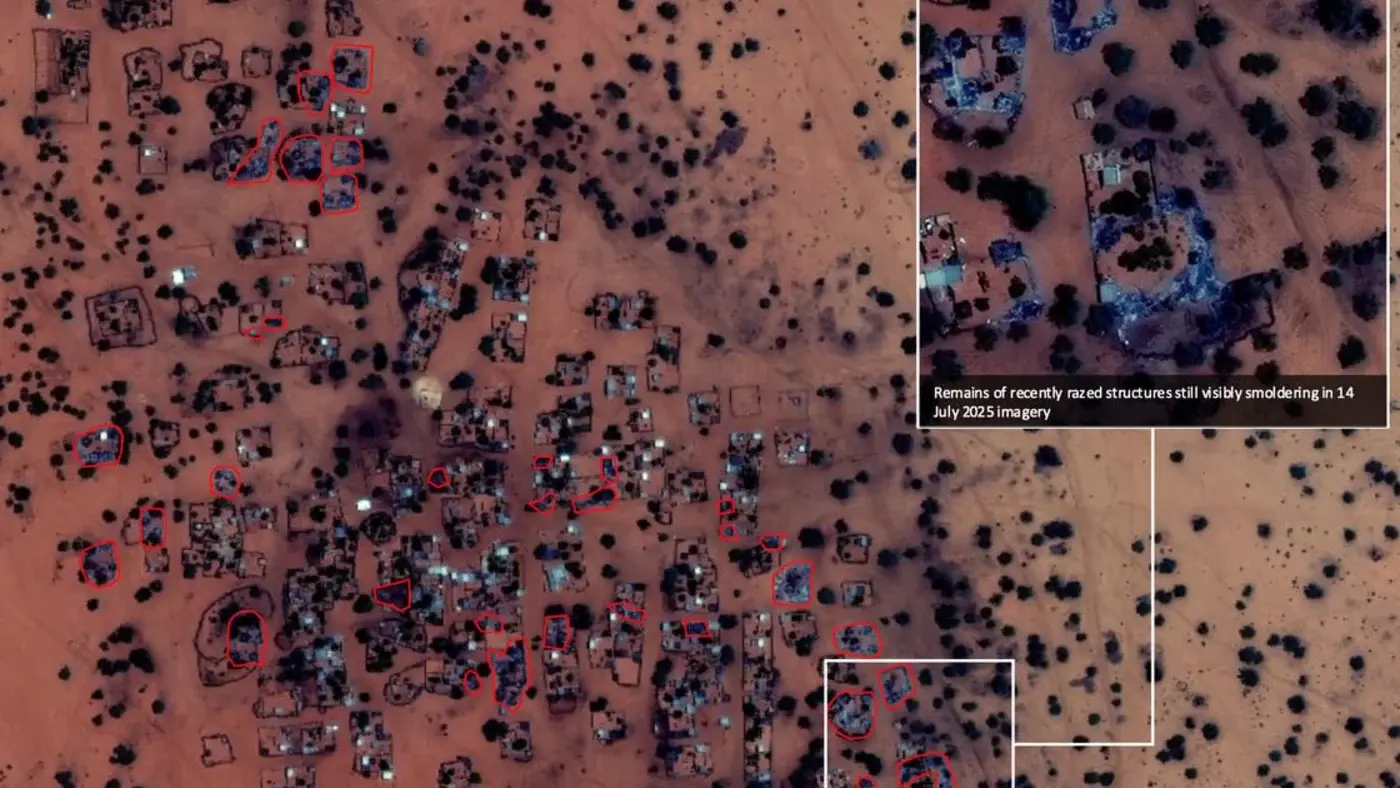
The areas of Karnoi, Umbaro and Al-Tina have witnessed repeated clashes for months, which have driven thousands of civilians to flee to neighbouring Chad.
Rights Investigation Documents the Deaths of 37 Civilians in El Obeid
In a related development, Amnesty International, in a report published on Wednesday, called for an investigation into drone attacks carried out by RSF forces on the city of El Obeid and its surroundings in North Kordofan State, as potential war crimes.
The organisation documented nine attacks that took place between June and August 2026, which resulted in the deaths of 37 civilians and injuries to ten others, and struck residential neighbourhoods, fuel and electricity stations, and civilian vehicles.
Amnesty International's investigation found no evidence of military targets near the sites that were struck at the time of the attacks.
Among the incidents documented by the organisation were the killing of at least five people during a funeral procession on 10 June, and the killing of 13 civilians who were travelling in a vehicle carrying guests to a wedding on 6 July.
The targeting of the main electricity station in El Obeid also caused a power outage in the city and aggravated the water and food crisis.
In its response to the organisation, the RSF denied responsibility for the attacks that resulted in civilian casualties, holding the Sudanese army responsible, and said it was considering forming a committee to investigate incidents in which civilians were killed.
Foreign Military Support and the Continuation of the War
Amnesty International reiterated what it had previously documented regarding the supply of weapons, ammunition and military equipment to the RSF by the United Arab Emirates, including Chinese-made drones, while Abu Dhabi denies providing military support to the RSF.
The organisation called for urgent measures to protect civilians and halt attacks on civilian objects, and noted that it is also investigating drone strikes by the Sudanese army that resulted in civilian casualties.
Drones Change the Nature of the Sudanese War
According to the UN Human Rights Office, drone attacks killed more than 1,630 civilians in Sudan during the first ten months of 2026, out of more than 2,230 civilian deaths documented by the Office during that period.
The escalating use of drones reveals a dangerous shift in the nature of the war, as attacks now threaten populations and essential facilities even in areas far from the direct front lines.
With military operations continuing in Darfur and Kordofan, millions of Sudanese find themselves facing growing risks that extend beyond shelling and displacement to include the collapse of essential services and difficulty accessing food, water and healthcare.


