

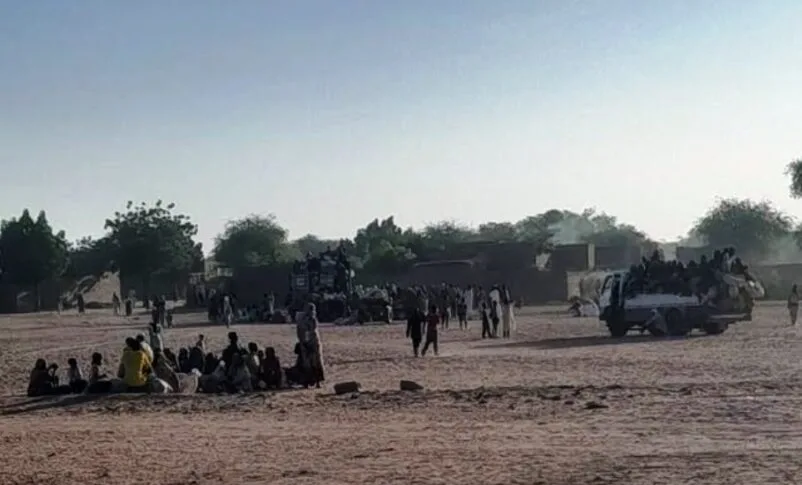
Acute food shortages, a failed agricultural season and continued security disruptions have pushed thousands of civilians to leave the Murshiq locality in South Darfur State and head toward the Tawila area in North Darfur, which already hosts hundreds of thousands of people displaced by the war.
Sudan Tribune reported in a report published on Saturday, 7 November, that new waves of displaced people reached Tawila on 6 November, amid deteriorating humanitarian conditions and shortages of food, water and health services in their original areas.
The newspaper quoted the General Coordination of Displacement and Refugee Camps in Sudan as saying that thousands of residents are being forced to leave every day after losing the ability to meet their basic needs.
An agricultural season without a harvest
The Coordination explained that farmers in Murshiq were unable to harvest their sorghum and millet crops during the current season, which has depleted the food stocks on which most households depend.
The two crops are a basic source of food for the population, so the failure of their harvest threatens the ability of farming communities to survive, especially with rising food prices and market disruption.
The Coordination added that the shortage of drinking water and health services, along with deteriorating security, has left many families unable to continue living in their areas.
These developments follow a season that saw a severe shortage of rainfall in various parts of Sudan, which caused damage to agriculture and livestock.
Tawila hosts an estimated 800,000 displaced people
The Tawila area lies about 60 kilometres west of El Fasher, the capital of North Darfur State, and is controlled by a faction of the Sudan Liberation Movement led by Abdul Wahid Mohamed Nour.
According to UN data cited by Sudan Tribune, Tawila hosts about 800,000 displaced people spread across eight camps.
The area has received repeated waves of civilians fleeing fighting in Darfur and Kordofan, increasing pressure on water facilities, health care, shelter and food supplies.
The arrival of more displaced people raises concerns that the capacity of the camps and host communities to respond may be exceeded, given limited humanitarian resources.
Calls for relief within the areas of origin
The General Coordination of Displacement and Refugee Camps called on humanitarian organisations to intervene inside Murshiq locality itself, rather than waiting for families to reach Tawila or other areas.
This demand aims to help residents who remain in their villages and to reduce their need to flee in search of food, water and basic services.
The crisis confirms that the drivers of displacement in Darfur are no longer limited to direct military attacks, but also include the collapse of agricultural production, the loss of livelihoods and the deterioration of services.
With the war that broke out between the Sudanese army and the Rapid Support Forces in April 2023 continuing, residents of Darfur face overlapping risks of violence, hunger and repeated displacement.
The new wave of displacement shows that reaching a safer area does not mean the end of suffering, as the displaced may find themselves in overcrowded camps lacking sufficient food, water and shelter.


