

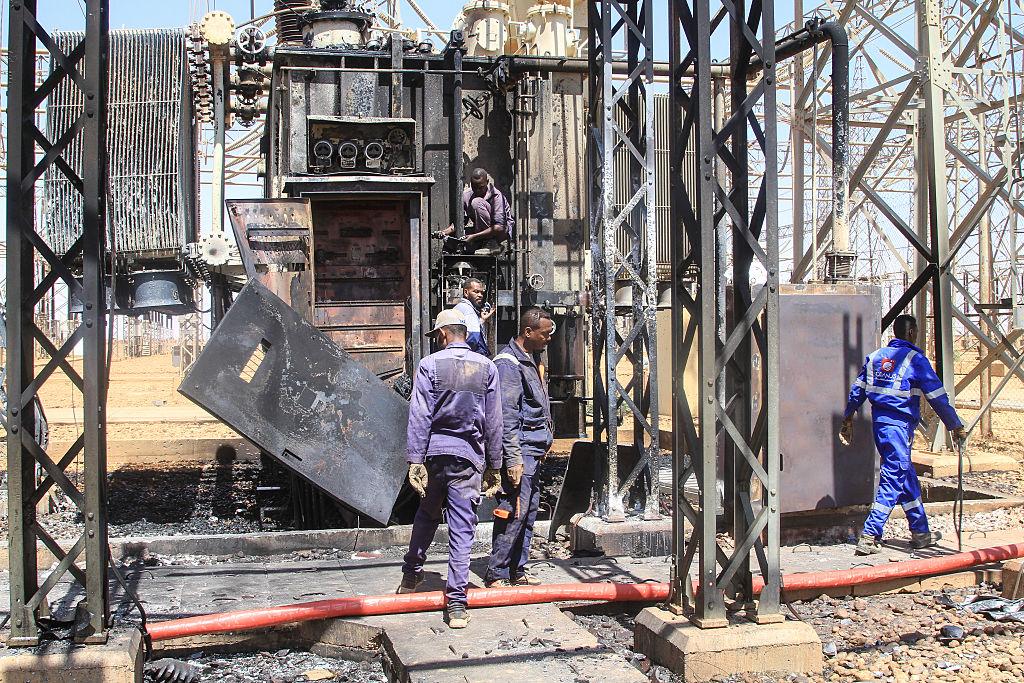
Drones struck two electricity substations in the cities of Halfa Al-Jadida and Aroma in Kassala State in eastern Sudan at dawn today, Monday, 2 November 2026, causing fires and cutting power to wide areas of the state, in a new escalation of attacks on energy facilities and civilian infrastructure.
Anadolu Agency quoted eyewitnesses as saying that drones bombed the Halfa Al-Jadida substation, causing electricity to be cut off in the city, while other witnesses confirmed that the Aroma station was subjected to a similar attack. Local sources said the two attacks caused widespread outages across parts of Kassala State.
Videos circulated by activists on social media showed fire engulfing both stations, and civil defence teams attempting to extinguish the blaze at the Aroma station, according to the agency. No official statement detailing the extent of the damage and losses from the two attacks had been issued at the time the Anadolu report was published.
In this context, the Ultra Sudan website reported, citing local sources, that the attack took place in two stages: the first targeted the Aroma station, followed by a second strike on the Halfa Al-Jadida station. The sources also spoke of fuel depots in Kassala being targeted, with no human casualties recorded according to eyewitness accounts.
On Monday morning, the attacks extended to the Northern State, where local sources reported that the Merowe–Al-Ghazali power station near the Merowe Dam was targeted, causing power to be cut to large parts of the state.
15 stations in one week, and attacks spread to new states
According to a tally published by Anadolu Agency, the number of electricity stations hit by drone attacks in one week rose to 15, in the states of Khartoum, Al-Jazirah, Sennar, Red Sea, Gedaref, Kassala and River Nile.
In a broader tally, Sudan Tribune reported that more than 17 electricity distribution stations were attacked or damaged over the same period, including in the Northern State, White Nile and South Kordofan, causing widespread outages and affecting service facilities in multiple cities and areas.
On Sunday, drones had targeted the electricity stations in Abu Hamad in River Nile State and Ad-Debba in the Northern State, before the attacks spread early on Monday to Kassala and Merowe.
Transmission and distribution stations are vital facilities for the continuity of energy supplies, and the consequences of their disruption extend beyond homes to healthcare facilities, drinking water pumping stations, and economic and agricultural activity.
The Aroma station is of particular importance within the electricity network of eastern Sudan, as it supplies the city and surrounding areas, while Halfa Al-Jadida lies within a wide agricultural area whose service facilities and activities depend on energy supplies.
Accusations against the Rapid Support Forces
Sudanese media outlets, including Sudan Tribune and Ultra Sudan, cited local sources accusing the Rapid Support Forces of carrying out the recent attacks using drones.
Sudanese authorities have also previously accused the Rapid Support Forces of targeting civilian facilities and electricity stations in a number of states, in the context of the war between the two sides that has continued since April 2023.
The perpetrator of the recent attacks on the Aroma and Halfa Al-Jadida stations could not be independently verified, and the Rapid Support Forces have not announced responsibility for the two attacks.
In a related development, the Sudanese government announced on Sunday that it had filed complaints with the United Nations Security Council and the African Peace and Security Council against Ethiopia, accusing it of involvement in attacks that targeted civilian facilities and electricity stations inside Sudan. No immediate Ethiopian response to the accusations was issued, according to Anadolu Agency.
The successive attacks on electricity networks raise concerns about a worsening humanitarian crisis in a country that has suffered a broad collapse of essential services and the displacement of millions since the outbreak of war.
International humanitarian law prohibits the deliberate targeting of civilian objects, including electricity facilities that are not military objectives, and requires respect for the principles of distinction, proportionality and precautions in attack where a facility is also used for military purposes.
With attacks spreading to multiple states within a few days, large areas of Sudan face the continued risk of power outages and the disruption of vital facilities, at a time when the population's need for health services, water and essential supplies is growing.


