


While some schools in the Sudanese capital, Khartoum, have begun receiving students again after a relative improvement in the security situation, the crisis of displacement is worsening in other parts of the country as fighting and floods continue. The scene reflects the sharp contrast between efforts to restore normal life and the continuing repercussions of the war, which has entered its fourth year.
The International Organization for Migration (IOM), a United Nations agency, said that the recent escalation in Sudan has forced some 200,000 additional people to leave their homes, at a time when the humanitarian response is under increasing pressure from fighting, damage to infrastructure and seasonal floods.
The organization added that Sudan faces "mounting pressures related to displacement and the humanitarian situation," noting that disruption to global supply chains, particularly through the Red Sea and the Strait of Hormuz, is making it more difficult to deliver aid to those affected.
Some 11,000 Displaced in Three Days in North Kordofan
In North Kordofan State, the IOM reported that nearly 11,000 people were forced to leave the villages of Umm Sumeima and Abu Haraz in Shiekan locality between 16 and 18 August 2026, due to the deterioration of the security situation.
The displaced families moved to other areas within Shiekan locality, but the organization warned that conditions there remain tense and unstable.
This follows only days after the organization announced the displacement of about 4,250 people from three other villages in Shiekan on 14 and 15 August, as a result of clashes and the deterioration of the security situation.
According to the organization, displacement in Shiekan locality rose by 25 percent over the past eight months, while the number of new displaced persons in the wider Kordofan region has exceeded 200,000 since late 2025.
Since October 2025, the states of North, West and South Kordofan have witnessed escalating battles between the Sudanese Army and the Rapid Support Forces, an extension of the war that broke out between the two sides in April 2023.
Drone strikes that targeted the main electricity transformer in El Obeid, the capital of North Kordofan, also caused a prolonged power outage, affecting the operation of water pumping stations, health facilities and telecommunications networks.
Floods Compound the Crisis
Sudanese suffering is not limited to the war, as the military escalation has coincided with heavy rains and seasonal floods.
The IOM said that heavy rains in the Tawila area of North Darfur State destroyed or damaged about 1,350 homes within a week, leading to the displacement of more than 1,000 families.
The Director General of the IOM, Amy Pope, said that Sudan is experiencing one of the largest displacement crises in the world, noting that the combination of armed conflict, damaged infrastructure and floods is pushing thousands of families beyond their capacity to endure.
United Nations and international organization estimates indicate that the Sudanese war, ongoing since April 2023, has killed tens of thousands of people and driven some 13 million people to flee inside the country or seek refuge in neighboring countries.
In Khartoum, Children Return to School
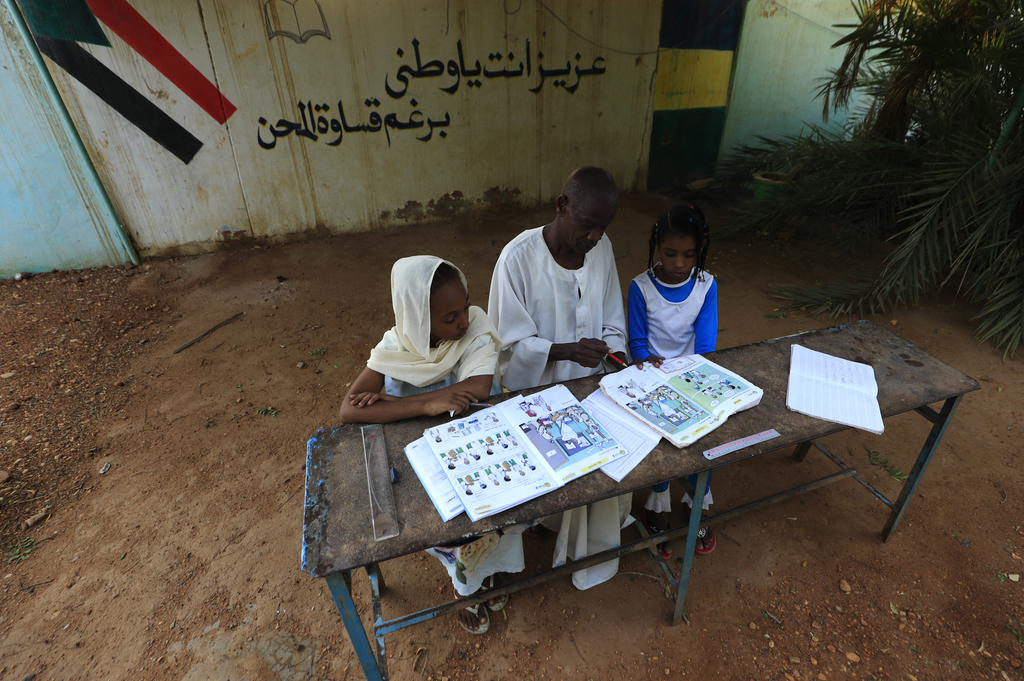
In contrast to the new waves of displacement in Kordofan and Darfur, different signs have gradually emerged in some areas of Khartoum, where children have begun returning to school after the security situation improved in parts of the capital and some displaced families returned to their homes.
However, the return to classrooms does not mean that the war's effects on the education sector have ended.
Hundreds of schools in Khartoum were destroyed or severely damaged during the fighting, while schools that remain standing operate amid shortages of teachers, books and educational materials, and overcrowded classrooms.
The principal of one school, Itimad al-Qaizouli, said the number of students is still far lower than before the war, as many children remain displaced within Sudan or refugees in neighboring countries.
She added that schools are trying to support students psychologically and educationally despite what they have endured during the years of war.
Eight Million Children Out of School
The education crisis is among the greatest challenges facing Sudan in the phase of restoring stability, with estimates indicating that some eight million children remain out of school.
A large number of educational facilities have also been destroyed, while other schools have been turned into shelters for displaced people, and a large number remain closed.
Students who have returned to their studies face educational gaps that have accumulated over years, in addition to the psychological effects of war and displacement.
Teacher Mohamed Elias said that families and schools are trying to make up for the lost school years in a short time, despite limited resources and the widespread damage to the educational infrastructure.
He explained that students need more than lessons alone; they need efforts that help them regain their desire to learn and their ability to concentrate, as well as psychosocial support.
For families returning to Khartoum, the cost of education is an additional burden, as they must provide transportation, school uniforms, books and other needs, at a time when they are still suffering from the economic losses left by years of displacement.
Manal Ali, a mother who returned with her family to Khartoum after moving between several areas over the past two years, said they decided to return in order to give their children a better chance for the future despite the heavy financial pressures.
Thus, the Sudanese scene today appears to be governed by two contradictory paths: tens of thousands are gradually returning to their homes and schools in areas where the situation has relatively stabilized, while other families are being pushed into a new journey of displacement in Kordofan and Darfur.
Between these two paths, rebuilding schools, hospitals, water and electricity networks, and creating conditions for the return of millions of displaced people will remain among the greatest challenges facing Sudan, even once the fighting eventually subsides.


