

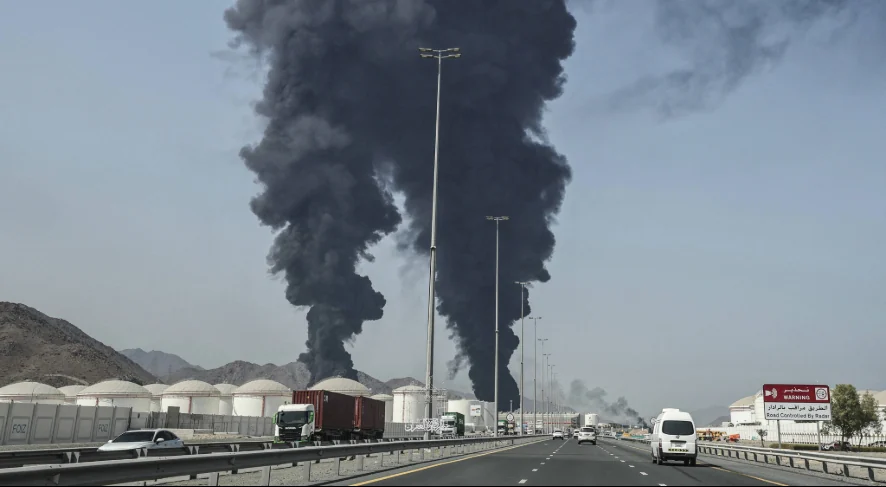
Saudi Arabia tops defence budgets at $64 billion, while the Israeli entity raises its allocations to $54.1 billion, and Gulf states face a difficult equation between rebuilding their air defences and declining energy revenues. A military-economic study reveals that the real increase in spending did not exceed 1.2%, despite a nominal rise of 7.1%, and warns that the war could push budgets to levels far higher than planned at the start of the year.
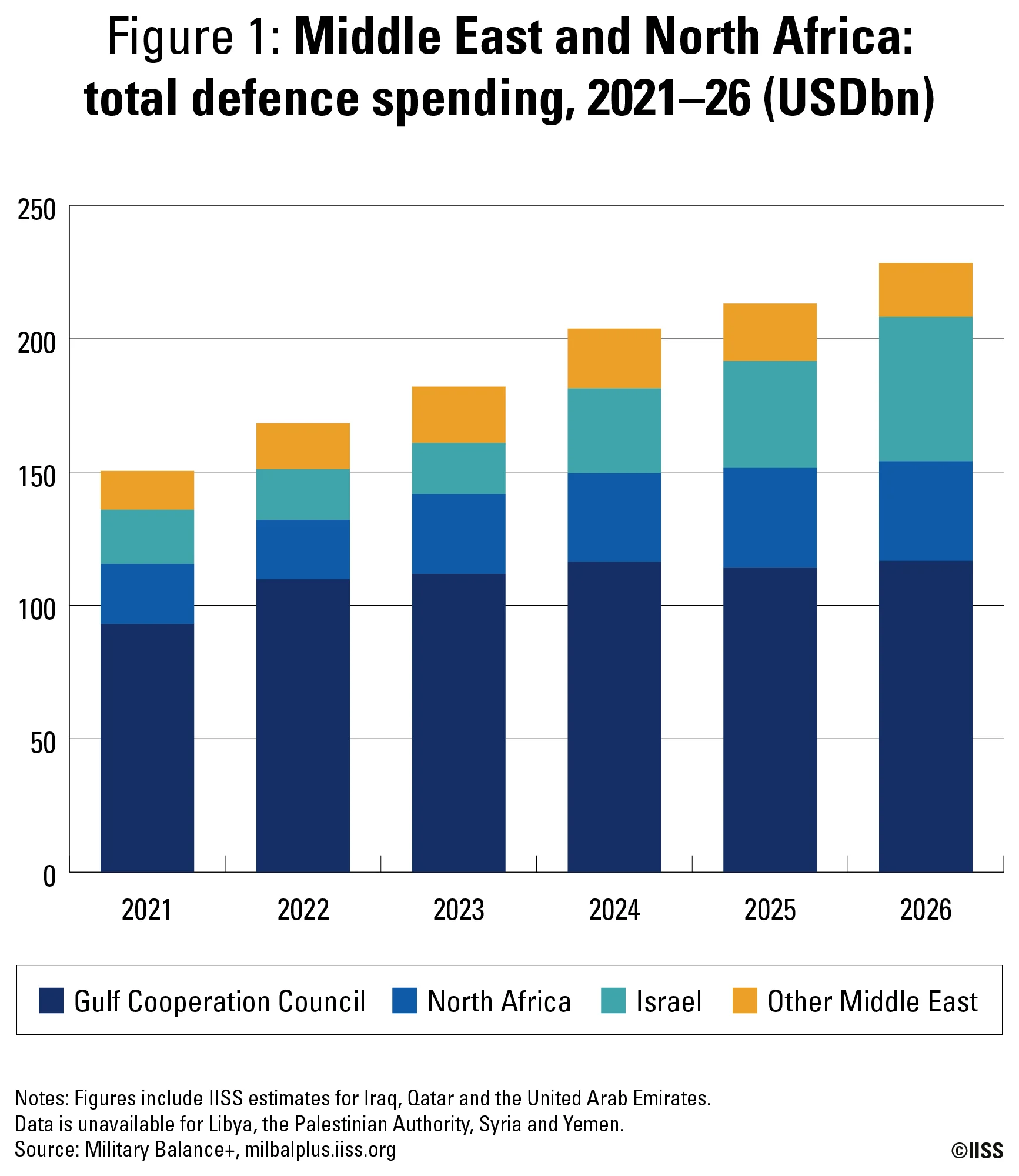
Defence budgets identified across the Middle East and North Africa reached approximately $228 billion in 2026, a nominal increase of 7.1% compared with 2025. At the same time, the US war on Iran and continuing regional tensions are expected to push a number of states beyond the military allocations they adopted when preparing their annual budgets.
A recent study by the International Institute for Strategic Studies (IISS) found that the recorded increase does not reflect the full financial impact of the ongoing war, because most 2026 budgets were drawn up in late 2025, before the military confrontation in the region widened.
The analysis indicates that Gulf governments in particular may need to increase spending to replenish air and missile defence stocks, compensate for consumed equipment and munitions, and strengthen the protection of vital facilities, despite the financial pressures they face as a result of disruption to energy exports and shipping through the Strait of Hormuz.
The Institute published the study on 26 October 2026 under the title "Ongoing conflicts and tensions could push defence spending in the Middle East and North Africa beyond the cautious 2026 budgets." It was prepared by researcher Will Harvey Paul, a specialist in defence economics.
The study's significance lies in the fact that it does not stop at comparing the size of military budgets, but examines states' capacity to finance new increases, and the differences between the economies of the Gulf, the Maghreb countries, Israel and Iran.
$228 billion, but the real increase is limited
Although defence budgets recorded in the region rose by a nominal 7.1% in 2026, the study finds that the real increase, after accounting for inflation, did not exceed 1.2%.
This gap reflects the pressures governments face, as rising costs of equipment, munitions and military services reduce the purchasing power of budgets even when their nominal value increases.
Regional defence spending saw a real increase of 10% in 2024, before growth slowed in the following two years as governments sought to balance modernising their armed forces with maintaining financial stability.
The study notes that Middle Eastern and North African states still allocate a high share of their economic resources to defence compared with most regions of the world.
Defence budgets recorded for 2026 amounted to about 4.6% of the region's gross domestic product, a proportion that reflects the large weight of the military establishment in public budgets.
However, the researcher warns that the $228 billion figure does not necessarily represent all actual military expenditure.
Some states do not publish full details of their defence budgets, while other military activities are funded through institutions, agencies or revenue sources that do not appear clearly in official allocations.
The figure therefore represents the spending that could be tracked and analysed, rather than a final inventory of all resources directed to military purposes during the year.
Saudi Arabia: the largest defence budget despite a policy of spending restraint
Saudi Arabia tops the Middle East and North Africa in declared defence budgets recorded by the study, having allocated 240 billion riyals, equivalent to about $64 billion, to defence in its 2026 budget.
This figure approaches the revised 2025 budget of 239 billion riyals, or about $63.7 billion.
However, it is clearly lower than the original 2025 budget, which stood at 272 billion riyals, or about $72.5 billion, before it was later amended.
This difference suggests that Riyadh was moving towards some restraint in military spending before the current war broke out, after years that saw large investments in modernising the armed forces and strengthening defence capabilities.
Military developments in the Gulf, however, changed the equation.
Escalation with Iran increased the need to protect vital facilities, ports, energy networks and military sites, alongside replenishing stocks of interceptor missiles and defensive munitions.
At the same time, Saudi Arabia benefited from higher energy prices and from its ability to use alternative export routes that do not rely entirely on the Strait of Hormuz.
According to the study, Saudi oil revenues rose by 22% in the second quarter of 2026 compared with the same period of 2025.
Improved revenues, however, do not mean the absence of financial pressure.
Government estimates raised the expected 2026 budget deficit from 3.3% to 4.9% of gross domestic product, as spending is expected to grow faster than revenues.
Even so, the expected deficit remains below its 2025 level of 5.8% of GDP.
The researcher considers it likely that Saudi Arabia has raised its actual military spending during the war beyond the original allocations, but he expects the government to seek to restrain expenditure again in 2027, as part of efforts to maintain fiscal balance.
Thus, the Saudi challenge concerns not only having the resources needed for armament, but also determining how large an increase can be borne without harming other economic and financial objectives.
Gulf states: war compels spending while revenues decline
The study reveals a financial paradox facing the members of the Gulf Cooperation Council.
While these states need to strengthen their defence capabilities, disruption to shipping and attacks on energy facilities have reduced the revenues of some economies that depend on oil and gas exports.
Gulf defence allocations had already seen a real decline of 0.4% in the 2026 budgets compared with 2025, before accounting for the effect of the current war.
This reflects governments' attempts to curb military increases that had continued for years, after oil prices fell in the period before the budgets were prepared.
The war, however, increased military requirements, particularly in air and missile defence.
States that were targeted by attacks need to rebuild their stocks of interceptor missiles, repair damaged systems, and strengthen their ability to confront new threats, including drones, ballistic missiles and cruise missiles.
The study points to an acceleration in US approvals of foreign military sales to Washington's partners in the Gulf since the war began, an indicator of the likelihood that defence procurement will rise in the coming period.
However, the capacity to finance these purchases differs considerably from one state to another.
States with large sovereign wealth funds or alternative energy export routes may be better able to absorb the increases, while states most dependent on the Strait of Hormuz face greater pressure on their budgets.
Qatar: declining gas exports complicate financing of defence needs
Qatar offers one of the clearest examples of the economic challenges imposed by the war.
According to the study's data, Qatari liquefied natural gas exports fell by 89% in the period from March to August 2026 compared with the same period of the previous year.
This decline has a major impact on an economy that depends heavily on energy exports, which accounted for roughly three quarters of government revenues.
The study notes that the Qatari budget deficit more than doubled during the second quarter of 2026.
Under these conditions, any new increase in military spending could add to pressure on public finances.
A complex equation emerges: the state needs to spend on protecting its facilities and export routes, while the disruption of those facilities and routes reduces the revenues that finance such protection.
This does not mean Qatar is unable to finance its military needs, but that increased expenditure alongside falling revenues could widen the deficit or require the use of other financial resources.
The researcher believes this problem is not confined to Qatar, although it is most visible there, but extends to other Gulf economies whose exports or vital facilities were damaged by the war.
Israel: the budget jumps to $54.1 billion
By contrast, the study reveals the continued sharp rise in Israel's defence budget since the war in Gaza began in October 2023.
Israel's military allocations for 2026 rose from 116 billion shekels, equivalent to about $38.4 billion in the initial budget, to 163 billion shekels, or about $54.1 billion, after additional funding was approved during the year.
The amended budget represents a real increase of 16% compared with the 2025 budget.
According to the Institute, this rise reflects the continuation of Israeli military operations in the Gaza Strip, the West Bank and southern Lebanon, alongside needs arising from regional confrontations.
The study notes that Israel's military budget for 2026 now exceeds twice its 2023 level.
Israel's share of total recorded regional military spending also rose to about 24%, compared with about 9% ten years earlier.
This shift means that Israel now accounts for nearly a quarter of the defence budgets recorded in the Middle East and North Africa, according to the Institute's methodology.
In addition to domestic allocations, Israel continues to receive annual US military assistance of $3.3 billion for the purchase of defence equipment, plus $500 million earmarked for missile defence.
These aid amounts should not be automatically added to Israel's total budget, given differences in how funding and procurement are accounted for and the possibility of some overlap between items.
Israeli armament weighs on the economy and civilian services
The study does not view the Israeli increase solely as a military matter, but links it to growing economic challenges.
Repeated defence increases have placed pressure on resources allocated to civilian sectors, amid the need to finance the war, rebuild military stockpiles and replace consumed equipment.
According to estimates the Institute cited from the International Monetary Fund, Israel's budget deficit is expected to reach 5.8% of GDP in 2026.
The researcher believes that sustaining this high level of military spending will become more difficult, both financially and politically, over time.
These concerns align with a study issued by the Israel Democracy Institute in May 2026, which warned that the continuing rise in defence spending reduces the government's ability to finance public services, invest in economic growth and maintain financial stability at the same time.
The Israeli study states that the expected defence burden approaches 8% of GDP, according to a broader definition of spending than the one used in some military budget comparisons.
Accordingly, the continuation of wars and tensions not only expands Israel's military arsenal, but also imposes more complex economic and political choices on the distribution of public resources.
Iran: a small declared budget and actual spending that is hard to estimate
The comparison with Iran reveals one of the largest problems in measuring military spending in the region.
Tehran approved an official defence budget for 2026 of about 7.71 quadrillion Iranian rials, covering the Ministry of Defence, the Armed Forces Logistics and the Army and Revolutionary Guard Corps.
These allocations equal about $4.4 billion at the official exchange rate used in the study, but fall to about $2.9 billion when calculated at market rates.
Compared with the declared budgets of Saudi Arabia and Israel, the Iranian figure appears much smaller.
However, the Institute warns that this comparison does not reflect the true scale of Iranian military spending.
The Armed Forces and the Revolutionary Guard receive additional resources from oil revenues and from economic and commercial activities, not all of which appear in the official budget.
For this reason, estimating Iranian military capability from the government allocation figure alone may lead to misleading conclusions.
Moreover, the declared budget was approved before the current war broke out, which makes it likely that actual military expenditure has significantly exceeded it.
Iran's capacity to increase spending, however, faces severe economic constraints.
Inflation has worsened, the rial has lost value and unemployment has risen, while US sanctions continue and the blockade of oil exports has tightened.
This means Tehran faces a double pressure: rising war requirements alongside a shrinking economic capacity to finance them.
The study does not provide a reliable final figure for total actual Iranian spending in 2026.
Algeria and Morocco: an arms race shaped by tensions and economics
Beyond the Gulf, Iran and what is called the "Israeli entity", the study points to the continuing influence of tensions between Algeria and Morocco on military spending in North Africa.
Algeria saw large increases in its defence budget in previous years, raising it to 3.35 trillion Algerian dinars, equivalent to about $25.5 billion, in 2025.
These allocations represented about 9% of gross domestic product, one of the highest defence burden ratios globally according to the study.
However, Algeria's 2026 budget fell in nominal terms to 3.21 trillion dinars, or about $24.2 billion.
The researcher links this decline to financial pressures, given an expected budget deficit of about 9.1% of GDP.
Rising oil prices may ease some of these pressures in the near term, but they do not remove the need to restrain public spending.
By contrast, Morocco recorded a new increase in defence allocations, which reached 73.8 billion dirhams, equivalent to about $7.96 billion, its highest level among the budgets covered by the study.
The researcher attributes Morocco's ability to increase spending to the improvement of its economic situation following structural reforms.
The comparison shows that strategic tensions between the two countries continue to shape armament priorities, but differing economic conditions lead to diverging budget trajectories.
Algeria is moving to reduce its allocations after a period of large increases, while Morocco continues to raise its defence budget.
These figures alone do not allow the military balance between the two countries to be determined, as that requires examining the quality of equipment, readiness, training, industrial capacities and the nature of military doctrines.
Beyond the numbers: why budgets differ from actual spending
The study stresses that analysing military economics in the Middle East and North Africa faces the problem of limited transparency and differing methods of preparing budgets.
Some states publish detailed budgets for their defence ministries, while others provide aggregate figures without disclosing how spending is distributed among salaries, procurement, operations, maintenance and running costs.
Military activities may also be funded through agencies or institutions outside the usual defence budgets.
The comparison becomes even more difficult when local allocations are converted into dollars, especially in countries that experience large fluctuations in exchange rates.
This problem is clearly evident in the case of Iran, where the use of different exchange rates produces widely divergent estimates of the dollar value of the announced budget.
For this reason, comparing military spending between countries requires taking into account the nature of the data, rather than looking at dollar figures alone.
It is also necessary to distinguish between three concepts: the original budget that the government approves before the start of the year, the amended budget that includes increases approved during the year, and actual spending, which only becomes clear once accounts are closed and the necessary data is available.
Accordingly, the figure of 228 billion dollars represents an estimate of the defence allocations that could be recorded, not a final calculation of actual spending for all the countries of the region.
The war reorders arms priorities
The study raises a question about the areas toward which new military increases may be directed.
With the continuation of missile and air threats, Gulf governments are likely to give priority to strengthening air and missile defence and replenishing stocks consumed during the war.
This may include the purchase of interceptor missiles, early warning and detection systems, and other equipment to protect vital facilities.
The disruption of navigation in the Strait of Hormuz has also reaffirmed the importance of maritime security, especially for countries that depend on exporting oil and gas through sea lanes.
However, the study does not provide a specific list of purchases that each country has decided to make, nor does it determine the final expected increase in the region's budget.
Rather, its projections are based on the expansion of military needs, the accelerated US approvals of defence sales, and the possibility that governments will reconsider the budgets they approved before the war.
The ability of each country to finance these increases remains linked to its financial situation, the size of its reserves, and its capacity to maintain energy and trade revenues.
Military spending and public services: an increasingly difficult equation
Among the most important findings that can be drawn from the study is that the arms race does not take place in isolation from economic and social conditions.
Countries that raise their defence allocations simultaneously face needs in health, education, infrastructure, energy and housing.
Increasing the defence budget does not necessarily mean reducing spending on these sectors in all cases, but it may narrow the fiscal space available to governments, especially when it coincides with deficits, rising public debt and declining revenues.
These trade-offs become more acute in countries facing armed conflicts or economic turmoil.
Moreover, a rise in military procurement does not automatically guarantee an improvement in defensive capability if it is not accompanied by systems of operation, maintenance, training and planning that allow equipment to be used effectively.
For this reason, the assessment of military spending should not rely on the volume of funds allocated alone, but on what these funds achieve in terms of real capabilities, and on their impact on financial and economic stability.
For the Middle East and North Africa, this dilemma appears especially significant given that wars and military tensions coincide with wide-ranging development and humanitarian needs.
Will the region exceed 228 billion dollars by year-end?
The International Institute for Strategic Studies considers it likely that actual defence expenditure during 2026 will exceed the initial budgets adopted by many countries, especially in the Gulf.
This estimate is based on three main factors: the expanding scope of the war, the depletion of military stocks, and the accelerating demand for American defence equipment.
However, the report warns that financial conditions will place uneven limits on governments' ability to increase spending.
Countries that benefited from higher energy revenues may have a wider margin for manoeuvre, while countries affected by disrupted exports may find it more difficult to finance new purchases.
At the same time, "Israel" still faces mounting pressure as a result of its rising defence budget, while Iran suffers economic constraints that make estimating the size of its actual spending more complex.
In North Africa, security considerations and regional competition continue to influence budgets, with Algeria and Morocco differing in their ability to sustain increases.
Therefore, the study does not provide a specific numerical forecast for the amount military budgets may reach by the end of the year.
What is certain is that the allocations recorded have reached 228 billion dollars, while the extent to which this level will be exceeded remains tied to new financial decisions and to what actual data reveals later.
Conclusion: arms spending is accelerating, and the capacity to finance it varies
The study by the International Institute for Strategic Studies reveals an important shift in the defence economics of the Middle East and North Africa.
The region, which allocated roughly 228 billion dollars to defence during 2026, now faces the prospect of additional spending imposed by the war on Iran, the need to rebuild air and missile capabilities, and the continuation of Israeli military operations and tensions in North Africa.
However, the picture does not reflect a uniform increase in spending, but wide differences between countries.
Saudi Arabia has the largest declared defence budget in the region, but it seeks to contain its fiscal deficit. "Israel" has sharply raised its military allocations since the Gaza war, while facing growing constraints on civilian spending.
In contrast, Iran struggles to estimate the true size of its military spending, alongside economic pressures that hinder increased funding. Qatar faces an exceptional decline in gas exports, while Algeria and Morocco are taking different paths in allocating defence resources.
These differences indicate that the future of armament in the region will be determined not only by the scale of military threats, but also by governments' ability to finance their responses to them.
The most prominent result the study puts forward is that the war may push the region toward military spending that exceeds its original budgets, at a time when the economic repercussions of the war make financing this spending more difficult.
Between the need to renew arsenals, protect vital facilities and maintain financial stability, the countries of the Middle East and North Africa face an increasingly complex strategic equation: how to strengthen their military capabilities without the defence spending itself becoming an additional source of pressure on their economies?
Primary source: International Institute for Strategic Studies (IISS), Will Harvey Paul, 26 October 2026.
Supporting sources: Israel Democracy Institute, May 2026; Knesset Finance and Security Committee, March 2026; Stockholm International Peace Research Institute (SIPRI), Trends in World Military Expenditure 2025.


