


Wasl | Strait of Hormuz: Its Importance and Impact
The Strait of Hormuz, which lies between the Sultanate of Oman and Iran, connects the Arabian Gulf with the Gulf of Oman and the Arabian Sea. Its depth and width can accommodate the largest crude oil tankers in the world, making it one of the most important waterways for oil transport. Enormous quantities of oil flow through the strait, and there are few alternative routes should it be closed.
The average daily flow of crude oil and petroleum products through the Strait of Hormuz in 2026 reached around 19.8 million barrels per day, equivalent to roughly 20% of global consumption of petroleum liquids.
The Strait of Hormuz is about 167 kilometres long, its width ranges between approximately 33 and 95 kilometres, and its depth reaches between 60 and 100 metres.
The Strait of Hormuz waterways are vital channels along the broad global shipping routes and are of critical importance to global energy security. Even a temporary interruption of oil flow through these channels could lead to major supply delays and higher shipping costs, which could raise global energy prices.
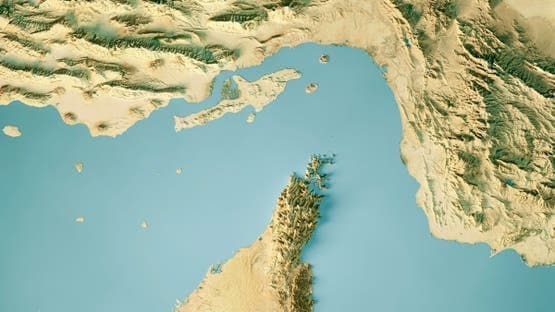
Strait of Hormuz
Also read: Why was the Strait of Hormuz named so? And who was Hormuz?.
While most of these waterways can be bypassed using alternative routes, which in many cases significantly extends transit times, some have no practical alternatives. Most shipments transiting the Strait of Hormuz have no exit route, although some pipelines are able to bypass it.
Based on vessel tracking data published by Vortexa, Saudi Arabia is the largest exporter of crude oil and condensates through the Strait of Hormuz. In 2024, the kingdom's crude oil and condensate exports accounted for 38% of total crude oil flows through the Strait of Hormuz (5.5 million barrels per day).
Saudi Arabia and the United Arab Emirates have alternative infrastructure that allows them to bypass the Strait of Hormuz, which may mitigate any disruption to shipping. These pipelines do not usually operate at full capacity, and it is estimated that around 2.6 million barrels per day of Saudi and Emirati pipeline capacity could be available to bypass the Strait of Hormuz in the event of a supply interruption. Saudi Aramco operates the East-West Pipeline, which has a capacity of 5 million barrels per day and runs from the Abqaiq oil processing facility near the Arabian Gulf to the Yanbu commercial port on the Red Sea.
Also read: What are naval mines and what does Iran possess?.
In mid-March 2026, the Saudi Ministry of Defense confirmed that it had foiled attempted drone attacks by Iran targeting energy facilities in the Eastern Province, while operations continued at Abqaiq as a main centre for processing crude oil and pumping it to the western ports.
Aramco temporarily raised the pipeline's capacity to 7 million barrels per day in 2019 when it converted some natural gas liquids pipelines to receive crude oil. In 2024, Saudi Arabia pumped larger quantities of crude oil through the East-West Pipeline to avoid shipping disruptions around the Bab al-Mandab strait.
The United Arab Emirates also operates a pipeline that bypasses the Strait of Hormuz. This pipeline, which has a capacity of 1.8 million barrels per day, connects onshore oil fields to the Fujairah export terminal on the Gulf of Oman. In 2024, the volume of crude oil and condensates from the United Arab Emirates transiting the Strait of Hormuz decreased by 0.4 million barrels per day compared with 2022, as a result of refinery upgrades that allowed greater quantities of heavy crude to be processed domestically. These upgrades also enabled the UAE to increase its exports of light crude, which led to greater use of the pipeline leading to the Fujairah export terminal. This increased use of the pipeline in daily operations reduced the capacity available to reroute additional volumes around the Strait of Hormuz.
Iran has imposed restrictions on transit through the Strait of Hormuz since 2 March 2026, in response to the American and Israeli military strikes. This has led to an almost complete halt in commercial shipping and oil tanker movement. Iran's restrictions on transit through the Strait of Hormuz caused a very sharp rise in fuel prices in the United States and several European and Asian countries. Iran allows vessels from several countries to pass, including Russia, China and six other countries. Iran imposes strict conditions requiring prior coordination with the competent authorities and the submission of complete information about the crew and cargo. It prevents the passage of vessels linked to the United States, Israel, or any parties that Tehran considers to be "participating in the war" against it.
Data reported by the American economic news agency Bloomberg yesterday, Sunday, indicated that the closure of the Strait of Hormuz has caused a major shock to energy markets, reducing global oil flows by around 11 million barrels per day. This disruption has created a fuel supply gap of nearly 9 million barrels per day, exceeding the total consumption of several European countries.
Since 28 February 2026, the United States and Israel have been conducting a broad military operation against Iran, which resulted in the assassination of Supreme Leader Ali Khamenei and dozens of commanders, with missile exchanges continuing.


