


"Stones on the Chessboard" is a book that is read neither as an ordinary political work nor merely as an account of a conspiracy theory. It presents a broad vision of modern history as an arena of conflict directed by networks of influence, financial, political and intellectual forces, while states, peoples and institutions become "stones" moving across a board far larger than their capacity to see.
The book's main points
- A controversial book: "Stones on the Chessboard" by William Guy Carr, published in 1955, is a key reference in the literature of global conspiracy theory, and it offers an explanation of major historical events as the result of organised planning.
- Hidden control: The book proposes the existence of secret organisations that seek to control the world by directing wars and revolutions, and it compares historical events to a chess game in which "grandmasters" manipulate peoples.
- Wide debate: The book has sparked discussion over its accusations against particular groups, such as Jewish families and the Illuminati, of standing behind these schemes, which places it among texts that have drawn accusations of antisemitism.
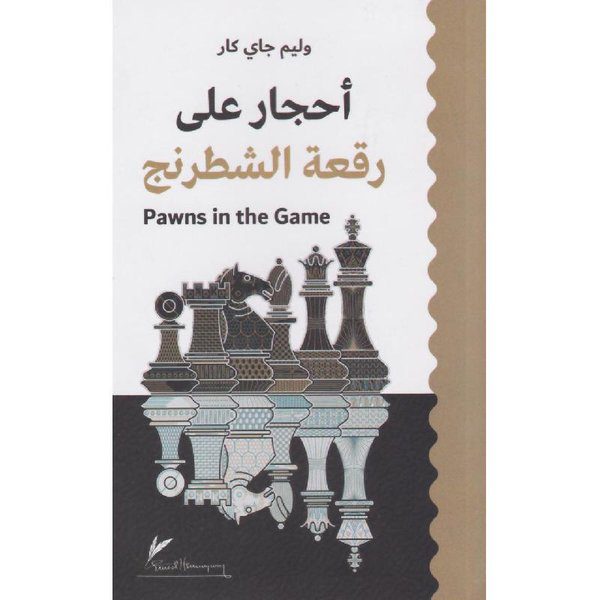
"Stones on the Chessboard", first published in 1955, is among the most influential and controversial works in the field of global conspiracy theories. The book is known in English as Pawns in the Game. It was published by the Canadian William Guy Carr (William Guy Carr), a former officer in the Royal Canadian Navy and a writer interested in political, economic and strategic issues.
The book appeared in the mid-twentieth century, in the climate of the Cold War and the ideological conflict between the United States and the Soviet Union, a period well suited to the spread of literature searching for the hidden forces behind world events.
The book seeks to present a comprehensive and systematic vision of how hidden powers and secret groups direct the course of human history. It holds that major events, including wars, revolutions and social and economic changes, are not mere coincidences or natural outcomes of societal development, but part of a plan studied and organised with great care.
Background and intellectual content of the book
William Guy Carr, who spent four decades researching and investigating in preparing this book, offers a detailed analysis of many revolutions and wars across the ages. He believes these events, such as the English, French, Russian and Spanish revolutions, as well as the two World Wars, are not separate from one another but are interlinked stages within what he calls the "World Revolution". This revolution, in his view, is not a random event but the product of continuous efforts by secret organisations aiming to reshape the global order.
Carr uses the chessboard metaphor skilfully to illustrate how peoples and leaders are manipulated as "pawns" on this board, and how they are steered toward particular goals that serve the interests of the "grandmasters".
The role of secret organisations
The book places particular emphasis on the role of certain groups. Carr links them to the "usurious" Jewish families such as the Rothschilds, as well as to the Illuminati and Freemasonry, explaining that these groups work behind the scenes to direct the course of civilisation and shape major events. In his narrative he relies on historical documents, including the "Protocols of the Elders of Zion", to support his arguments.
Economics and politics in the project of control
Carr does not limit himself to discussing secret organisations; he gives the economic factor a central place in his interpretation of history. According to his view, wars, revolutions and major political transformations cannot be understood apart from the movement of money and centres of financial power. He argues that control over resources, credit and markets can become a more effective instrument than direct military force.
From this standpoint, the author links major financial institutions with the rise of some political forces and the collapse of others, holding that money not only finances events but can, in some cases, prepare the conditions that allow them to occur.
Here one of the book's central ideas emerges: the separation between apparent power and actual power. Presidents, governments and parliaments may appear, in this view, to hold the final decision, while behind them stand wider networks of interests operating with less visibility.
World wars in Carr's perspective
The book treats the two World Wars as part of a larger historical course rather than merely as the direct result of rivalry between states. Carr seeks to identify the interests that benefited from the conflicts and the forces that had the capacity to influence their directions and outcomes.
This reading gives war a dimension beyond military operations, extending to what might be called the engineering of the international order. After every major war, borders are not the only things that change; so too do the balances of power, economic institutions, political alliances and the rules governing relations between states.
The Russian Revolution and the reshaping of the world
The Russian Revolution occupies an important place in the book's intellectual structure. Carr argues that the fall of the Tsarist regime and the rise of the Bolsheviks was not merely the result of the internal turmoil Russia experienced, but came within a wider network of international movements.
The author pays attention to financing, foreign relations, and the movement of political figures and revolutionary ideas, seeking to demonstrate a link between the Russian Revolution and international forces that sought to reshape the global political and economic order.
Answering this question, however, requires distinguishing between external support and political exploitation on the one hand, and the claim that the revolution itself was entirely manufactured from abroad on the other.
The media, religion and public opinion
Carr does not regard the media as merely a conveyor of events; he sees it as one of the most important tools for shaping collective consciousness. Power, in his view, does not always need to force peoples to accept a particular idea; it is sometimes enough to control the information reaching them, or to determine which issues dominate public debate.
The author links this to religion, education and culture, as fields through which the way people understand the world can be shaped.
The difference between an analysis of real media influence and a conspiracy theory, however, lies in the existence of specific evidence establishing the nature of the relationship, its mechanisms and its aims.
The new world government
Carr's narrative arrives at the idea of establishing a single world government, the notion that gives the book its larger intellectual title.
In his view, the successive events are merely stages in a long process aimed at weakening national sovereignty, reorganising societies, and then gradually moving toward a centralised global system.
Here lies the attraction of the idea for the reader, since it offers a single explanation for a vast number of scattered events. Yet this very attraction is the source of the methodological danger, because history does not always move according to one plan; states and major powers themselves compete with one another, and events can produce outcomes that none of the parties had counted on.
"Stones on the Chessboard" in the modern era
Decades after its publication, "Stones on the Chessboard" still holds its place as a central document in the tradition of conspiracy theory. Its significance is perhaps growing in an era of digital information and the spread of misleading news, when distinguishing between facts and invented narratives has become more difficult.
The book remains relevant to contemporary events that may appear to reinforce the questions the author raised about attempts at hidden control over societies.
A look at the debate over the author's death
Some sources add a note of mystery to the book by stating that the author, William Guy Carr, and his family were subjected to "physical elimination under mysterious circumstances". Such accounts contribute to the book's appeal among believers in conspiracy theories, who regard the author's death as additional evidence for the truth of his claims about the hidden forces that target anyone who exposes their secrets.


