


In an old café overlooking the weary streets of Beirut, one can hear Lebanese people arguing about almost everything: politics, the economy, war and peace, and the future of the country. Yet behind these many disagreements stands a single factor that has remained present at every major juncture in the Lebanese Republic since its founding: political sectarianism.
While supporters of the sectarian system present Lebanon as a unique model for protecting religious and cultural diversity, its critics argue that over time it has become a complex mechanism for reproducing crises, perpetuating division, and weakening state institutions.

Roots of the Crisis: When Religious Communities Became Political Entities
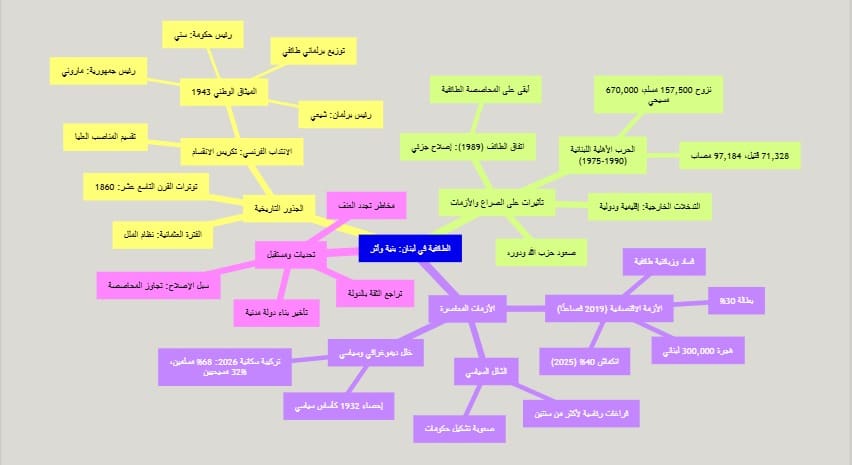
To understand the current Lebanese scene, one must go back centuries, to when the Levant was part of the Ottoman Empire. During that period, what became known as the "millet system" took shape, an administrative framework that granted religious communities a degree of autonomy in managing their religious, judicial and social affairs.
At the time, the aim was not to produce a sectarian state in the modern sense. However, this system gradually contributed to entrenching sectarian identities as independent political and social units. With the arrival of the nineteenth century CE, European interventions in the Mashreq began to increase.
This trajectory reached its peak during the bloody events of Mount Lebanon in 1276 AH/1860 CE, when wide-scale confrontations broke out between the Druze and the Maronites, leaving deep wounds in the Lebanese collective memory whose political and psychological effects remain present to this day.
The French Mandate: The Moment the Sect Moved to the Heart of the State
With the collapse of the Ottoman Empire following the First World War, Lebanon entered a new phase under the French Mandate. Contrary to the common image that reduces the crisis to religious plurality, a number of researchers argue that the real problem began when the sect moved from the social sphere into the constitutional and institutional sphere.
In 1345 AH/1926 CE, the Lebanese constitution was adopted, while "Greater Lebanon" was established within new borders that joined Muslim-majority areas to Mount Lebanon, which at that time had a Christian majority.
During that period, mutual fears emerged among the different Lebanese components. The Christians feared being absorbed into a broader Arab environment, while part of the Muslim population viewed the new entity as a project separate from its natural Syrian surroundings. These mutual fears would later become the unspoken foundation of the Lebanese political system.
The National Pact: A Settlement That Saved Independence and Entrenched Division
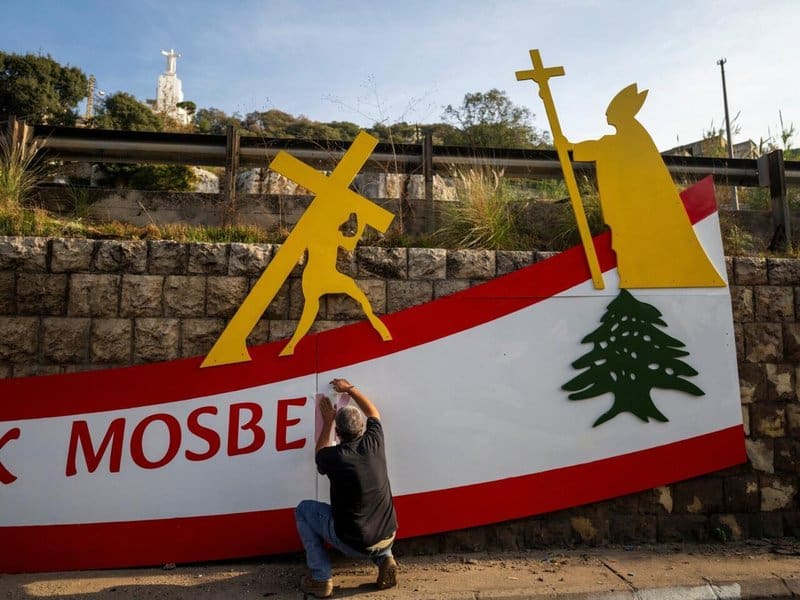
When Lebanon gained its independence in 1362 AH/1943 CE, what became known as the National Pact was born. The Pact was less a written document than a historic political settlement.
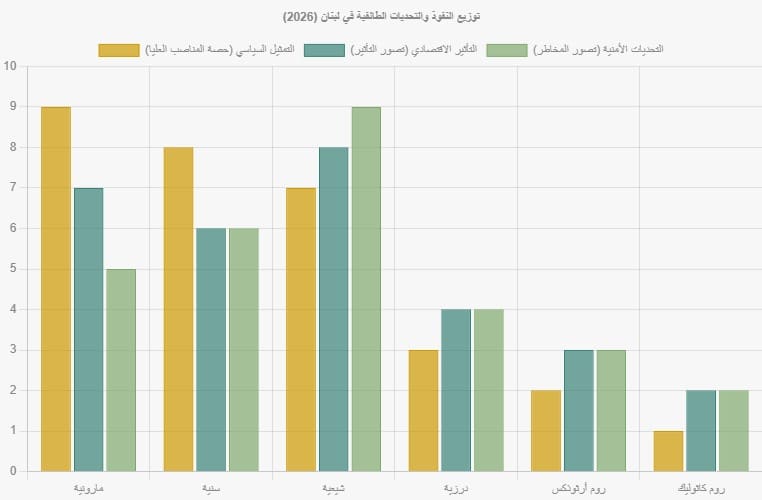
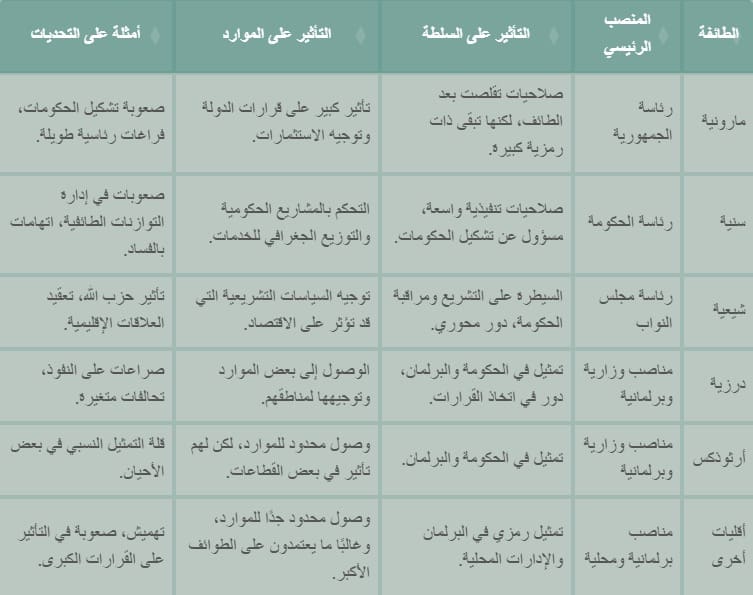
Christians gave up the idea of direct Western protection, while Muslims retreated from their demand for unity with Syria. In return, power was distributed on a sectarian basis: the presidency of the republic went to the Maronites, the premiership to the Sunnis, and the speakership of the parliament to the Shiites.
At the time, this arrangement appeared to be a practical solution for avoiding confrontation, but it carried within it the seeds of a long-term crisis, because it tied political legitimacy to sectarian affiliation rather than to "citizenship." Over the decades, the sects turned into fully fledged political institutions possessing their own leaderships and their own economic, media and educational networks.
The Civil War: The Greatest Explosion of the Sectarian System
By the mid-1970s, the accumulated contradictions within the Lebanese system began to surface in more violent forms. In 1395 AH/1975 CE, the Lebanese Civil War broke out and continued until 1410 AH/1990 CE, becoming one of the most complex wars in the modern Middle East.
However, the war was not merely an internal conflict between sects. Lebanese territory turned into an open arena for regional and international rivalry, and Syrian, Palestinian, Israeli and international calculations became intertwined in an unprecedented way. Here emerged one of the most dangerous outcomes of the sectarian system: the weaker the central state became, the more the sects relied on external allies to protect their interests.
The Taif Agreement: The End of the War or the Reproduction of the Crisis?
In 1410 AH/1989 CE, the Taif Agreement was reached, formally ending the civil war. The agreement redistributed powers among the three presidencies and gave Muslims a larger role in running the state. It also stipulated, in theory, that work would be done to abolish political sectarianism in the future. In reality, however, things moved in a different direction: rather than dismantling sectarian power-sharing, it was updated and expanded.
The distribution of public posts and positions continued according to the same sectarian balances, with relative shifts in centres of power. Thus, sectarianism moved from the phase of war into the phase of day-to-day state administration.
Table of Distribution of Posts and Resources in the Lebanese Sectarian System
How Sectarianism Became a Driver of Corruption and Political Paralysis
Over the years, the problem was no longer limited to political division. The sectarian system produced an economic model based on clientelism and favouritism, in which state institutions often became extensions of the influence of sectarian leaders. Public posts, services and projects were turned into tools for consolidating political loyalties rather than tools for building a modern state.
Gross domestic product declined sharply, unemployment rose to unprecedented levels, and hundreds of thousands of Lebanese left the country in search of better opportunities abroad. Economists argue that the financial crisis was not merely the result of economic mistakes, but a direct reflection of the sectarian system's inability to produce effective state administration.
Hezbollah and the Shifting Balance of Power Within the System
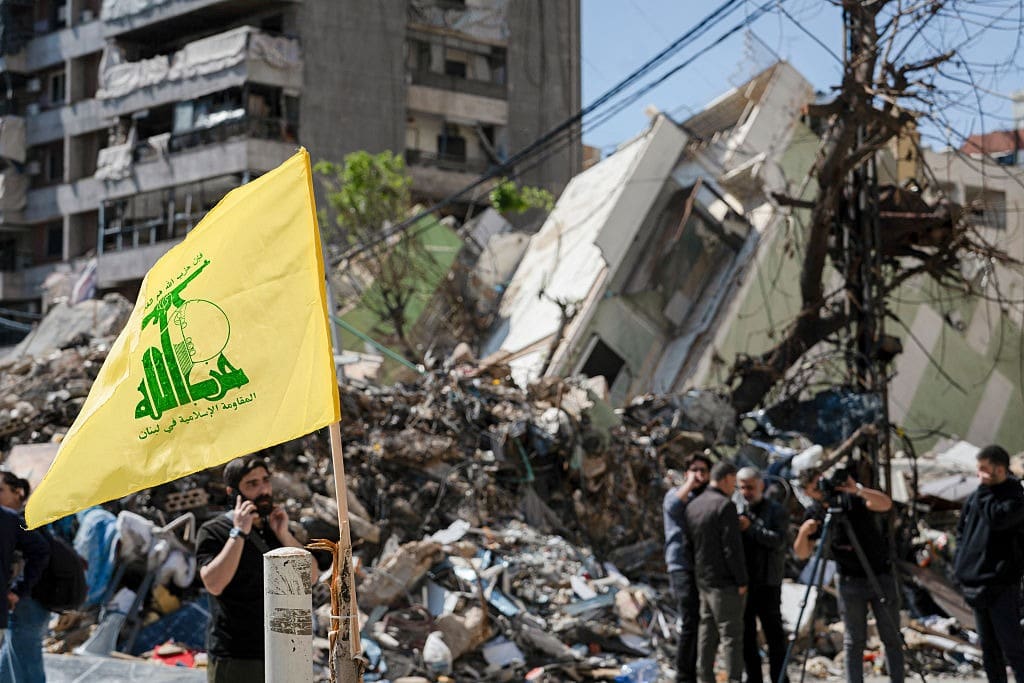
One of the most prominent transformations Lebanon witnessed after the civil war was the rise of Hezbollah as an influential political and military force. The party did not confine itself to a political role within institutions; it developed independent military capabilities that made it a regional actor with influence over files extending beyond Lebanon's borders.
This reality added a new layer of complexity to the sectarian system, as internal balances became linked not only to the distribution of posts but also to military and regional balances of power. In turn, concerns grew among other Lebanese parties that the equation of national partnership had been disrupted, deepening the state of political polarisation.
The Silent Demographics: The Problem No One Wants to Discuss
Among the most sensitive issues in Lebanon is the question of demographic change. The last official population census was conducted in 1351 AH/1932 CE, and its results still serve as a basic reference for many political arrangements. However, recent estimates point to major changes in the population structure compared with what existed nearly a century ago.
This change has created a gap between the demographic reality and the existing political system, making any discussion of constitutional reform or the redistribution of power fraught with risk. For this reason, most political actors prefer to avoid opening this file, despite recognising that it represents one of the main sources of future tension.
Is It Possible to Exit the Sectarian System?
In recent years, particularly after the protests of 1441 AH/2019 CE, voices calling for building a "civil" state that transcends sectarian affiliations have grown louder. However, experience has shown that the matter is more complicated than merely raising slogans. A number of Lebanese researchers now argue that the problem lies not only in the existence of the sects, but in the absence of a unifying "national" project capable of reassuring all components at the same time. In recent academic and media debates, a trend has emerged calling for treating the sects as an existing social reality that should be turned into a space for dialogue and consensus, rather than attempting to abolish it by force.
Lebanon 2026: A State in Search of Itself
More than 160 years after the events of Mount Lebanon, more than 80 years after the National Pact, and more than three decades after the Taif Agreement, the same question remains firmly on the table: is sectarianism the cause of Lebanon's crisis or its consequence? What appears clear is that the system originally designed to prevent clashes between different groups has gradually turned into one of the main obstacles to building a modern state. While Lebanese continue to search for a way out of their accumulated crises, political sectarianism remains the most complex knot in the Lebanese landscape: a knot that for decades succeeded at times in preventing a full explosion, yet failed to build a stable state capable of meeting the aspirations of its citizens.


