

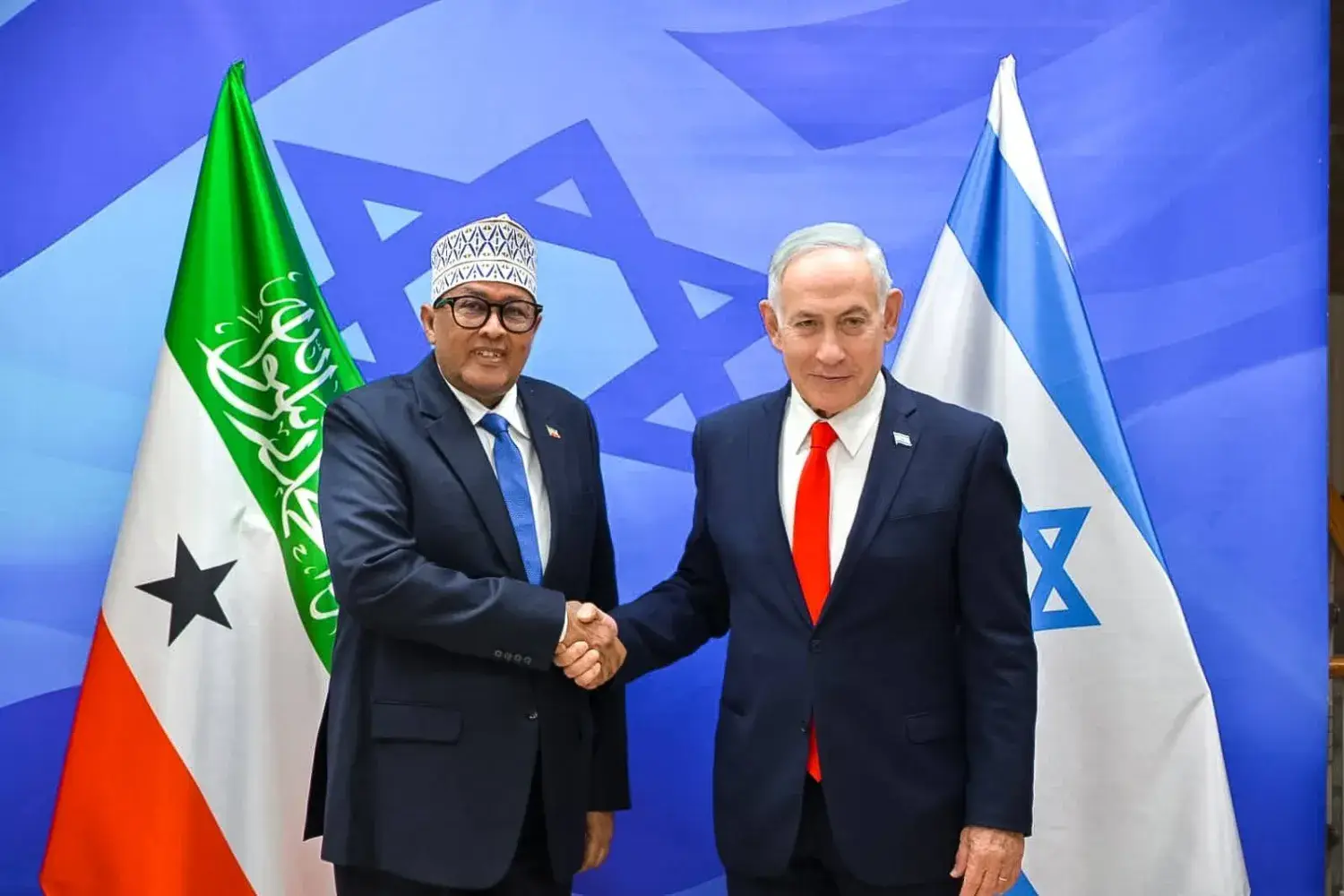
Series: Israeli Military and Security Influence Around the World | Part Two
Israel's recognition of Somaliland on 26 December 2025 was not merely a diplomatic shift in a secessionist file that had remained stalled for more than three decades. The decision refocused attention on a strategic location at the southern entrance to the Red Sea, opposite the Yemeni coast, where the interests of regional and international powers intersect in pursuit of expanded military, intelligence and commercial influence.
Months after the recognition, aspects of security cooperation between Israel and the authorities in Hargeisa began to emerge, alongside reports of military visits and the training of security personnel, and expansion work at Berbera airport overseen by the UAE. Questions have arisen as to whether these facilities could become a launch point for future Israeli operations in the Gulf of Aden and the Red Sea.
On 6 July 2026, the French newspaper «Le Monde» published an investigation based on satellite imagery and security sources, describing military preparations at Berbera airport that Israel and the United States could potentially benefit from. Meanwhile, a report issued by the International Institute for Strategic Studies in London concluded that a possible Israeli access to the airport could widen the Israeli army's options in confronting the Houthis in Yemen.
The picture, however, is not fully settled. The authorities of Somaliland deny the existence of an established Israeli military base or any announced agreement to create one, and the nature, scale and actual extent of the military and intelligence activities remain surrounded by a degree of secrecy and contradictory statements.
Most importantly, this expansion is taking place amid a Somali society divided over the Israeli recognition, among competing authorities over legitimacy and sovereignty, and in areas that are not under Hargeisa's control at all, while opponents, religious scholars and activists warn against drawing Somali territory into conflicts that go beyond the interests of its people.
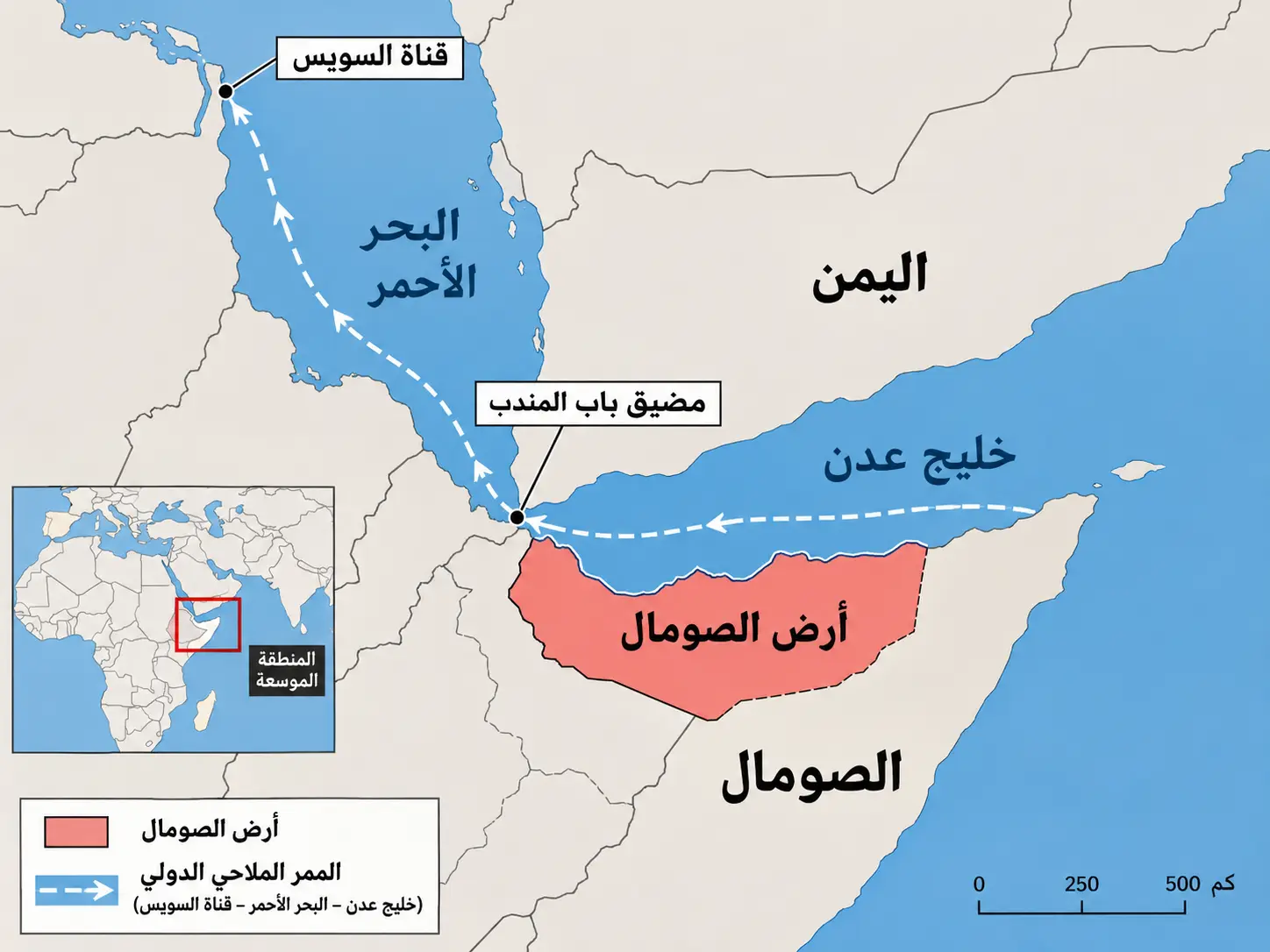
First: Why Somaliland Specifically?
To understand Israel's interest in Somaliland, one must begin with geography.
Somaliland lies in the northwest of Somalia, with coastline extending along the Gulf of Aden, facing Yemen and close to the Bab al-Mandab Strait, which links the Gulf of Aden with the Red Sea and constitutes one of the vital corridors for international trade and maritime traffic heading to the Suez Canal.
The city of Berbera holds particular importance. It contains a commercial port being developed by DP World, and an airport with a long runway built during the Soviet era, which underwent modernisation and expansion in later years.
The geographic location of Berbera theoretically allows for the establishment of facilities for aerial and naval surveillance and the monitoring of shipping traffic, or the use of the airport for military transport, reconnaissance and logistical support.
The International Institute for Strategic Studies (IISS) addressed these advantages in an analysis published on 27 January 2026 under the title «Extended reach: Diplomatic recognition paves the way for Israeli army presence in Somaliland».
The analysis concluded that use of Berbera airport by Israeli aircraft, if it materialises, could shorten the time needed to reach targets in Yemen and provide additional capabilities for reconnaissance, surveillance and intelligence gathering.
These geographic advantages, however, remain potential capabilities and do not constitute proof that Israel operates an actual military base in the area.
It is also important to recognise that the authority of the Hargeisa administration is not comprehensive across all the territories it claims. The city of Las Anod and parts of the Sool region came out of its control after clashes in 2023, and an administration called «North-East Somalia» was established in 2025, which the federal government in Mogadishu recognised as a federal state.
Accordingly, Somaliland cannot be treated as a homogeneous political and security space, nor can it be assumed that any agreement signed by the Hargeisa authorities reflects the position of the residents of all the areas it claims.
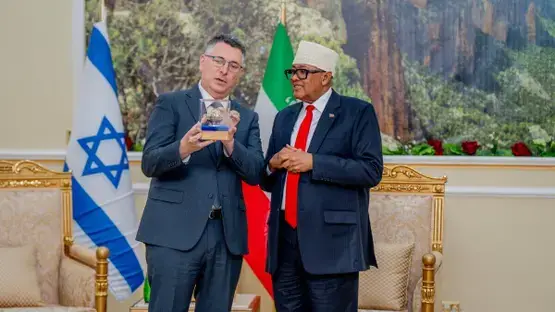
Visit of Israeli Foreign Minister Gideon Sa'ar to the city of Hargeisa
Second: The Israeli Recognition: What Changed After December 2025?
Israel announced on 26 December 2025 its recognition of Somaliland as an independent state, becoming the first member state of the United Nations to take this step since the region declared its secession from Somalia in 1991.
The decision crowned long efforts by the Hargeisa authorities to obtain international recognition that would enable them to establish direct diplomatic, economic and security relations with other states.
In response, the Somali federal government rejected the recognition, considering it a violation of the country's sovereignty and unity. This position was supported by several African and regional institutions, including the African Union and the Intergovernmental Authority on Development (IGAD).
Relations, however, did not stop at the political announcement.
In January 2026, Israeli Foreign Minister Gideon Sa'ar visited Hargeisa, a step that marked the beginning of open diplomatic engagement.
In June, the President of Somaliland, Abdirahman Mohamed Abdullahi, known as "Irro", made an official visit to Israel, during which political, economic and security cooperation was discussed, alongside investment in technology, agriculture, water and energy.
Somaliland opened an embassy in West Jerusalem during the visit, a step that provoked fresh regional objections.
Relations then advanced further in late October, when the Israeli ambassador Michael Lotem presented his credentials to the President of Somaliland in Hargeisa, and the laying of the foundation stone for an Israeli embassy there was announced, as confirmed by the Israeli Foreign Ministry on 1 November 2026.
The Israeli diplomatic presence thus became declared and institutional, after contact between the two sides had been limited and informal for years.
Nevertheless, diplomatic recognition remains different from granting rights for military deployment: the former has become an established reality, while the details of the latter remain the subject of conflicting reports.
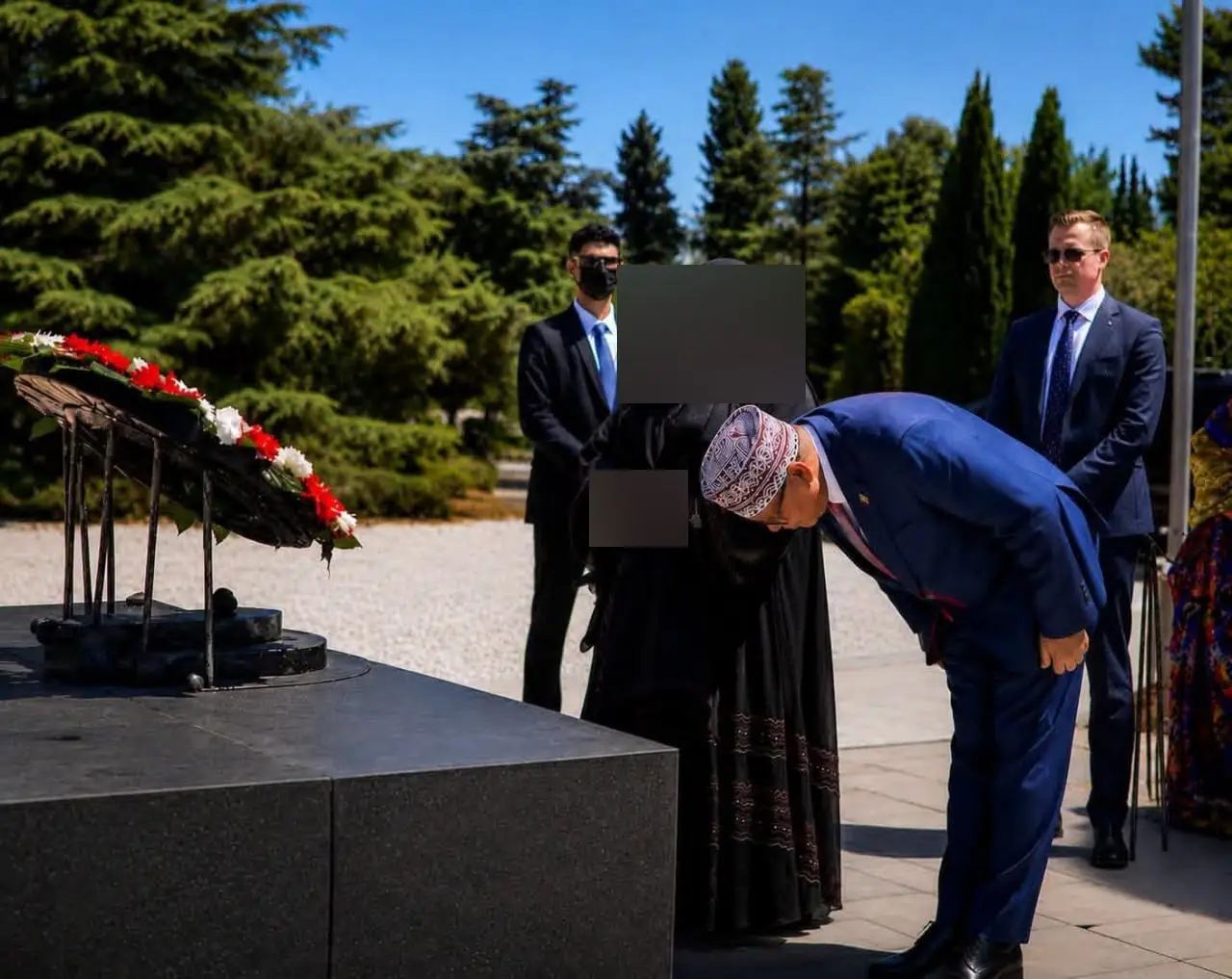
A photograph of the President of the Somaliland region, Abdirahman Irro, during his visit to occupied Palestine to strengthen his relations with the Israeli occupation, showing him performing a bow in front of the grave of the founder of the Zionist movement, Theodor Herzl.
Third: Intelligence Cooperation and Military Training: What Has Been Established?
Among the most prominent indications that relations have moved beyond the diplomatic sphere are statements made by Israeli Defence Minister Israel Katz during the visit of the Somaliland president in June 2026.
According to a Reuters report published on 17 June, Katz said the two sides had cooperated for years in undisclosed operations whose details would remain secret, and expressed his desire to expand security, economic and diplomatic relations.
These statements are particularly significant because they constitute a public acknowledgement by a senior Israeli official of past cooperation whose nature or scope has not been disclosed.
On their own, however, they do not identify the locations of those past operations, their participants, or the level of military involvement.
On the same day, Reuters quoted Somaliland's Defence Minister Mohamed Yusuf Ali as saying that Israel was helping train some police and military personnel, while denying the existence of Israeli bases in the region or the conduct of negotiations over establishing them.
The Somaliland Ministry of Defence subsequently issued a statement denying that the minister had made these remarks to Reuters or other media outlets, and described the information attributed to him as inaccurate.
Other reports, however, supported the existence of aspects of security cooperation.
On 13 June 2026, the website «Drop Site News» published an investigation drawing on Somali officials, a Somaliland official and a European security source, which reported that Israel had established an intelligence presence at Berbera airport, and that members of the presidential guard and Somaliland intelligence had received training in Israel.
«Le Monde», in its investigation published on 6 July, likewise reported that Somaliland intelligence officers had travelled to Tel Aviv for training, and that Israeli military delegations had visited Hargeisa and Berbera and held meetings with local military officials.
These accounts reinforce the picture of organised security cooperation, but they do not provide a documented list of the units involved, the nature of the training, or the number of personnel who received it.
The result is that security cooperation is no longer a mere diplomatic possibility, yet its precise operational details remain unavailable to full independent verification.
Fourth: Berbera Airport: What Do the Images and Military Works Reveal?
Berbera airport represents the most sensitive aspect of the file, because its development could turn security cooperation into an operational capability with effects beyond the borders of Somaliland.
«Le Monde» relied on satellite images showing excavation and expansion work at three sites at least, south of the airport runway, during the period from October 2025 to March 2026.
The newspaper reported that the images showed the digging of no fewer than 18 trenches in the area, with containers or structures placed inside some of them and then backfilled.
It quoted a European security source and a military expert as saying that the nature of the works was consistent with the construction of protected ammunition stores or fuel tanks.
It also reported that the UAE is carrying out these expansions, and quoted a worker at the airport as saying the works were being carried out on behalf of partners including Israel and the United States.
According to the same investigation, Israeli military delegations visited the airport, while a security source in East Africa spoke of the possibility that the facility could in future be used to support operations toward Yemen.
These findings intersect with the analysis of the International Institute for Strategic Studies, which noted the development of aircraft facilities and engineering works at the airport, and suggested that some of the changes may be consistent with plans to deploy air defence systems.
However, a distinction should be drawn here between three levels of evidence.
The first is the existence of expansion works with military characteristics, which is supported by satellite imagery and technical analyses.
The second is the existence of visits and security cooperation with Israeli entities, as reported by press investigations drawing on security sources.
The third, the establishment of a permanent Israeli army base operating independently in Berbera, is not supported by any independent public evidence I have found that settles the question so far.
Indeed, the «Le Monde» investigation itself acknowledged that the ultimate beneficiary of the new facilities cannot be determined precisely at the stage it examined.
Accordingly, describing Berbera as an already existing Israeli base goes beyond what the available evidence establishes, while the question of whether Israel could covertly or prospectively use it appears to rest on indications that merit serious follow-up.
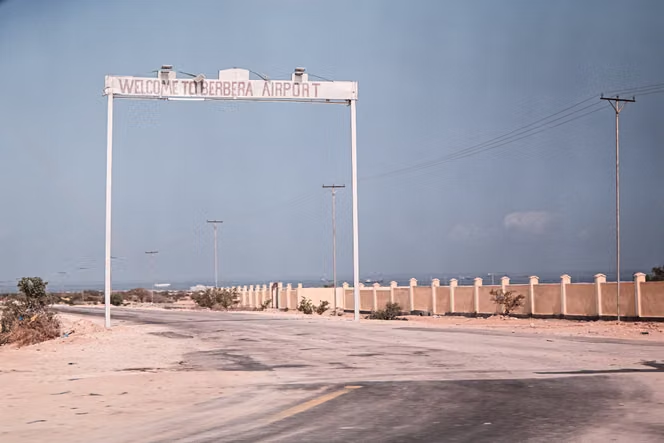
Fifth: The UAE: The Link in the Network of Military Influence
The developments at Berbera cannot be understood without considering the Emirati role, which preceded Israel's recognition by several years.
In 2016, DP World obtained a concession to develop and manage the port of Berbera, and in 2017 the UAE reached an agreement with the authorities of Somaliland to establish military facilities and use installations in the area.
This expansion coincided with the UAE's involvement in the war in Yemen and its interest in securing transport routes and logistical support across the Gulf of Aden and the Red Sea.
Over time, Berbera became a hub combining commercial investment and infrastructure with military-relevant uses.
Emirati activities were not confined to Berbera. Abu Dhabi maintained security and military relations with other local authorities in Somalia, including Puntland, where Bosaaso airport also saw the development of military facilities.
«Le Monde»'s investigation noted the deployment of an Israeli-made EL/M-2084 radar in Bosaaso in March 2025.
However, the presence of an Israeli-made military system inside a facility run or supported by the UAE does not on its own prove the presence of Israeli forces or direct Israeli operation of that system.
It does, however, reveal the transfer of Israeli military technology into the network of facilities and security partnerships existing in the region.
The existing security and economic relations between the UAE and Israel increase the importance of tracking this line, especially where civilian infrastructure projects overlap with potential military needs.
On the other hand, the convergent interests of the three countries — the UAE, the United States and Israel — do not imply a joint military command or an announced tripartite agreement concerning Berbera.
The Emirati role has also entered a wider dispute with Mogadishu, which announced on 19 November 2026 that the Emirati ambassador must leave the country, accusing Abu Dhabi of failing to respect Somali sovereignty.
This is an indication of the growing tension over relations linking external powers with local Somali administrations, although the details of the diplomatic dispute extend beyond the Israeli cooperation file alone.
Sixth: What Does Israel Want from a Presence Near Yemen?
The Somali coast overlooking the Gulf of Aden holds particular importance in Israeli security calculations, because of its proximity to Yemen and the Bab al-Mandab Strait.
Since the outbreak of the war on Gaza in October 2023, the Houthi group, backed by Iran, has carried out missile and drone attacks toward Israel, and has also targeted ships in the Red Sea and the Gulf of Aden, disrupting shipping and trade in the region.
For the Israeli military establishment, operations against targets in Yemen pose challenges relating to long distances, information gathering, target identification and monitoring of movements.
For this reason, military analysts consider that potential access to facilities in Berbera could provide three main advantages.
The first is an expanded reconnaissance capability: facilities close to the Yemeni coast could, in theory, allow monitoring of naval and aerial movements and the gathering of additional information about areas of military activity.
The second is facilitated logistical support: including transport, supply, maintenance and services linked to any potential military deployment.
The third is a shortening of operational distances: if the airport were made available for military aircraft, this could widen the options available to the Israeli command in the region.
These advantages, however, assume military arrangements whose completion has not been publicly confirmed.
Conversely, any Israeli presence could carry significant risks for Somaliland: the Houthis have threatened to target any Israeli military presence there, meaning that facilities or local areas could become targets within a wider regional conflict.
In this way, authorities that see relations with Israel as an opportunity for recognition and support may find themselves facing new security challenges that exceed their capacity to control the course of confrontation.
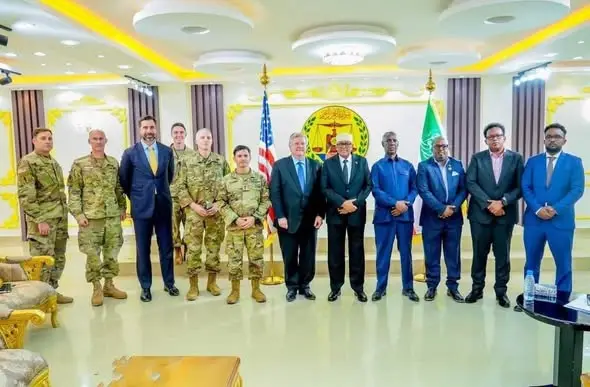
A visit by an American delegation to Somaliland
Seventh: Is Washington Seeking a New Foothold Near Bab al-Mandab?
The strategic importance of Berbera is not separable from the American military presence in the Horn of Africa.
The United States maintains facilities and forces in Djibouti, where the Camp Lemonnier base is located, and there is also a Chinese military base there, making the area a zone of direct overlap between the interests of the two powers.
Officials from the US military command for Africa, AFRICOM, have visited facilities in Berbera in recent years, as part of attention to the location and to regional security needs.
«Le Monde»'s investigation noted that Washington regards facilities outside Djibouti as options that could give it greater flexibility in dealing with security challenges in the Red Sea and Yemen.
However, American interest in the location does not mean that Washington has agreed to establish a permanent base there, or that it has adopted Israel's recognition of Somaliland.
Drop Site News reported that the US Africa Command had at the time denied seeking to establish a base in Somaliland.
From a strategic perspective, Berbera can be understood as a site over which multiple possibilities compete: commercial use, logistical facilities, intelligence cooperation, and potential military presence.
Eighth: The Position of the Somali People: Between Welcome, Opposition and Fear of a New War
The popular and political dimension may be the most overlooked aspect in coverage that focuses on Berbera, Israel and external powers.
Somalia is not ruled by a single authority that effectively controls the entire country, and Somali society is not a homogeneous political bloc in its position on Somaliland's secession or its external relations.
Deep disagreements exist over sovereignty, representation and the legitimacy of authorities, in addition to differing historical experiences and local interests between Hargeisa, Mogadishu, Laascaanood, Puntland and others.
Therefore, a distinction must be made between the positions of governments and political forces, the positions of scholars, notables and activists, and the attitudes of residents in the various regions.
1. Hargeisa: Welcoming Recognition Does Not Mean Consensus on a Military Alliance
Hargeisa witnessed wide celebrations following Israel's recognition, and Israeli flags appeared at public occasions, including celebrations of the anniversary of Somaliland's declaration of independence in May 2026.
Supporters of the new relations argue that they have broken a long diplomatic isolation and may pave the way for recognition by other states and attract investment and technical and economic assistance.
These hopes are rooted in a complex history: the population of northern Somalia suffered severe repression under the regime of Mohamed Siad Barre, including the bombing of northern cities and large numbers of casualties, a legacy on which supporters of independence draw to explain their insistence on obtaining external recognition.
However, support for recognition does not necessarily mean approval of establishing an Israeli military base or allowing the use of territory for operations against other states.
France-Presse, during 2026, recorded voices in Hargeisa fearing that rapprochement with Israel, especially amid the war on Gaza, could harm the reputation of the independence cause or expose the region to retaliatory attacks.
No independent polling data exist that would allow an accurate determination of the proportion of supporters and opponents of the relations or of the Israeli military presence.
2. Religious Scholars and Activists: Opposition to Rapprochement and Concerns over Freedom of Expression
Religious and social voices inside Somaliland have emerged criticising the relationship with Israel, linking their position to the war on Gaza and solidarity with the Palestinians.
Among them is Sheikh Mustafa Haji Ismail Haron, who warned in public remarks in Hargeisa during January 2026 against rushing into relations with Israel in exchange for political recognition, and called for consideration of the moral and political implications of the decision.
Human rights and media reports have also documented the arrest of religious figures and young people who expressed rejection of the new relations or solidarity with Palestine.
In September 2026, police in Hargeisa detained journalists from a local channel while they were covering a religious gathering at which one attendee made remarks supporting the Palestinians, according to the Committee to Protect Journalists.
The committee reported that the journalists were released after several hours, but that they were forced to delete the video recording.
These facts reveal a matter that goes beyond the diplomatic debate: Is the local community allowed to freely express rejection of relations with Israel, or has external recognition become an issue on which the authorities restrict discussion?
Popular support cannot be properly assessed without guaranteeing freedom of expression for both supportive and opposing positions alike.
3. Opposition Political Forces in Somaliland: Disagreement with the Government Does Not Mean Rejecting Recognition
It is a mistake to treat opposition to the local government as automatic opposition to relations with Israel.
On 29 September 2026, the opposition parties Kaah and Kulmiye in Somaliland rejected statements by Somali Prime Minister Hamza Abdi Barre, which implied that Somaliland's political, religious and communal forces reject Israeli recognition.
Representatives of both parties declared support for the recognition as an asset for the Somaliland independence project, despite their political differences with the existing authorities.
This distinction matters, because alignment on the question of independence does not necessarily coincide with alignment on the performance of the government or the nature of foreign military cooperation.
A political party may support diplomatic recognition while its positions differ on specific military agreements, on the scale of foreign influence, or on the degree of transparency in decision-making.
4. Mogadishu and Other Somali Cities: Popular Protests Against Recognition
In contrast, the capital Mogadishu and other Somali cities witnessed wide protests rejecting Israel's recognition of Somaliland.
Demonstrators took to the streets in late December 2025 and early January 2026, raising Somali flags and chanting slogans affirming the country's unity and rejecting any infringement on its sovereignty.
The protests were not limited to the capital but included other cities and regions, among them Baidoa, Garowe and Laascaanood.
Different motives intermingled in these protests: some participants expressed rejection of the country's partition, others their opposition to cooperation with Israel because of their position on the Palestinian cause, while some combined both positions.
This mobilisation confirms clear popular rejection across multiple regions.
It is also necessary to distinguish between society and government: the federal government in Mogadishu, though the internationally recognised representative of Somalia, faces political and security disputes with local administrations and opposition forces, and does not control all Somali territory.
5. Laascaanood and Northeast Somalia: Objection from Areas Not Controlled by Hargeisa
The positions of residents of Laascaanood and the northeastern regions of Somalia carry particular importance, because they live in areas that Somaliland claims but which are not entirely under Hargeisa's authority.
After the armed confrontations in 2023, Somaliland forces withdrew from Laascaanood, and the "Khatumo" administration emerged, which developed into the "North Eastern State of Somalia" recognised by the federal government.
Amnesty International had documented indiscriminate shelling that struck residential neighbourhoods and civilian facilities in Laascaanood during those confrontations, and called for investigation of the violations and accountability for those responsible.
In May 2026, France-Presse quoted local representatives in northeastern Somalia as expressing concern that a possible military rapprochement between Israel and the authorities in Hargeisa could encourage new escalation in the disputed areas.
Local figures expressed fear that external support could become a factor disrupting the balance of power and increasing the risk of confrontations, while ceasefire and prisoner-exchange negotiations were facing difficulties.
These concerns do not mean that Israeli support has already been used on those fronts, as no published evidence proves this.
But they show that the impact of the new relations is not confined to foreign policy; it extends to existing local conflicts between authorities and communities contesting land and legitimacy.
6. Puntland and the Remaining Regions: Different Interests and Alliances
Puntland has its own security and administrative institutions and maintains relations with external partners, among them the United Arab Emirates, and it differs with Mogadishu on files relating to the distribution of powers and federal authority.
This makes the Somali landscape more complex than a binary of "Mogadishu versus Hargeisa".
Some local forces oppose secession from Somalia, yet differ with the federal government over the management of security and foreign relations files.
Other administrations may deal with foreign military partners out of their security needs, without this meaning that they adopt the same political position toward Israel.
Distinguishing between these positions is necessary, because external influence may benefit from the dispersal of authority and the divergence of local alliances, even without a comprehensive agreement uniting all parties.
Ninth: Regional Reactions: Fears of Turning the Horn of Africa into an Arena of Confrontation
Israel's recognition of Somaliland drew objections from regional states and institutions.
On 6 January 2026, the Peace and Security Council of the African Union issued a statement rejecting the recognition, warning of its impact on Somalia's sovereignty and unity and on the stability of the Horn of Africa.
IGAD also affirmed its commitment to the territorial integrity of Somalia, while rejecting positions were issued by states including Djibouti, Turkey, Egypt and Saudi Arabia.
The positions of these states carry additional importance given the network of existing security interests in the region.
Turkey has extensive military cooperation with the Somali federal government, and takes part in training its forces and developing their capabilities.
Djibouti holds a strategic military and commercial position hosting bases for international powers, while the United Arab Emirates is linked to a network of investments and security relations in Berbera, Bosaso and elsewhere.
As for Egypt and Saudi Arabia, they follow developments in the Red Sea, maritime security, and the impact of regional conflicts on their security and economic interests.
Accordingly, expanding Israeli influence in Somaliland could complicate relations among regional powers, particularly if it is later linked to arrangements allowing the use of military facilities in cross-border operations.
However, this possibility does not mean that all those states have become parties to opposing military alliances; the nature of their interests and relations is more complex, and areas of cooperation and disagreement may overlap.
Tenth: What Could a Possible Israeli Presence Change in the Balance of Red Sea Security?
If Israel were in future to obtain the right to operate military or intelligence facilities in Berbera, this could result in a shift in the scope of its security presence beyond its borders.
Rather than relying on operations launched from distant locations, it could benefit from points closer to the southern Red Sea and the Gulf of Aden for surveillance and logistical support.
This could strengthen its capacity to monitor maritime and aerial movements in the region, and provide wider options for dealing with threats it considers directed at it.
However, an overseas military facility does not necessarily guarantee lasting superiority; it requires securing supply lines, protection and maintenance, may become a target of threat, and depends on the continued consent of local authorities and their internal balances.
More sensitive still is that the region itself suffers from existing conflicts: in Yemen armed confrontations continue, and in Somalia political disputes intertwine with jihadist activity and local conflicts.
The addition of a direct Israeli military presence could raise the likelihood of friction, or turn local civilian and military facilities into part of the calculations of wider regional conflicts.
Here a fundamental question emerges: Will security cooperation with Israel bring additional protection to the people of Somaliland, or will it increase their exposure to risks in whose emergence they were not a party?
This question cannot be answered merely by discussing military opportunities; it requires assessing the impact of any agreement on civilians, ports, trade, local stability, and the paths of political settlement among Somalis.
Eleventh: Harakat al-Shabaab al-Mujahideen: Threat of Confrontation with the Israeli Presence in Somaliland
Harakat al-Shabaab al-Mujahideen entered the political and security confrontation following Israel's recognition of Somaliland, declaring its rejection of any Israeli attempt to use Somali territory or establish a presence in it.
On 27 December 2025, the day after the recognition was announced, the group threatened to confront any Israeli attempt to establish a presence in Somali territory or use it, and its spokesman Ali Mahmoud Rage, known as "Ali Dhere", said in a statement carried by Agence France-Presse: "We will not accept that, and we will fight it."
The group considered that Israel's recognition paves the way for expanding foreign influence in northern Somalia, and returned to threats after the visit of Israeli Foreign Minister Gideon Saar to Hargeisa in January 2026.
These statements carry importance given the group's military weight: a report by the European Union Agency for Asylum published in June 2026 stated that it controls or has strong influence over wide areas of southern and central Somalia, with estimates suggesting control of around 30% of the country's territory, in addition to influence over supply routes and areas nominally under the control of the federal government.
Strategically, the group's position adds a new security risk to the calculations of any possible Israeli presence. Its declaration of targeting this presence may give it attractive material for expanding recruitment and mobilising supporters, or push it to attempt to shift some of its operations toward targets linked to the new relations.
The threat Harakat al-Shabaab issued in 2025 against the Israeli presence in Somaliland was not the first friction between it and Israeli interests and security activities in East Africa. In September 2013, the group carried out an attack on the Westgate shopping centre in the Kenyan capital Nairobi, which was partly owned by Israeli investors, and which left around 67 people dead. During the confrontations, the group's spokesman Ali Mahmoud Rage announced that Israeli and Kenyan forces had attempted to storm the centre by force, while Israeli security sources confirmed the presence of advisers assisting the Kenyan authorities in managing the crisis, and denied their participation in the storming. In January 2019, the group claimed another attack on the DusitD2 complex in Nairobi, linking it to Washington's decision to recognise Jerusalem as the capital of Israel, within a series of operations targeting American and Jewish interests, which it named "Jerusalem Will Not Be Judaised". These two incidents show that Israeli interests featured in the group's rhetoric and threats years before the recognition of Somaliland.
Conversely, the possibility of exploiting the issue of an Israeli presence to expand the group's activity threatens to complicate the Somali security landscape, and increases the threats that Somaliland could become a new arena for armed conflict.
Thus the security challenge facing any possible Israeli deployment is not limited to the threats of the Houthis across the Gulf of Aden, but also includes the calculations of the jihadist movement inside Somalia, especially since Harakat al-Shabaab al-Mujahideen has been waging a long war against government forces and their international allies, and has carried out attacks inside and outside the internationally recognised Somali borders for nearly two decades.
Twelfth: Secret Contacts between Mogadishu and Tel Aviv: A History Older than the Recognition of Somaliland
Contacts between Somali officials and Israel do not begin with Israel's recognition of Somaliland in December 2025; historical and journalistic reports point to undisclosed channels going back decades, although the available information about them varies in the strength of its documentation.
A study published by the platform "Jeska" reported that Abdirahman Abdi Hussein, son-in-law of former Somali president Mohamed Siad Barre, made an undisclosed visit to Jerusalem in February 1985, during which he explored the possibility of military cooperation, particularly in counter-insurgency. This account relies on historical sources, without providing evidence that a military agreement was reached or that joint operations began.
News of secret contacts resurfaced during the first presidency of Hassan Sheikh Mohamud: in July 2016, the Times of Israel reported, citing a source close to the Somali president, that Mohamud had met Israeli Prime Minister Benjamin Netanyahu, following a report by a Somali website that spoke of a secret visit to Tel Aviv involving three officials.
The source said that Somali officials had previously met representatives of the Israeli Ministry of Economy in Jerusalem during December 2015.
In contrast, the Somali Ministry of Foreign Affairs officially denied that any meeting took place between Mahmoud and Netanyahu, while the latter refrained from confirming or denying the meeting.
The accounts were repeated during the presidency of Mohamed Abdullahi Farmaajo. In July 2022, the same Israeli newspaper quoted an unnamed former diplomat as saying that Farmaajo met Netanyahu in Nairobi on 28 November 2017, and then travelled to Jerusalem in February 2020 accompanied by his envoy Bilal Osman, to discuss the possibility of establishing diplomatic relations.
In March 2019, Somalia abstained from voting on a Human Rights Council resolution on human rights in the occupied Syrian Golan, a step that a former diplomat described as an attempt by Farmaajo to test reactions to rapprochement with "Israel". However, Somali Foreign Minister Ahmed Awad described the abstention at the time as a mistake.
Following the return of Hassan Sheikh Mohamud to the presidency in May 2022, new reports emerged speaking of contacts with Israeli officials during a visit to the UAE, and some accounts went further to claim that he secretly travelled to "Israel", which the Somali presidency denied.
In June 2023, the website Axios, citing Israeli officials, revealed that Somalia agreed to send representatives as observers to an anticipated meeting of the Negev Forum, which includes the United States, "Israel" and a number of Arab states. The report did not include confirmation from Mogadishu, and it does not establish that a Somali delegation actually attended the meeting.
The most direct Israeli statement came on 11 December 2025, when Israeli Deputy Foreign Minister Sharren Haskel spoke of the existence of "some kind of communication" with the Somali government, in the context of her remarks on security threats linked to the Houthis in the Horn of Africa.
However, the Israeli official did not disclose the nature or level of these contacts, and the federal government did not announce the existence of security cooperation with "Israel".
On 13 November 2023, Hassan Sheikh Mohamud said in an interview with the Saudi newspaper Arab News, on the sidelines of the Saudi-African Summit in Riyadh:
"There is a globally accepted solution, which is two states, Palestine and 'Israel', living side by side in peace. This is possible, so why do we not move forward in achieving it?"
These facts reveal a history of reports and contacts involving officials in Mogadishu, marked by official denials and discrepancies in accounts. That the federal government was not far from "Israel".
Thirteenth: Israeli military and intelligence cooperation with Washington's allies in Somalia
Israeli interest in Somali security did not remain limited to diplomatic contact attempts; a parallel track emerged through military and intelligence cooperation with East African states, particularly Kenya and Ethiopia, which took part in armed operations inside Somalia.
Some accusations date back to 2006, when officials of the Islamic Courts Union accused the Mossad of providing intelligence and logistical assistance to Ethiopian forces and to their local adversaries, in the period preceding the Ethiopian intervention to support the Somali Transitional Government.
In a report published by Amnesty International in 2008, it was noted that Ethiopia imported Israeli weapons worth around 1.2 million dollars in 2005, before its military intervention in Somalia at the end of 2006. However, the report does not establish that those weapons were used specifically in Somali battles.
The clearest publicly declared track of Israeli cooperation linked to confronting al-Shabaab emerged with the Kenyan military intervention in southern Somalia in 2011.
In November of that year, the office of Kenyan Prime Minister Raila Odinga announced that "Israel" had expressed readiness to assist Kenya in combating al-Shabaab, including developing police capabilities to confront the group's networks, securing borders, and providing maritime surveillance equipment.
Also raised during talks with Netanyahu was the idea of establishing a regional alliance to confront jihadist groups in East Africa, with the participation of Kenya, Ethiopia, South Sudan and Tanzania.
However, the Kenyan position was not unified. In a session of the Kenyan parliament on 7 December 2011, Defence Minister Yusuf Haji announced that the military operations underway in Somalia were not receiving assistance from a foreign government, and he affirmed his rejection of "Israel's" participation in them.
This divergence is important, as it shows that Israeli support was at least under discussion at the political level, even if no proof accompanied it of the participation of Israeli forces in Kenyan military operations inside Somalia.
In September 2013, the Associated Press quoted Israeli officials and experts as saying that "Israel" exchanged intelligence information and provided security training to Kenya, and that similar intelligence relations linked it with Uganda, Ethiopia and Tanzania, and that the exchanged information included jihadist organisations, among them al-Shabaab.
In the same month, Israeli security experts took part in providing assistance and advice to the Kenyan authorities during the crisis of the al-Shabaab attack on the Westgate shopping centre in Nairobi.
"Israel" strengthened its cooperation with Kenya during Netanyahu's visit to Nairobi in July 2016, when the talks addressed expanding security training, exchanging information and providing the equipment needed to confront armed threats.
These relations are significant because the Kenyan army was one of the participating parties in African Union mission operations inside Somalia, which makes Israeli support for Kenya indirectly relevant to the war raging there.
As for the United States, for years it has carried out military and intelligence operations inside Somalia in coordination with the federal government, and has provided training, equipment and reconnaissance information to Somali forces, alongside air operations targeting al-Shabaab and the Islamic State.
However, the published official statements of the US Africa Command, AFRICOM, and the military reports that could be reviewed, do not establish the direct participation of Israeli forces in US operations inside Somalia, nor do they establish that Israeli intelligence agencies were responsible for identifying the targets of US strikes or for managing joint operations on Somali territory. Although statements attributed to al-Shabaab claimed the killing of Israeli soldiers in its attacks on US bases inside Somali territory, such as its attack on the US military base at Baledogle, within its series of operations against American and Israeli interests.
Accordingly, what can be established is the existence of Israeli security and intelligence cooperation with regional states participating in the war against al-Shabaab, foremost Kenya and Ethiopia, while indications of direct Israeli involvement within the US military coalition require further follow-up, as they cannot be ruled out and are likely to be kept secret, given the close nature of the American-Israeli alliance.
These data reveal that Israeli security influence around Somalia was not linked to Somaliland alone, but preceded it through a network of training relations, information exchange, military cooperation and contacts with East African states, although the level of this cooperation differs from one state to another.
Fourteenth: Hassan Sheikh Mohamud and Somaliland... Why does rapprochement with outside powers become a threat to sovereignty only when rivals do it?
The positions of Somali President Hassan Sheikh Mohamud on the Israeli rapprochement with Somaliland raise questions about the consistency of his foreign policy and his standards in dealing with foreign influence. Israeli media outlets had previously published reports in 2016 about a secret meeting that brought him together with Benjamin Netanyahu, citing a source close to him, despite the Somali Foreign Ministry's denial that the meeting took place. Reports of undisclosed contacts with Israeli officials in the UAE were renewed after his return to the presidency in 2022, which the presidency also denied. In November 2023, Mohamud explicitly expressed his support for the two-state solution, including the establishment of a Palestinian state and an Israeli one, which carries indirect recognition of "Israel" by the Somali government. These facts gain significance in light of his sharp criticism of the foreign relations of the Hargeisa authorities, at a time when his own government faces domestic criticism over its reliance on foreign powers — American and African — in a vital way, including the broad military and economic agreements with Turkey, some of whose clauses opponents accuse of squandering national resources and reducing Somali decision-making independence, while the government presents them as a means of protecting sovereignty and strengthening defence capabilities. Despite the legal difference between the authority of the internationally recognised federal government and the disputed status of Somaliland, these paradoxes raise a legitimate question:
Does Mogadishu's objection rest on a constant principle that rejects dependence on outside powers, or on a dispute over which body holds the exclusive right to form alliances and sign agreements?
This question calls for holding all parties accountable for the transparency of their foreign relations and the extent to which they serve Somali interests, far from double standards.
Questions still unresolved
Despite the multiplicity of reports and statements, fundamental matters remain without documented answers:
- Are there written but undisclosed security agreements between "Israel" and the authorities of Somaliland, and what is their scope?
- What is the nature of the intelligence and military training spoken of in press investigations, and what is the extent of participation in it?
- Will the Berbera facilities be used by Israeli forces on a permanent basis, or through temporary access or logistical arrangements?
- Which bodies hold decision-making authority over the military use of the airport, and what role do the UAE play in these arrangements?
- Is there local political or parliamentary oversight of possible security agreements?
- How will these developments affect the disputed regions, and the prospects for reconciliation among Somali components?
- And what guarantees could prevent the use of Somali territory in operations that expose civilians to new dangers?
- Would the Israeli intervention truly look different if the Somali federal government exercised effective sovereignty over Somaliland? How can Mogadishu's position be explained, as it strongly opposed Somaliland's agreement with Ethiopia to grant it access to the sea, and then expressed readiness to grant Addis Ababa access to the sea through an agreement with the federal government itself? Does the disagreement lie in the nature of agreements with external powers, or in which body holds the authority to conclude them?
- To what extent can the Israeli intervention in Somalia be read apart from the growing American military and security presence in the region? Are we facing two independent tracks governed by divergent interests, or a strategic convergence between Washington and Tel Aviv to strengthen their influence in the Horn of Africa and control vital sea lanes?
In sum, the issue goes beyond the dispute between Mogadishu and Hargeisa over sovereignty and political recognition, raising deeper questions about the future of Somali sovereign decision-making in light of the competition of external powers over the Horn of Africa and its sea lanes.
The greatest challenge remains the extent to which Somalis can protect their interests and security, and prevent their territory and coasts from becoming an arena for settling regional and international scores, the price of which the Somali people pay without being a party to shaping its aims or determining its courses.
Conclusion: Is diplomatic recognition a gateway to wider security influence?
Developments in relations between "Israel" and Somaliland during 2026 show that diplomatic recognition has not remained a symbolic step. It was followed by official visits, an exchange of ambassadors, and Israeli statements about prior security cooperation, alongside press investigations that addressed the training of security personnel, military movements and facilities being developed in Berbera.
These facts point to the widening scope of cooperation between the two sides, although they are not yet sufficient to prove all the accusations concerning the existence of a permanent Israeli base or the actual operation of military missions from it.
Geography gives Somaliland particular importance in strategic calculations linked to the Red Sea and Yemen, while the Emirati role and the existing military infrastructure in Berbera add a new dimension to the potential for external influence.
However, the future of this influence is not determined by "Israel" and the Hargeisa authorities alone.
The Somali people, with their diverse positions, the various political forces, scholars and activists, and the residents of the disputed regions, are all parties affected by the outcomes of these relations, even if they do not take part in shaping their decisions.
Perhaps the most dangerous thing this issue reveals is the possibility that demands for political recognition and internal disputes over sovereignty could become gateways to expanding foreign military influence in a highly sensitive region.
The question is not only whether "Israel" will be able to reach Berbera airport, but who holds the authority to take such a decision, what Somalis stand to gain or lose, and who will bear the consequences if local facilities become part of a wider regional confrontation.
Thus the outlines of Israeli activity in Somalia become clear, from undisclosed political and diplomatic contacts with Mogadishu, to security and intelligence cooperation with neighbouring states and the Americans, up to open rapprochement with Somaliland and the possibilities for military deployment near Bab al-Mandab that it raises. These intertwined tracks show how "Israel" seeks to expand its presence and influence beyond its borders, benefiting from regional alliances and competition over strategic positions, in a scene that calls for continued monitoring of what has been established in terms of activities and of what coming developments may reveal.
---
References and sources
- Le Monde (France), 6 July 2026: UAE Discreetly Builds Military Base in Somaliland for US and Israel, an investigation based on satellite images and security sources on expansion work at Berbera airport and the possible military presence.
- International Institute for Strategic Studies (IISS), 27 January 2026: Extended Reach: Diplomatic Recognition Paves the Way for IDF Basing in Somaliland, a military analysis of the importance of Berbera airport and its location for possible Israeli operations near Yemen.
- Reuters, 17 June 2026: Report on security cooperation, military training and statements by Somaliland's defence minister.
- Horn Diplomat, 17 June 2026: Somaliland Defence Ministry Rejects Reuters Israeli Base Report, Denies Interview.
- Drop Site News, 13 June 2026: Investigation into Israel's efforts to establish a foothold in the Red Sea via Somaliland, which addresses intelligence relations, security training and military interests in Berbera.
- Al Jazeera English, 1 November 2026: Israel's First Ambassador to Somaliland Presents Credentials in Hargeisa.
- Agence France-Presse, 19 May 2026: Somaliland Divisions Remain as It Marks Independence Day After Israel Recognition, a report published via the Lebanese newspaper L'Orient Today.
- Committee to Protect Journalists (CPJ), September 2026: Documentation of the detention of photojournalist Abdiqadir Ismail Foodhaadhi in Hargeisa, following his interview with a man who expressed solidarity with Palestinians during a religious gathering.
- European Union Agency for Asylum (EUAA), June 2026: Security Situation and Areas of Control in Sool, Sanaag, Cayn and North Eastern State, which addresses the contest over Laascaanood and areas outside the control of Hargeisa's authorities.
- African Union, 6 January 2026: Communiqué of the Peace and Security Council on Israeli Recognition and the Unity and Sovereignty of Somalia.
- Somali Public Agenda, January 2026: Red Sea Geopolitics and Secession: Policy Implications of Israel's Recognition of Somaliland, Policy Paper No. 12, prepared by Farhan Ishaq Yusuf and Uways Ahmed.
- Horn Diplomat, 29 September 2026: Somaliland Opposition Parties Kaah and Kulmiye Reject Israeli Recognition.
- Agence France-Presse, 27 December 2025, and Associated Press, 13 January 2026: Statements by al-Shabaab rejecting Israeli recognition of Somaliland and threatening to confront any Israeli presence there. AFP report and AP report.
- European Union Agency for Asylum (EUAA), June 2026: Al-Shabaab Control Areas, Presence and Influence in Somalia, which addresses the extent of its control in southern and central Somalia and its influence over supply routes, cities and villages.
- The Times of Israel, 5 July 2016: Report on an alleged secret meeting between President Hassan Sheikh Mohamud and Israeli Prime Minister Benjamin Netanyahu, which also addresses alleged contacts between Somali and Israeli officials in 2015.
- Puntland Mirror, 7 July 2016: Somalia's Foreign Ministry Denies Secret Meeting Between Hassan Sheikh Mohamud and Netanyahu.
- The Times of Israel, 12 July 2022: Former Diplomat Speaks of Alleged Secret Meetings Between President Mohamed Abdullahi Farmaajo and Netanyahu in 2017 and 2020, based on a source whose identity the newspaper did not disclose.
- Goobjoog, 25 June 2022: Villa Somalia Denies Reports of President Mohamud's Travel to Israel During His Trip to the UAE.
- Axios, 28 June 2023: Israeli Officials Say Somalia and Comoros Agreed to Attend Negev Forum Meeting as Observers, which also addresses undisclosed contacts and alleged secret visits by officials.
- Arab News, November 2023: Interview with President Hassan Sheikh Mohamud on the War on Gaza and the Two-State Solution, which includes his statement calling for a Palestinian state and an Israeli state living side by side.
- Somali National News Agency (SONNA), November 2023: Republication of Hassan Sheikh Mohamud's Interview with Arab News, an additional official source documenting the president's statement on the two-state solution.
- Al-Araby Al-Jadeed, 11 December 2025: Israeli Deputy Foreign Minister Sharren Haskel Speaks of Communication Between Israel and the Somali Government, in the context of regional security and the Houthis.
- United Nations Human Rights Council, 22 March 2019: Resolution A/HRC/RES/40/21 on Human Rights in the Occupied Syrian Golan, including the voting record in which Somalia abstained during the presidency of Mohamed Abdullahi Farmaajo.
- Defence Web, November 2011: Israeli Offer of Assistance to Kenya in Confronting al-Shabaab, following the visit of Kenyan Prime Minister Raila Odinga to Israel, noting areas of security, surveillance and regional cooperation.
- Parliament of Kenya, 7 December 2011: Official Record of the Parliamentary Sitting on the Kenyan Military Operation in Somalia, including the statement by Defence Minister Yusuf Haji denying that the operation received assistance from any foreign government and rejecting Israeli participation in it.
- Associated Press, 23 September 2013: Israeli Officials Confirm Sending Team of Experts to Help in Westgate Mall Attack in Nairobi, which addresses Israeli security relations with Kenya and other East African states.
- Reuters, 23 September 2013: Al-Shabaab Claims Israeli and Kenyan Forces Tried to Storm Westgate Mall During Attack, a report republished by The Jerusalem Post, which includes conflicting accounts of the Israeli military role.
- The Guardian (UK), 23 September 2013: Israel's Role in Advising and Providing Security Assistance to Kenyan Forces During the Westgate Attack.
- Combating Terrorism Center at West Point, July 2019: The Dusit Hotel Attack in Nairobi and the Historical Evolution of the Armed Group Threat in East Africa, a study by Matt Bryden and Premdeep Bahra addressing the al-Shabaab attack of January 2019 and its regional background.
- US Africa Command (AFRICOM): Why Is the U.S. Military in Somalia?, an official overview of the tasks of US forces and military cooperation with Somali forces in counterterrorism, without establishing direct Israeli participation.
- Amnesty International, 2008: Report on Arms Transfers to Somalia and the States Involved in the Conflict, including information on Ethiopia's purchases of Israeli weapons before its military intervention in Somalia in 2006, without evidence that these weapons were specifically used in Somali battles.


