

From sustaining military and economic pressure to striking nuclear facilities and launching a campaign that threatens the survival of the Iranian regime, an American study outlines six possible paths before the administration of President Donald Trump. It warns, however, that military success does not guarantee political gains, and that expanding operations could lead to a prolonged confrontation that drains American resources and threatens regional security.
As the war between the United States and Iran continues, diplomatic efforts stall, and threats to navigation in the Strait of Hormuz intensify, Washington is seeking additional means of pressure on Tehran to push it into making concessions in negotiations. Yet the military options available, varying in scope and objectives, carry risks that extend beyond the battlefield and could spill over into energy markets, global trade, and the military balance among major powers.
This is the subject of an analysis published on 2 November 2026 by the U.S. Center for Strategic and International Studies (CSIS), titled "What US Military Options Are Available in Iran?", prepared by Benjamin Jensen, Director of the Futures Lab and Senior Fellow in the Center's Defense and Security Program.
Jensen reviews six potential options open to the United States, ranging from continued military buildup to bolster the negotiating position to a broad campaign targeting the Iranian regime's ability to survive.
The researcher stresses that these options are derived from a reading of military history and past campaigns and from the nature of available capabilities. They are not announced U.S. operational plans, nor decisions that the Trump administration has been shown to have taken.
The six scenarios proceed from the assumption that the current U.S. economic pressure campaign, including sanctions and the naval blockade imposed on Iran, continues.
Option One: Coercive Diplomacy, Negotiating Under Military Threat
The first option consists of continuing to strengthen the U.S. military presence in the region without moving directly to new large-scale offensive operations.
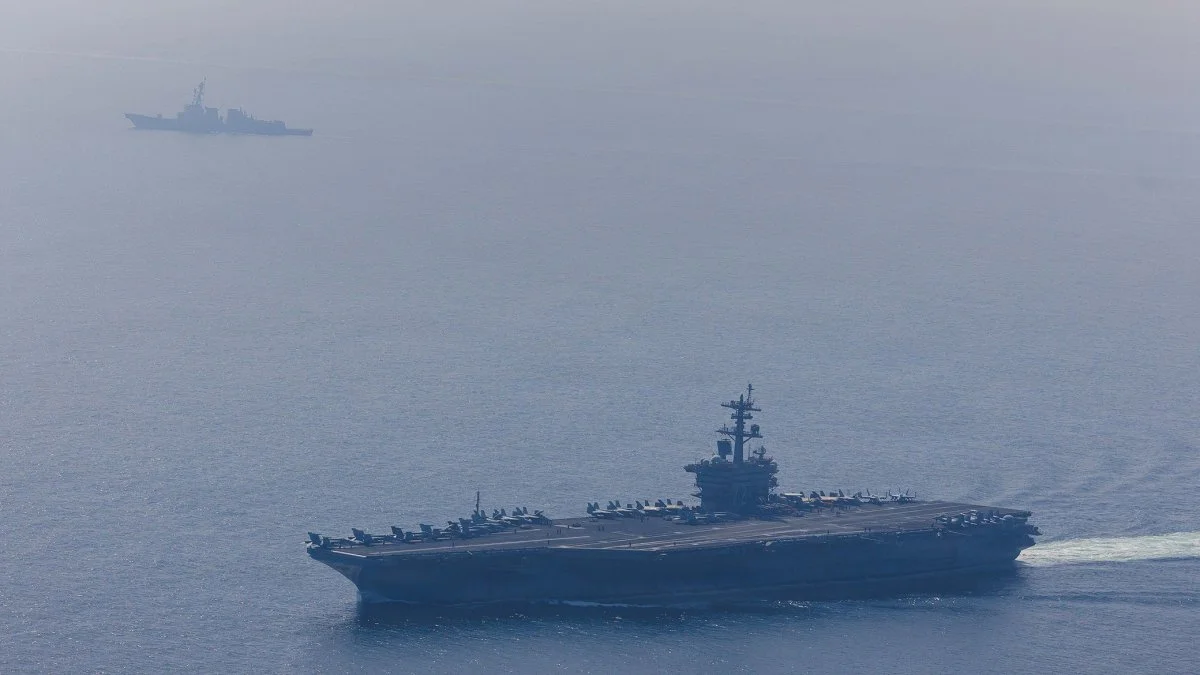
According to the study, Washington could send additional forces and naval assets, including an additional carrier strike group, along with aerial refueling aircraft and other military support.
The aim of these moves is not to enter an immediate confrontation but to raise the cost to Tehran of refusing to negotiate and to persuade it that continued escalation could expose it to further strikes.
In strategic studies, this approach is known as "coercive diplomacy," the combination of threatening the use of force with offering political or economic incentives to push the other side to change its position.
Jensen believes this option offers a greater chance of maintaining coordination with the Gulf states, which are wary of a return to broad military confrontation because of the dangers their vital facilities and economies would face.
He warns, however, that this approach could falter because of differing American and Israeli calculations, as Israel may adopt broader military objectives.
The Iranian leadership may also interpret the continued buildup without new strikes as American hesitation, encouraging it to keep up military pressure or test the effectiveness of the naval blockade.
Thus, the least reliant on direct force of the options still carries a risk of escalation, especially when military moves intersect with multiple political calculations.
Option Two: Limited Strikes to Weaken Iranian Defenses
The second option rests on carrying out a series of limited strikes against selected Iranian military installations, such as radar and air defense sites, with the aim of weakening Tehran's capabilities and demonstrating Washington's readiness to use force.
This concept is based on the idea of calibrated strikes that alter the military balance without entering a comprehensive campaign.
The researcher cites the limited Israeli strike that targeted a radar system linked to Iranian air defenses near Isfahan in April 2024 as an example of operations that seek to demonstrate military capability without necessarily leading to an open war.
The presumed benefit of this option, according to the study, lies in persuading Iran that the United States can inflict additional losses on its defensive capabilities and that continued refusal to reach a settlement could expose it to harsher strikes.
The core problem, however, is the Iranian response.
If Tehran retaliates with a broad attack on American forces or on its allies' interests, the limited strike could become the start of a mounting military exchange rather than a means of containing the crisis.
Here lies one of the paradoxes Jensen discusses: a limited strike may succeed in hitting its military target while failing to achieve the political goal for which it was carried out.
Option Three: Striking High-Value Nuclear Facilities
The third option moves to a more sensitive level, consisting of striking major facilities within Iran's nuclear program.
This scenario differs from limited strikes against air defenses in the nature of its targets, as it directly seeks to reduce the capabilities of the nuclear program or to influence the Iranian leadership's calculations about retaining it.
The researcher cites Operation "Midnight Hammer," which the United States carried out in June 2025 against Iranian nuclear facilities, as a model of American capability to conduct precise, long-range strikes.
The concept rests on the premise that inflicting additional damage on the nuclear infrastructure could prompt Tehran to reconsider its negotiating positions.
The study, however, warns of a possible opposite outcome.
Instead of pushing Iran toward concessions, strikes could reinforce its leadership's conviction that the nuclear program is a strategic guarantee for protecting the state from external military intervention.
In that case, Tehran may move to rebuild the damaged capabilities while increasing its insistence on the nuclear program rather than giving it up.
Striking nuclear facilities also carries political and security risks beyond the damage to the facilities themselves, including the possibility of retaliation against American forces, regional states, or interests linked to Washington.
Thus, destroying a nuclear facility does not guarantee achieving the broader goal of changing Iran's nuclear policy.
Option Four: A Major Special Forces Operation Inside Iran
Jensen outlines a more complex option, consisting of a large-scale operation by U.S. special forces inside Iranian territory, aimed at seizing or removing enriched nuclear material from sites where it is believed to be stored.
This option differs from aerial bombardment; it does not aim merely to destroy facilities but to deal directly with the material that Washington believes could be used to develop a nuclear weapon.
The researcher reviews past military special operations carried out by the United States, Israel, and Ukraine, but stresses that conducting an operation of this kind inside Iran would be far more complex and dangerous.
The targeted sites may be dispersed across multiple facilities, some underground, which raises the risks facing the participating forces and increases the likelihood that the operation turns into a prolonged engagement.
The report warns that American forces could face fierce Iranian resistance, including the possibility that the sites themselves are targeted while U.S. troops are inside them.
Moreover, any ground operation inside Iranian territory, even one with limited objectives, could carry political and military implications beyond the nuclear target and open the door to escalation whose limits would be difficult to control.
Accordingly, achieving a quick and defined result does not appear assured, while the cost of failure could be high on both the military and political levels.
Option Five: A Long Campaign for Naval Control and Securing the Strait of Hormuz
The fifth option focuses on one of the most sensitive dimensions of the confrontation: Iran's ability to threaten commercial shipping and navigation routes in the Gulf and the Strait of Hormuz.
This concept rests on a prolonged military campaign to reduce Iran's capacity to disrupt maritime navigation, rather than relying on scattered strikes in response to attacks.
The study indicates that such a campaign could target multiple military systems linked to Iranian forces' ability to threaten ships, in an attempt to lower the risks to commercial corridors in the short and medium term.
Jensen notes, however, that Iran has developed its naval capabilities in a way that makes eliminating them a complex task, particularly as it relies on military means that can be concealed or dispersed across scattered locations.
For this reason, sustained American operations could require considerable time and the consumption of large quantities of munitions, at a time when U.S. military stockpiles are under increasing pressure.
The researcher also warns that military control over part of the maritime domain does not mean the ability to prevent all Iranian attacks.
Even after weakening Tehran's naval capabilities, it may still be able to use drones, missiles, cyberattacks, or call on its allies in the region to retaliate.
An additional problem arises concerning the global economy.
The longer military operations continue near the Strait of Hormuz, the greater the likelihood of rising oil shipping and maritime insurance costs and continued disruptions to trade and energy flows.
The researcher adds a strategic dimension extending beyond the Middle East, arguing that the munitions the United States expends in confronting Iran reduce the resources available to deter other adversaries, foremost among them China, Russia, and North Korea.
Thus, Washington's success in reducing the Iranian threat to navigation could come at a military and economic cost that affects its ability to confront other crises around the world.
Option Six: A Military Campaign to Threaten the Survival of the Iranian Regime
The sixth option is the broadest of the scenarios the study discusses. It consists of expanding military operations to a level that threatens the Iranian regime's ability to remain in power.
This concept is not limited to striking military or nuclear installations; it aims to persuade the Iranian leadership that continued confrontation could expose the regime itself to the risk of collapse.
The researcher cites the NATO air campaign against Serbia during the Kosovo war in 1999 as a historical example of using military force within a broad political pressure campaign.
Jensen, however, explains that applying a similar model to Iran would face fundamental differences, chief among them the country's size, its population, and the strength of its military and security institutions.
He notes that Iran's area is roughly 151 times that of Kosovo, and that its population exceeds 90 million people.
He also discusses a scenario involving covert operations or cooperation with groups opposed to the regime, but warns that building such capabilities requires a long time and does not guarantee the expected results.
The greatest risk lies in the possibility that air strikes fail to compel the Iranian leadership to surrender or make substantive concessions.
If the regime persists in resistance, Washington may find itself facing the choice of expanding operations further, and perhaps sliding into a prolonged ground war.
The researcher points out that this possibility could prove exceptionally costly, given Iran's size, population, and military capabilities.
Any campaign targeting the regime's survival also carries broad humanitarian and political risks, including the possibility of greater suffering for civilians, wider internal turmoil, and a diminished capacity to contain the war regionally.
This scenario therefore represents the highest degree of military pressure among the six options, but it also carries some of the most complex and hard-to-predict potential outcomes.
The Strait of Hormuz and the Economic Blockade: What Do the Latest Developments Say?
The study gains additional significance in light of developments in the confrontation in the days following its publication.
In a military assessment issued on 8 November by the Institute for the Study of War (ISW) and its Critical Threats Project (CTP), the researchers reported that the United States continues to enforce a naval blockade on Iranian ports, as part of a campaign aimed at increasing economic pressure on Tehran.
The assessment stated that U.S. forces disabled an oil tanker flying the flag of Saint Kitts and Nevis, named "Hoda," on 7 November, after it attempted to bypass the blockade following a visit to an Iranian port.
On the other side, the report recorded continued attacks on ships in and around the Strait of Hormuz.
It cited the British Maritime Trade Operations centre reporting that a vessel was struck by an unidentified projectile while leaving the strait on 7 November, along with another report of a fire on a tanker near Khasab in the Sultanate of Oman.
It also noted the Islamic Revolutionary Guard Corps' announcement that two ships had struck naval mines, while the researchers cautioned that the Iranian account could not be independently verified.
The institute believes Iran seeks, through disrupting navigation, to pressure for recognition of its role in controlling the passage of ships, while Washington continues to use the blockade to restrict Iranian trade.
These developments show that the confrontation now combines economic pressure, military operations, and maritime threats, the context from which the six options presented by Jensen emerge.
Can Washington Turn Military Superiority into Political Gains?
The central idea of the CSIS study is the distinction between the ability to carry out military operations and the ability to achieve political objectives.
The United States possesses extensive military capabilities that allow it to conduct precise strikes and prolonged campaigns, but it cannot ensure that the Iranian leadership will respond to this pressure in the way Washington wishes.
Limited strikes could lead to retaliatory responses, while attacks on nuclear facilities could encourage Iran to rebuild its program.
Special operations could also turn into prolonged clashes, while a naval control campaign consumes vast resources without ending all threats.
Expanding the war to a level that targets the regime's survival carries the risk of entering an open conflict whose duration, cost, and outcomes are difficult to control.
For this reason, Jensen cautions against assuming that the success of earlier military operations guarantees greater political gains should the United States expand its use of force.
He also argues that continuing negotiations under military pressure remains the option with the least risk in terms of the scope of direct operations, but it is not a guarantee of reaching an agreement, and Tehran may use the time to strengthen its capabilities or deepen divisions among its adversaries.
A War That Could Extend Beyond Iran
The repercussions of the six military options are not confined to U.S.-Iranian relations; they extend to Gulf security, the future of international navigation, and the global military balance.
Gulf states face direct risks from any widening of the war, whether through strikes on energy facilities, ports, and airports, or through disruption to trade and investment.
Other countries may be affected by rising energy and shipping costs, particularly economies most dependent on imports.
The United States, for its part, faces a dilemma concerning the distribution of its military resources between the Middle East and other regions of strategic importance.
The study notes that widening the war on Iran could consume munitions and capabilities that Washington needs to deter other major powers, making the calculations of confrontation linked to American global strategy rather than to Iran alone.
Meanwhile, continued Iranian attacks on ships or infrastructure make a settlement more difficult and deepen regional fears of a new escalation.
Hence, the essential question is not only which type of strike comes next, but also what political objective it is meant to achieve, and the limits at which escalation could be halted.
Conclusion: Six Military Paths and One Political Question
The Center for Strategic and International Studies study reveals that Washington possesses a broad range of military tools to continue pressure on Iran, but in every option it faces a complex equation between potential military gains and the risks of escalation.
Coercive diplomacy may fail to achieve concessions, limited strikes may invite a broader response, targeting nuclear facilities may deepen Tehran's attachment to its nuclear program, and special operations may turn into a dangerous ground confrontation.
As for an extended naval campaign, it may drain American munitions and resources without any guarantee of eliminating the threats, while a campaign aimed at the survival of the regime could open the door to a long war with uncertain outcomes.
In conclusion, the study highlights a fundamental strategic truth: possessing the force capable of inflicting severe damage on an adversary does not necessarily mean possessing the ability to impose a political settlement on it.
Accordingly, the most important question for Washington does not appear to be limited to the size of the military force that can be used against Iran, but extends beyond that to defining the outcomes it wants to achieve, the cost it can bear, and the path that allows the confrontation to end without turning it into a wider war.
The primary study: Benjamin Jensen, "What are the U.S. military options available in Iran?", Center for Strategic and International Studies (CSIS), 2 November 2026.
Source of the military developments: Institute for the Study of War (ISW) and the Critical Threats Project (CTP), "Military Assessment of Iran," 8 November 2026.


