


Wasl News | Sistan and Baluchestan clashes
Security Escalation in Sistan and Baluchestan
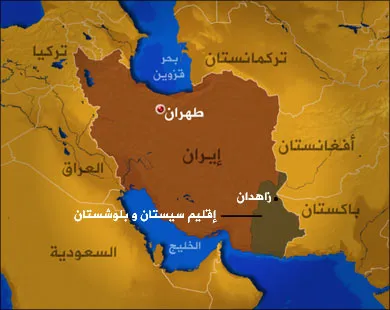
Over the past two days, Iran's southeastern province of Sistan and Baluchestan witnessed a series of armed confrontations and security operations in the cities of Zahedan and Rask, amid rising tension between Iranian forces and armed groups active in the region's predominantly Sunni Baluch population.
The developments come at a time when the province, which borders Pakistan and Afghanistan, has seen increasing activity by Baluch armed groups, including factions that had previously announced their joining of a coalition called the "People's Fighters Front." The front was formed in late 2025 (corresponding to Rajab 1447 AH) with the aim of coordinating the activities of several armed factions in Baluchistan.
Police Sergeant Killed in Attack on Checkpoint in Rask
The latest developments began at dawn on Thursday, 1 October 2026 (corresponding to 20 Rabi al-Thani), when the Ahmad Abad checkpoint at the entrance to the city of Rask was attacked by armed men, resulting in the death of Iranian police Senior Sergeant Ali Reza Sanjouli.
The Sistan and Baluchestan Provincial Police confirmed Sanjouli's death, noting that search operations continue to identify and arrest the attackers. No armed group had claimed responsibility for the attack at the time of writing.
Revolutionary Guards Announce Six Militants Killed in Zahedan
In Zahedan, the provincial capital, clashes broke out the same day in the Manzel Ab area and lasted several hours, amid reports of heavy gunfire and the use of rocket-propelled grenades.
The Islamic Revolutionary Guard Corps (IRGC) said its forces carried out an operation against an armed cell, announcing that six people it described as members of a "terrorist group" were killed, and adding that explosive devices and equipment were found during the operation.
The IRGC did not provide details on the identities of those killed, while the rights organisation Haalvsh, which monitors developments in Sistan and Baluchestan, confirmed that clashes had taken place between security forces and armed individuals.
Five Members of the Afghan Shia Fatemiyoun Militia Reportedly Killed
In a separate development in Zahedan, local sources reported the deaths of five members of the Afghan Fatemiyoun militia in an attack targeting an IRGC force.
According to official Iranian media, the attack began with the explosion of a roadside bomb, followed by an armed clash with forces that arrived at the site of the blast. The IRGC, for its part, announced the death of one of its members during the confrontations.
For its part, Haalvsh, citing eyewitnesses, confirmed the deaths of five Fatemiyoun members in the attack, while the final death toll remains unverified independently, given the differing accounts between official and local sources.
Press reports had recorded in recent weeks the deployment of members of the Afghan Shia Fatemiyoun militia in various areas of Sistan and Baluchestan, in parallel with rising security and military activity by Iranian forces in the province.
New Clashes in Rask
On Friday, 2 October (corresponding to 21 Rabi al-Thani), escalation continued with new clashes in areas under the jurisdiction of Rask, where Haalvsh reported the deployment of military and security forces in a number of villages, and the sound of gunfire and explosions during raids and sweeping operations.
Reports also referred to Iranian forces carrying out security operations in residential areas following armed attacks on security installations, though the final death toll from these clashes has not been clarified.
A Scene Recalling Occupation Practices
In a move that recalls the practices of the Israeli occupation, a circulating video documented Iranian security forces blowing up a house in Zahedan, which was found to belong to the family of a Baluch citizen killed in an earlier armed clash with the authorities.
Local and rights sources affirm that the demolition of the homes of families of wanted persons or those accused of involvement in armed activity has become a systematic security pressure tool that Tehran applies against residents of Sistan and Baluchestan.
In this context, Baluch voices condemned these practices and described them as blatant "collective punishment," likening them to the systematic house demolition policy carried out by the Israeli occupation against Palestinian families in occupied Palestine.
The circulation of the video comes amid escalating security operations and armed clashes in Zahedan and Rask.
Why Are Clashes Escalating in Baluchistan?
The continuing escalation in Sistan and Baluchestan cannot be understood apart from a long reality of marginalisation and pressures that activists and rights organisations say Baluch residents face, in one of Iran's poorest and most marginalised regions, despite its strategic location and economic resources and potential.
Baluch activists and rights organisations say that the province's residents, most of whom are Sunni Muslims, suffer from religious, economic and political discrimination, alongside security restrictions and the heavy deployment of military forces, which, according to these bodies, has deepened feelings of anger and tension among local residents.
For many people in Baluchistan, the issue is not limited to confrontation between Iranian forces and armed groups; it is also tied to broader demands concerning dignity, religious rights, equality and an end to the marginalisation of the Baluch population. As military operations, arrests and clashes continue, civilians in the region remain the party most exposed to the consequences of the conflict.
The continuation of clashes shows that a security-only approach has not addressed the causes of tension in Baluchistan, as popular demands for justice, equality and respect for residents' rights persist, far from policies of collective punishment or restrictions on the local community.
Dear readers, to receive all the latest, follow us on Telegram


