


The energy crisis in the Middle East has entered a more complicated phase after the Saudi East–West oil pipeline went out of service following a drone attack, at a time when shipping through the Strait of Hormuz is already severely disrupted, and concern is growing that the danger could spread to Bab al-Mandab amid military escalation in Yemen.
The East–West pipeline, also known as the Petroline, extends for about 1,200 kilometres from eastern Saudi Arabia to the Red Sea port of Yanbu. In recent months, the pipeline has become one of the most important alternatives on which the Kingdom relies to transport oil away from the Strait of Hormuz. It was carrying between four and five million barrels per day, equivalent to roughly 4% to 5% of global oil supplies.
However, a drone attack on 11 September 2026 (30 Rabi al-Awwal 1448 AH) prompted Saudi Arabia to shut the pipeline as a precautionary measure. Riyadh and Baghdad said the drones were launched from Iraqi territory, where armed groups linked to Iran are active, while no party has claimed responsibility for the attack. US President Donald Trump later said he believed Iran was responsible, without presenting any publicly announced evidence to prove this.
A blow to a route that was meant to bypass Hormuz
The significance of the attack lies in the fact that the East–West pipeline was not merely an internal oil facility. During the current war, it had become a vital route for bypassing the bottleneck in the Strait of Hormuz.
Ship traffic through the strait has fallen sharply as the war between the United States and Iran continues. Shipping data showed that only four vessels crossed the strait on one day in mid-September, compared with an average of 18 ships per day during the previous ten days, while traffic before the war was far greater.
For this reason, Saudi Arabia was transporting millions of barrels per day from its eastern fields across the desert to Yanbu, before shipping them from the Red Sea. But the pipeline outage transferred the crisis from the Gulf to that same alternative route.
Oil market sources told Reuters that Yanbu's stocks available for export would cover only about five to seven days if the pipeline remained shut, while estimates for repairing the damage ranged from a faster partial resumption to a full return that could take five or six weeks.
On 18 September 2026 (7 Rabi al-Thani 1448 AH), reports said Aramco had informed some European refineries that they would not receive their usual October shipments after three pumping stations were damaged and loading operations at Yanbu were disrupted. In response, the company began increasing shipments from the Gulf through ship-to-ship transfers near the Omani port of Sohar to make up for part of the missing volumes. (Reuters)
Bab al-Mandab enters the calculation
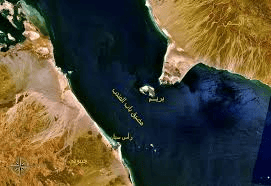
The second problem is that the route from Yanbu to global markets through the Red Sea is no longer free of risk either.
Iran-backed Houthis made rapid gains on Yemen's western coast during September, seizing the city of Mokha and other areas, including Mayun Island at the entrance to Bab al-Mandab, according to Reuters reports. This advance has heightened concern about navigation in the strait that links the Red Sea with the Gulf of Aden and the Indian Ocean.
This follows the collapse of a long period of calm between Saudi Arabia and the Houthis. On 13 July 2026, Saudi-backed Yemeni government forces bombed Sanaa airport to prevent the landing of an Iranian aircraft, according to the Yemeni Ministry of Defence, before the Houthis responded by firing missiles towards Saudi Arabia, in the first attacks they have announced against the Kingdom since the truce began in 2022.
The escalation later developed into attacks on tankers and Saudi facilities, alongside Saudi and Yemeni military operations against Houthi positions. In recent weeks, renewed fighting on the western coast has displaced more than 112,000 people within Yemen, according to the International Organization for Migration.
Saudi Arabia thus faces a dual problem: the Strait of Hormuz is suffering a sharp decline in shipping traffic, while the alternative route through the Red Sea has also become exposed to growing security pressures.
Oil prices respond quickly
These developments were quickly reflected in the markets.
After the East–West pipeline was disrupted and risks on shipping routes rose, Brent crude exceeded $109 per barrel during the week, before later retreating to around $102–103 as signs emerged that parts of the pipeline could be restarted and Saudi Arabia increased its shipments via alternative routes.
Brent had closed on 13 September at $105.68 per barrel, after rising by about 9% over the previous week, while petrol, diesel and jet fuel prices also rose compared with pre-war levels.
International Energy Agency figures indicate the pressure on Saudi supplies: the Kingdom's reported production fell from about 10.9 million barrels per day in February to 6.2 million barrels in August, the lowest level in more than three decades, amid disrupted export routes and the regional war.
From a shipping-lane crisis to a supply-network crisis
In the early months of the war, the assumption was that the disruption in Hormuz, however serious, could be mitigated by using alternative infrastructure in the region, above all the Saudi East–West pipeline and Red Sea ports.
But recent developments have shown the limits of that assumption: the pipeline outage is placing pressure on the alternative land route, while the Houthi advance and maritime threats are placing Bab al-Mandab itself under further risk.
This does not mean Saudi exports have stopped entirely. Riyadh still has stocks and alternative outlets, and it is seeking to restore the pipeline's operation gradually. Nevertheless, the combination of weak traffic through Hormuz, the disruption of the East–West pipeline, and rising risks at Bab al-Mandab has narrowed the room for manoeuvre of one of the world's largest oil exporters.
For the United States, the crisis adds a new economic challenge to the war with Iran: the longer supply and shipping disruptions last, the harder it becomes to keep oil flowing at prices markets can bear. But the claim that the pipeline outage alone brought down the American strategy, as some commentators argue, remains a political assessment. What is certain so far is that the attack temporarily removed one of the most important safety valves on which oil markets had relied to get past the Hormuz crisis.


