


The long-standing rivalry between Saudi Arabia and the UAE, which erupted in recent weeks across southern Yemen, has brought about a dramatic shift in regional balances of power, threatening to destabilise other fragile countries where the two states hold significant influence.
Saudi Arabia, which supports the internationally recognised Yemeni government, intervened last month after UAE-backed separatists swept across large areas and seized strategic territory. The kingdom struck the rebel fighters and targeted a UAE shipment that Riyadh said was carrying weapons intended for the group. The UAE moved quickly to withdraw its forces, while the separatists' leadership council dissolved itself urgently.
However, the rift between the two oil-rich monarchies has begun to extend beyond Yemen. Saudi Arabia, concerned by what it regards as aggressive military and foreign policy steps by its smaller neighbour, is moving to counter the deep network of influence that Abu Dhabi has spent years building in the Horn of Africa and around the Red Sea.
A Saudi diplomat, who requested anonymity because he was discussing a highly sensitive matter, said the expansion of UAE influence in this region "conflicts with the kingdom's view of these territories as part of its strategic security belt", adding that Riyadh is determined to send clear messages regarding its "red lines".
The sudden and more assertive Saudi tone has confronted the countries of the region with the challenge of dealing with this division. For years, Saudi Arabia and the UAE largely worked in harmony, backing other authoritarian regimes in the face of the Arab Spring uprisings and uniting against the Iran-backed Houthi movement in Yemen.
In recent days, however, Saudi Arabia has sought to reinforce other alliances aimed at containing its rival, and has entered into talks with both Egypt and Somalia to expand security cooperation among the three countries, according to a senior Somali security official. The Somali federal government has also announced its intention to cancel its defence agreements with the United Arab Emirates, which operates commercial ports and military bases in at least three regions — Somaliland, Puntland and Jubaland — where the government in Mogadishu has little or no meaningful presence.
At the same time, flight-tracking data has shown that aircraft arriving from the UAE — which analysts believe are carrying supplies to Abu Dhabi's proxies in countries such as Chad, Libya and Sudan — have recently rerouted their flight paths to avoid Egyptian, Saudi and Somali airspace.
Liam Karr, head of the Africa team at the Critical Threats Project of the American Enterprise Institute, said that "the shift here is enormous", referring to the change in the positions of the UAE and Saudi Arabia.
He added that in late December, it appeared that the UAE and its allies in Yemen were moving to establish control over both the northern and southern sides of the Bab al-Mandab Strait — a narrow but vital waterway linking the Red Sea to the Gulf of Aden — as well as the Gulf of Aden itself. However, with Saudi Arabia gaining the upper hand, "the picture now suggests that the opposite may be true", Karr said.
When contacted for comment, the UAE Ministry of Foreign Affairs did not directly answer questions about tensions with Saudi Arabia. The Saudi Ministry of Media in Riyadh and a spokesperson for the Saudi Embassy in Washington did not respond to requests for comment, while other senior officials declined to make any statements or did not respond to enquiries.
In the UAE, analysts and commentators have framed the recent Saudi moves as the product of what they call an "elder brother complex", meaning Riyadh's sense that it has been left behind at a time when its smaller neighbour, in terms of territory and population, has played a role beyond its size on the regional and international stage.
In 2022, for example, the UAE overtook China to become the largest investor in Africa, according to data from fDi Markets, a global investment monitoring platform owned by the Financial Times. These investments have ranged from operating commercial ports in Somalia and Djibouti to agricultural projects in Ethiopia, Kenya and Uganda, aimed at securing the UAE's food imports.
Abdulkhaleq Abdulla, a prominent Emirati academic, said that "the Saudis see the UAE as a challenge to their leadership in the Gulf, perhaps the only challenge at present, and a credible challenge across the entire region".
He added that Saudi Arabia probably felt that "something had to be done, and perhaps the most suitable place to start was Hadramout", referring to the oil-rich Yemeni region that has been the focus of recent clashes.
Disputes between Saudi Arabia and the UAE, over issues ranging from border disputes to oil production policies, are not new; they have repeatedly surfaced at intervals since the UAE was founded out of a British protectorate in 1971.
However, in 2014, when Crown Prince Mohammed bin Salman emerged as a central figure in the power equations within the Saudi ruling family, UAE President Mohamed bin Zayed Al Nahyan saw in him a "smaller version of himself", according to Christian Coates Ulrichsen, a Middle East researcher at the Baker Institute. In the following years, the relationship between the two leaders grew close, and they "seemed to be reshaping the Gulf", Ulrichsen said.
The coalition supporting fighters battling the Houthi movement, which seized the Yemeni capital Sanaa in 2014 and later extended its control over large areas of the north-west of the country, was perhaps the most prominent indicator of the partnership that was emerging at the time. However, differences in interests, strategies and objectives soon produced new fissures between the two sides.
Saudi Arabia, through its support for the internationally recognised government, sought to preserve Yemen's unity and territorial integrity. The United Arab Emirates, which regards political Islam as an existential threat, narrowed the scope of its interest to focus on confronting Islamist factions in the country, including those within the anti-Houthi coalition.
As a result, the UAE pursued a policy of funding, arming and uniting separatist forces in southern Yemen, and in 2017 it helped sponsor the founding of the Southern Transitional Council, headed by Aidarous al-Zubaidi, a veteran separatist and former governor of Aden.
Relying on proxy fighters loyal to it, the United Arab Emirates began to expand its presence, establishing airstrips, outposts and other infrastructure in port cities or on islands off the coast, sometimes without the approval of the Saudi-backed government, which gave it a considerable strategic advantage along some of the world's most important maritime routes.
This is a pattern the UAE has repeated in countries such as Libya and Sudan, where it has forged alliances with non-state actors, allowing it to establish a foothold serving its investments, resources, security and political influence, in clear contrast to the more cautious Saudi approach, which is based on supporting and preserving traditional governments.
The Saudi diplomat said that "the Emirati approach, from the Saudi perspective, produces centres of power outside the framework of the state, which may lead to the weakening of Red Sea states and contribute to their fragmentation".
Andreas Krieg, associate professor at the School of Security Studies at King's College London, described the UAE's regional network as "the axis of the separatists".
He said: "Abu Dhabi is comfortable operating without reaching the level of formal diplomacy. It builds its influence through a network of commercial entities, the provision of logistics, security assistance, intermediaries and armed local partners."
But the rapid advance of the Southern Transitional Council in the governorates of al-Mahra and Hadramout placed its forces along the Yemeni border with Saudi Arabia. This expansion prompted the kingdom to move to reverse the Southern Transitional Council's gains and confront the UAE's role openly — although an Emirati official described the accusation that Abu Dhabi directed this advance as "entirely false".
This resulted in a "complete separation" in the Saudi-Emirati relationship in Yemen, according to former Yemeni Foreign Minister Khaled al-Yamani. He added: "The Emirati withdrawal was truly shocking. In just two days, they completely disappeared."
Al-Yamani said the UAE appeared to have refrained from engaging in any diplomatic efforts immediately after its withdrawal, even when some Southern Transitional Council leaders were summoned to Riyadh, and accused the Saudi group's members of keeping them out of contact. He said the message the UAE seems to be sending to Saudi Arabia is: "Now the problem is yours; deal with it."
Riyadh also accused the UAE of smuggling Aidarous al-Zubaidi, whom the government had accused of treason, out of Yemen to Somaliland via Mogadishu on 7 January. Karr said the alleged movement of al-Zubaidi through Somali territory comes within a broader pattern that the government in Mogadishu regards as a UAE violation of the country's territory.
Abu Dhabi maintains a deep-water port and an associated airstrip in Berbera, Somaliland, the separatist region in northern Somalia. In neighbouring Puntland, which enjoys semi-autonomous rule, the UAE has invested in a port and established a military base in Bosaso on the southern coast of the Gulf of Aden.
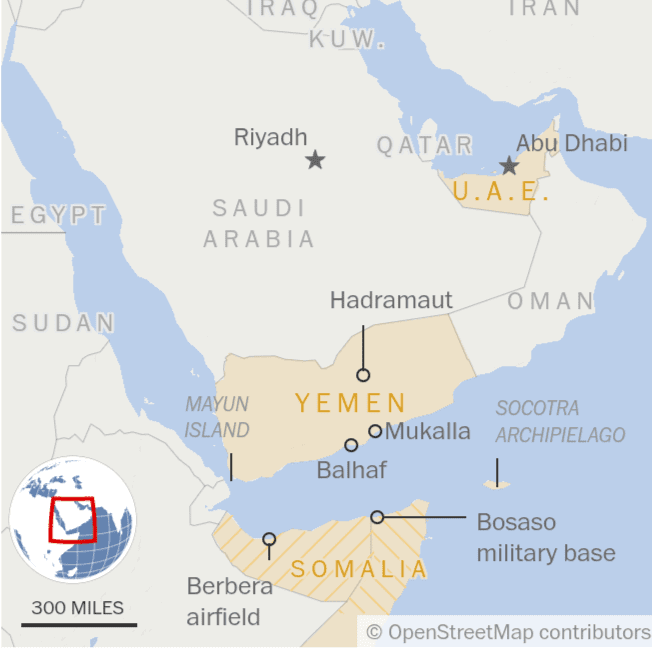
According to analysts, the base in Bosaso is a key logistical hub for the UAE, and includes a hangar for drones used in UAE strikes against Islamic State elements in Puntland. Bosaso previously received several IL-76 cargo aircraft arriving in or departing from the UAE, but those flights have stopped in recent weeks, according to flight-tracking data.
Justin Lynch, chief executive of the research and analysis firm Conflict Insights Group, said of the Rapid Support Forces, a paramilitary group fighting the Sudanese army: "We know that some of the planes landing in Bosaso are providing support and supplies to Rapid Support Forces fighters in Sudan."
The UAE has a long-standing relationship with the commander of the Rapid Support Forces, Mohamed Hamdan Dagalo, who sent thousands of mercenaries to fight alongside UAE-backed forces in Yemen. The UAE has also previously invested in Sudanese gold mining and large agricultural projects, and concluded a $6 billion deal to develop a port in Sudan before the civil war broke out.
The UAE has denied arming the Rapid Support Forces, although there is evidence documenting the presence of UAE-purchased weapons among Rapid Support Forces stockpiles seized by the Sudanese army.
The diplomat said Saudi Arabia is prepared to use "all available means" to deter the influence of the Rapid Support Forces.
Nevertheless, although the rivalry extends beyond Yemen, some believe there are benefits in the two countries' borders being clear, and in knowing what kind of intervention each can tolerate in areas that each regards as within its sphere of influence.
Badr al-Saif, assistant professor at Kuwait University and associate fellow at Chatham House, said: "It is important that all parties spell out their red lines. In the long term, I see clarity of purpose."
The Washington Post.


