


El Fasher, Sudan, looks like a "vast crime scene," with large piles of bodies accumulating in its streets, as the paramilitary Rapid Support Forces work to destroy the evidence that reveals the scale of their massacre.
Six weeks after the Rapid Support Forces took control of the city, analyses indicate that the bodies have been gathered into dozens of piles in preparation for burial in mass graves or for burning in large pits.
With the capital of North Darfur state still closed to outsiders, including United Nations war crimes investigators, satellite images have revealed a network of burned and newly dug mass pits believed to be intended for disposing of large numbers of bodies.
Up to 150,000 residents of El Fasher have been unaccounted for since the city fell to the Rapid Support Forces. They are not believed to have left the city, and this grim development comes amid increasingly bleak speculation about their fate.
The latest analysis by Yale University indicates that the markets are no longer in use to the extent that they have begun to be overgrown with vegetation, and that all livestock appears to have been removed from the city, whose population was 1.5 million before the war began in 1444 AH (April 2023 AD).
Raymond said: "The city has begun to look a lot like a slaughterhouse."
No expert or agency has been able to clarify where the tens of thousands of missing residents are since El Fasher – the army's last major stronghold in the region – fell on 26 October after a brutal siege of 500 days by the Rapid Support Forces that caused famine.
The Guardian has spoken to sources who described the detention of El Fasher residents in detention centres in the city, although the numbers detained remain small.
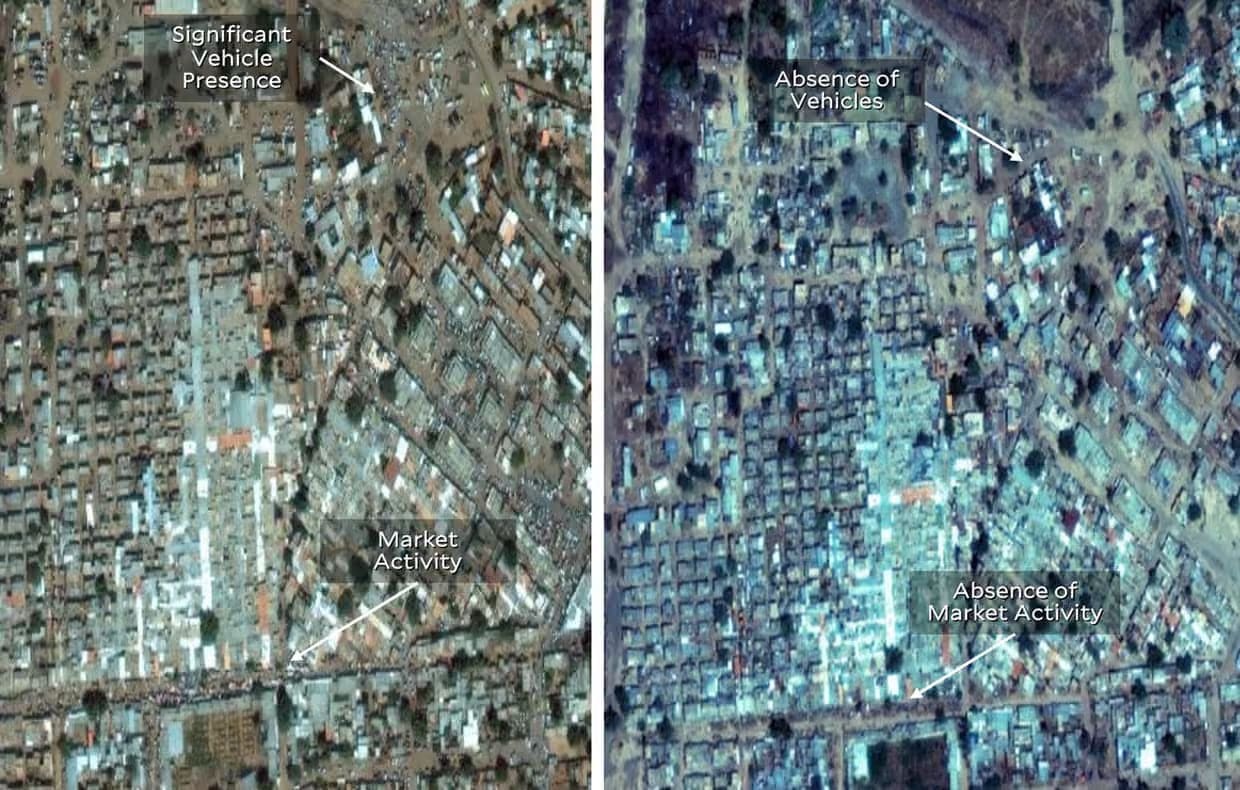
Satellite images from 1447 AH (August 2025 AD), on the left, show evidence of market and vehicle activity around El Fasher, while an image taken on 17 November 2025, on the right, shows no signs of life in the city. Image: Humanitarian Research Lab/Yale School of Public Health.
Rapid Support Forces officials have promised to allow the United Nations to enter El Fasher to deliver aid and investigate the atrocities, but so far the city remains out of reach for humanitarian organisations as well as UN officials.
Aid convoys are understood to be waiting in neighbouring cities and towns while negotiations continue for security guarantees from the Rapid Support Forces. So far, the paramilitary group, which has entered its third year of war with the Sudanese Armed Forces, has refused to provide any guarantees.
A UN source said: "A security assessment is needed before we plan to send assistance. At present, there is no guarantee of safe passage or protection of civilians, humanitarian workers or humanitarian assets."
Despite uncertainty about how many people may still be alive inside El Fasher, the need for aid to reach the city is critical, with reports of "staggering" levels of malnutrition among those who have managed to flee. International experts have declared that the city is in a state of famine.
Raymond said some residents, with whom his team later lost contact, communicated with them during the first two days of the attack, reporting that up to 10,000 people had been killed.
Human rights experts now believe that El Fasher is likely to be the worst war crime of the Sudanese war, which has already been marked by mass atrocities and ethnic cleansing.
Meanwhile, calls have been repeated for a comprehensive investigation into the Rapid Support Forces' attack on the Zamzam displacement camp, seven miles (12 km) south of El Fasher, six months ago.
A new Amnesty International report documents how the Rapid Support Forces targeted civilians, took hostages, and destroyed mosques and schools during a large-scale attack on Zamzam camp, and called for an investigation of the forces for "war crimes".
Source: The Guardian (UK).


