

Security and humanitarian crises in the African Sahel continue to drive millions of people to flee within their countries or seek refuge in neighbouring states, amid persistent armed violence, damage to essential services and difficulties in delivering humanitarian aid.
The UNHCR data dashboard for the Sahel crisis shows that the total number of internally displaced persons registered in the countries covered by monitoring exceeds 3.2 million, according to the latest data available for each country.
However, this total combines statistics issued on different dates and does not represent a unified field census conducted in November 2026.
Burkina Faso: The Highest Recorded Displacement Figures
Available data show approximately 2.06 million internally displaced persons registered in Burkina Faso, according to the latest government update listed in March 2023.
This figure reflects the scale of displacement that has accumulated over years of fighting and security disturbances, but it does not precisely determine the current number of displaced persons given the age of the update.
Niger and Mali: Continuing Burdens of Displacement
In Niger, updated data through September 2026 indicate 548,386 internally displaced persons.
As for Mali, the UNHCR dashboard records 414,524 internally displaced persons, based on data from September 2025.
Areas in both countries face security challenges linked to the spread of military activity, as well as difficulties in accessing essential services in rural and border regions.
Attacks and repeated displacement are damaging agricultural and commercial activities, increasing the vulnerability of local communities that depend on farming, herding and traditional markets.
Mauritania: Pressures of Hosting Refugees
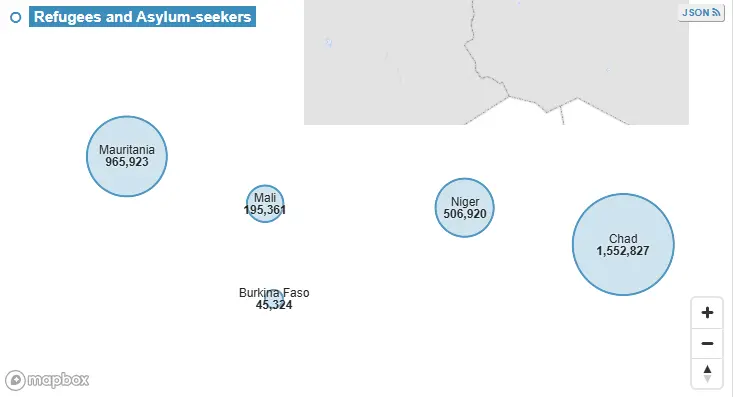
UNHCR data record approximately 965,923 refugees in Mauritania, according to an update from September 2026, within the regional monitoring of the Sahel crisis.
This figure highlights the humanitarian burdens facing host countries for those fleeing conflicts, alongside the need to support host communities and improve water, food, health and education services.
A Cross-Border Crisis
Humanitarian indicators reflect the widening impact of conflicts in the Sahel, as its consequences are not limited to the countries experiencing fighting, but extend to neighbouring countries that receive those fleeing and bear additional pressure on resources and services.
These conditions underscore the need to support civilian protection programmes and facilitate humanitarian access, alongside addressing the factors that lead to repeated displacement and loss of livelihoods.
Providing recent and consistent data on displaced persons remains a significant challenge in the region, so that humanitarian organisations can determine actual needs and direct aid to the most affected areas.


