


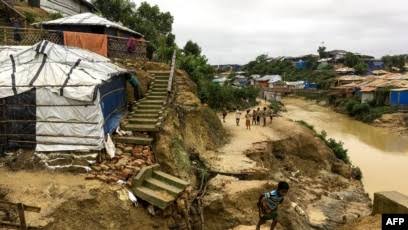
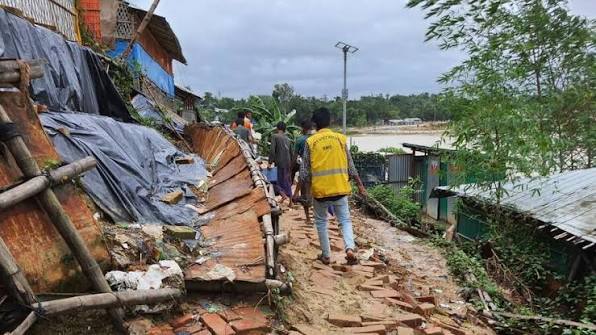
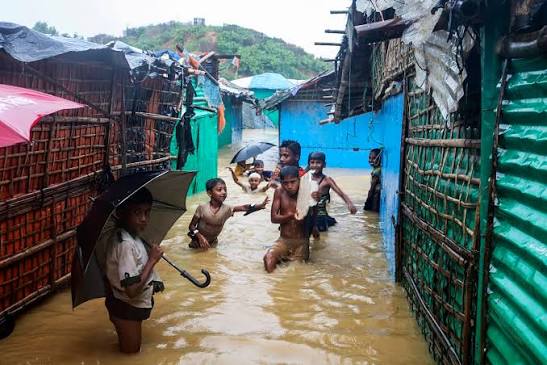
Abdur Rozak had not expected his flight from the war in Myanmar in search of safety to become a new tragedy inside refugee camps in Bangladesh. Amid the heavy monsoon rains that struck the Rohingya camps in Cox's Bazar, mud slid from a hill toward his family's bamboo shelter while the women and children were asleep. The disaster killed two of his daughters and two of his grandchildren.
According to a report by Inter Press Service (IPS) by journalist Mohammad Zunaed, Rozak's tragedy illustrates the harsh paradox faced by the Rohingya in Bangladesh: people who fled persecution and violence in Myanmar seeking protection, only to find themselves facing new dangers inside overcrowded camps built on slopes vulnerable to landslides and flooding.
Overcrowded camps facing a harsh monsoon season
Bangladesh hosts around 1.2 million Rohingya and forcibly displaced people from Myanmar, most of whom live in 33 highly congested camps in the Cox's Bazar area. These camps were originally established as emergency settlements, but after years of continued displacement they have effectively become long-term places of residence.
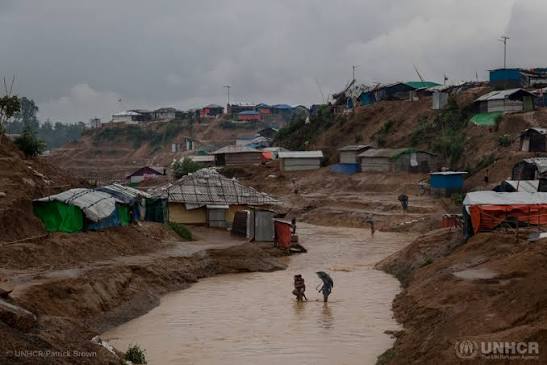
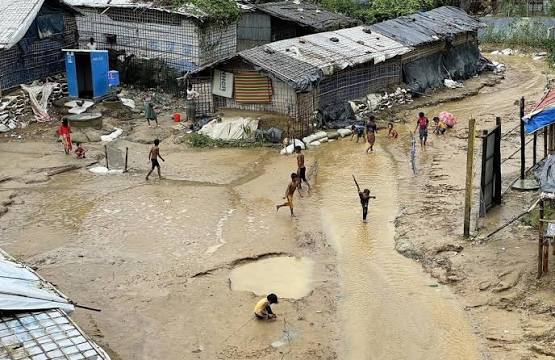
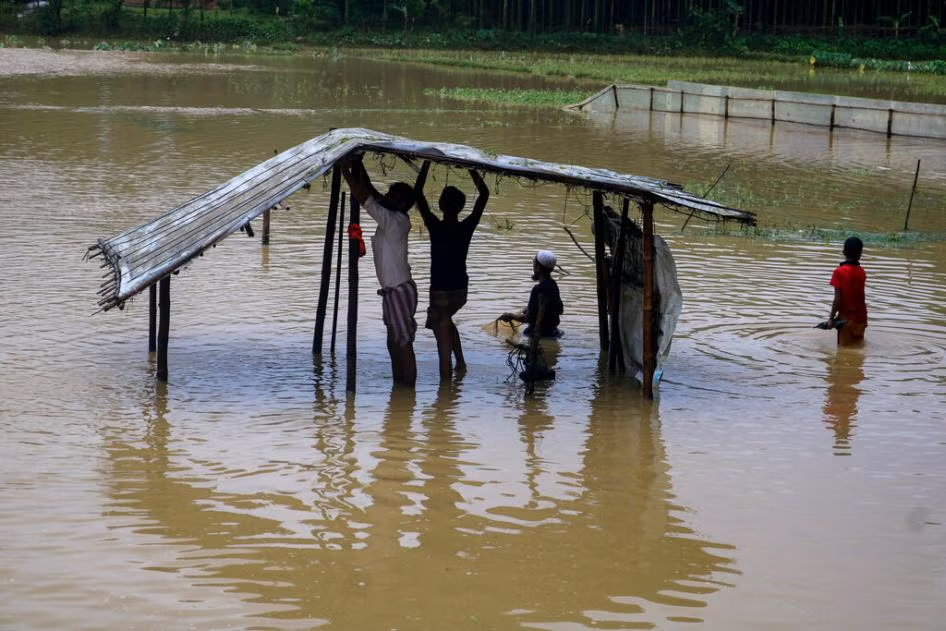
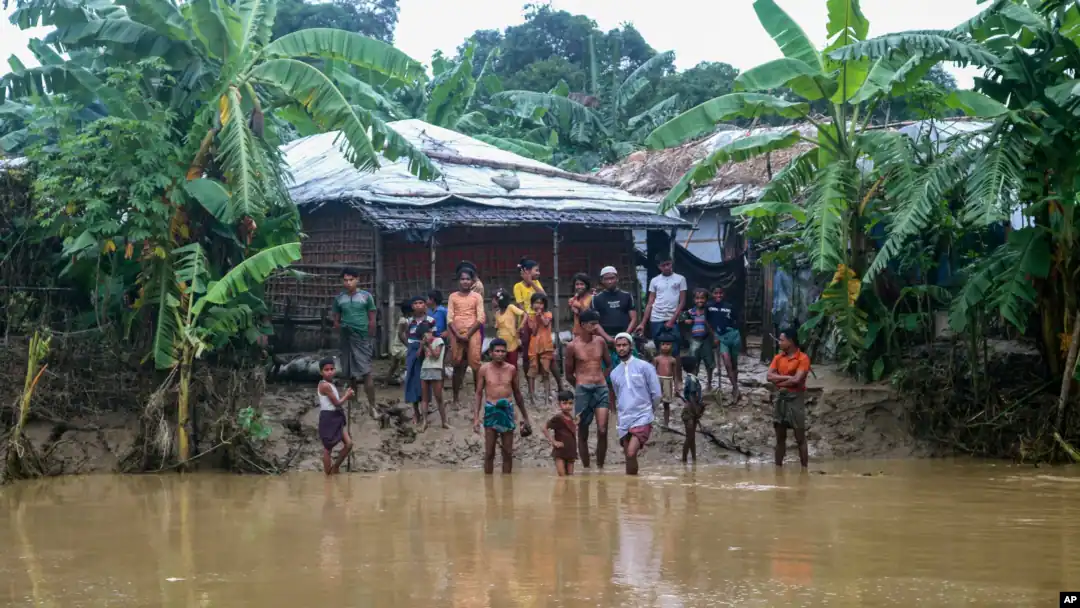
The fragility of the situation is compounded by the nature of the camps themselves. Bamboo and plastic-sheet shelters are spread across steep slopes and in fragile environmental areas. As displacement continues, overcrowding, weak drainage networks, the fragility of the shelters, and a shortage of funding have become factors that increase the impact of natural disasters.
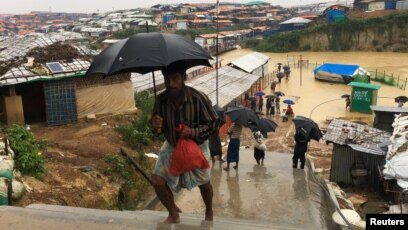
Between 4 and 9 July 2026, the camps recorded hundreds of weather-related incidents, while landslides caused the displacement of thousands of refugees and damage to homes, roads, bridges, toilets, water facilities and education centres. According to the report, at least 17 people were killed and more than 3,000 others were displaced during the July landslides and weather-related incidents.
The Bangladeshi authorities attempted to relocate more than 1,000 refugees away from the most dangerous areas, but the evacuation faced a fundamental problem: the limited availability of safe alternatives, as well as the lack of basic housing and services at some relocation sites.
New waves of flight
The roots of the Rohingya crisis in Bangladesh go back to successive waves of flight from Myanmar. After the large-scale military campaign in 2017, more than 700,000 refugees arrived in Bangladesh, creating one of the largest refugee concentrations in the world.
But the camps have not stopped receiving those fleeing. Since fighting escalated in Myanmar, between about 152,000 and 153,640 Rohingya have entered Bangladesh, depending on the date of the count and the method of calculating the figures. This newest group faces an even more precarious situation: many new arrivals have not received official housing, and some have been forced to rent space or build temporary shelters on unstable slopes.
The newcomers thus face a double problem: fleeing the conflict in Myanmar, then trying to find a safe place inside camps that already suffer from limited land and resources.
A flight that does not end at the border
The IPS report highlights the stories of a number of new arrivals, including children and young people who lost family members during the war or after arriving in Bangladesh.
Among them is Mohammad Kais, 13, who was studying in the town of Buthidaung in northern Rakhine State when fighting intensified between the Myanmar military and the Arakan Army. Schools closed, food became scarce, and medical services declined, before his family was forced to flee through forests and villages on a seven-day journey to reach the Bangladeshi border.
During the journey, Kais said that members of the Arakan Army detained his family for several days before releasing them, after which his father was taken away for questioning and never returned.
After reaching Bangladesh, the family faced another tragedy: his mother died after months of illness caused by a stomach tumour, despite attempts to obtain treatment.
Kais now helps care for his younger siblings and lives with his grandmother. Although the family receives food rations, the loss of his mother made them ineligible for a cooking gas cylinder. Nevertheless, the boy remains committed to his dream of studying and becoming a teacher in the future.
A similar story is told by other young people. Sufuan, 17, had dreamed of working for the United Nations, but fighting that reached his village in Buthidaung led to the closure of schools. He said the sound of gunfire could be heard almost daily, and the men of his family were forced to flee for fear of forced recruitment by the Arakan Army.
As his mother, who has diabetes, struggled to obtain medication, the family decided to flee. After two attempts to return them from the Bangladeshi border, she managed to enter the country on the third attempt, and then reunited with relatives inside the camps.
But reaching Bangladesh did not end the family's suffering: several families are forced to share a single shelter made of bamboo and plastic sheets. Sufuan says he feels safer here, but adds that life is still extremely difficult.
Ongoing conflict inside Myanmar
These new waves of displacement come amid continuing conflict in Rakhine State, where the Arakan Army controls most of the state, while the city of Sittwe remains outside its control.
Survivors and rights groups accuse the Arakan Army of committing abuses against the Rohingya, including forced recruitment, mass killings, arbitrary arrests, the burning of villages, and drone attacks on people gathered near the border. The Arakan Army denies responsibility for the Hpaung Shi Ra village massacre that took place in May 2024.
At the same time, air strikes carried out by the Myanmar military continue, further driving civilians to flee within the state and beyond.
The danger is not limited to land: some Rohingya fleeing violence have been turned back at the Bangladeshi border, while hundreds of others have died attempting dangerous sea crossings or have fallen victim to human traffickers.
Temporary policy in the face of a long-term crisis
Bangladesh faces an increasingly complex dilemma. On the one hand, it hosts more than one million refugees and is dealing with a continuing new influx; on the other, it is trying to prevent the camps from becoming permanent settlements.
According to the report, the number of Rohingya and forcibly displaced people in Bangladesh reached about 1.2 million in June 2026, including more than 1.16 million in Cox's Bazar and around 33,800 on Bhasan Char island.
But displacement continues. The report quoted Refugee Relief and Repatriation Commissioner Mizanur Rahman as saying that around 50 to 60 Rohingya enter Bangladesh each week.
The report notes that this situation places the authorities before two crises at the same time: managing a huge population concentration that has been stable for years, and responding to new waves of displacement from Myanmar.
The paradox is that the policy of containing the camps and preventing them from becoming permanent settlements coincides with the absence of conditions that would allow the Rohingya to return safely to Myanmar. As a result, the shelters remain temporary, while the displacement crisis itself continues for years.
Funding shortfalls compound the risk
The crisis in the camps is inseparable from the decline in international humanitarian funding. According to the article, the response relating to shelter and camp management suffers from a major shortage of funding, and disaster risk reduction programmes face an additional gap affecting the maintenance of roads, drainage networks, dams and refugee relocation sites.
These cuts affect sectors beyond food and household assistance, extending to health, education, fuel distribution and food programmes, as well as the maintenance of roads, bridges, pathways, water points and health facilities that had partly depended on community initiatives.
The report notes that the 2026 humanitarian appeal sought about $710.5 million to assist nearly 1.6 million people, including Rohingya refugees and host Bangladeshi communities, but the appeal was about 26% lower than the previous year's request, at a time when the risks of displacement and environmental conditions are increasing.
Here lies one of the most important aspects of the crisis: a shortage of money not only reduces direct assistance but also limits the capacity to prevent disasters, such as clearing drains, strengthening dams, stabilising slopes, repairing roads, and preparing safe sites to relocate families before the rains arrive.
Between preventing settlement and providing protection
According to the report, Bangladesh's policy is based on genuine concerns about temporary camps turning into permanent communities. The authorities have approved stronger models for temporary and semi-permanent shelters, discussed the possibility of two-storey housing, and agreed in principle to rebuild around 50,000 shelters. However, the plan was later halted due to a lack of funding and objections from forestry officials, local representatives, and sections of the host communities.
The report argues that this policy has created an unsafe middle ground: existing shelters are not robust enough to withstand repeated seasonal disasters, while restrictions on permanent construction limit the ability of humanitarian actors to build more protective infrastructure.
Protection should not be temporary
The report stresses that calls for the Rohingya to return to Myanmar are not sufficient on their own to address their current situation, as sustainable return, according to the report, requires that it be safe, voluntary and dignified, with genuine political and legal guarantees, including on citizenship, security, freedom of movement, property rights, and protection from persecution.
While awaiting such conditions, the report points to the need to provide basic protection to refugees within Bangladesh, including safe housing, healthcare, clean water, food, sanitation, and protection from foreseeable environmental hazards.
It also notes that newcomers who do not receive registration or adequate assistance become more vulnerable to food shortages, lack of healthcare, exploitation, detention and forced return.
Not only a natural disaster
In concluding its analysis, the report notes that describing what happened as merely a "natural disaster" may obscure the human factors and policies that contributed to increasing the scale of the risk.
Rain, floods and landslides are natural phenomena, but the placement of shelters in hazardous areas, deforestation, weak drainage systems, the fragility of housing, and the limited capacity to relocate populations are all factors linked to management and policy.
An article quotes Meenakshi Ganguly, Deputy Asia Director at Human Rights Watch, as saying that the growing danger of the monsoon season for the Rohingya cannot be explained purely as a natural phenomenon, but is also linked to policies that leave refugees in shelters exposed to danger, amid declining funding allocated to reinforcing the camps.
The refugee crisis also affects host communities
The report does not overlook the pressures borne by the host Bangladeshi communities in Cox's Bazar. The presence of such a large number of refugees places pressure on land, forests, markets, employment opportunities, roads, healthcare and public services, while local concerns grow about the environmental impact of large-scale settlements.
The report argues that these concerns should not be ignored, especially since host communities have borne considerable social, economic and environmental burdens since the 2017 influx.
However, according to the article's argument, support for host communities should not come at the expense of refugee protection; rather, the two should advance in parallel, through financing local infrastructure, addressing environmental damage, improving drainage networks and slope stabilisation, alongside providing safer shelter for refugees.
The Rohingya at a new crossroads
The recent disasters in Cox's Bazar reveal a crisis that goes beyond the monsoon season. Bangladesh hosts one of the largest refugee concentrations in the world, while displacement from Myanmar continues, international resources needed to manage the camps are shrinking, and safe return home remains out of reach.
The report argues that the urgent priority is to fund slope stabilisation, improve drainage networks, dams and access roads, and prepare safe sites for relocating families, while ensuring that water, sanitation, healthcare, education and protection are available at any new site. It also calls for multi-year funding rather than waiting for a new disaster before international attention returns to the crisis.
Ultimately, the Rohingya crisis places Bangladesh's policy before a difficult test: camps that were meant to be temporary have become a reality that has lasted for years, while the future of return to Myanmar remains uncertain.
According to the article's conclusion, preventing the camps from becoming permanent settlements should not mean preventing sustainable protection measures. Safer shelter and disaster-resilient infrastructure do not necessarily mean abandoning the goal of return, but rather protecting refugees' lives until conditions exist that make that return safe, voluntary and dignified.
What the 2026 rains revealed, according to this analysis, is that the danger facing the Rohingya is no longer limited to the war they fled; it is also linked to the fragile conditions in which they live, and to a funding and relief policy facing a long-term reality with tools designed for a temporary crisis.


