

The Burma Human Rights Network (BHRN), in its monthly report issued on 17 November 2026, documented continued abuses against Muslims and other religious and ethnic minorities in Myanmar during October, amid restrictions imposed by the military council on the practice of religious rites and the rebuilding of mosques, and accusations against the Arakan Army regarding its abuses against Rohingya Muslims in Rakhine State in the west of the country.
The report drew on field documentation carried out by the network and other human rights organisations, as well as reports from local and international media.
Obstruction of the Rebuilding of Earthquake-Damaged Mosques
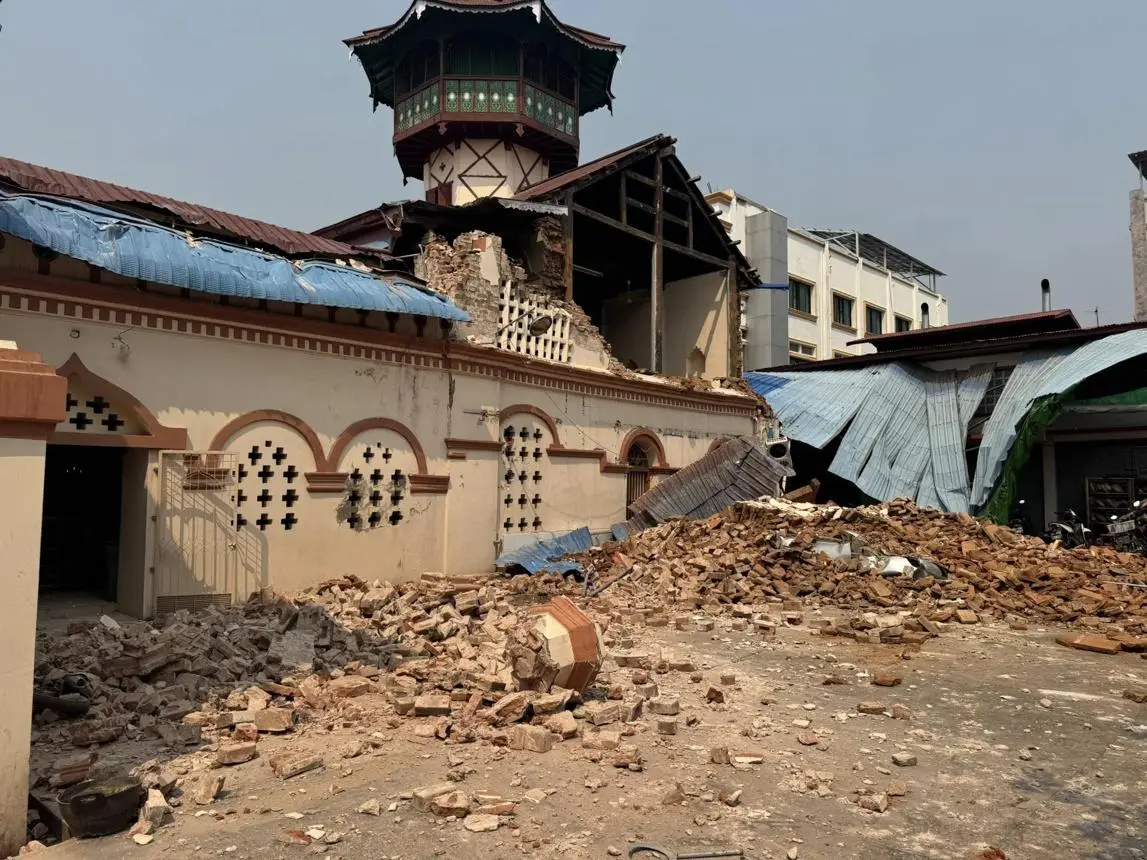
More than 18 months after the earthquake that struck central Myanmar on 28 March 2025, military authorities continue to obstruct the repair and reconstruction of mosques, depriving Muslim communities of places in which to practise their religious rites.
The network documented damage to at least 180 mosques and Islamic religious buildings in 29 towns and administrative areas, 102 of which sustained severe damage, while engineering assessments concluded that 47 buildings cannot be repaired.
According to the network, at least 670 Muslims lost their lives when mosques and Islamic religious buildings collapsed during Friday prayers on the day of the earthquake.
Mosque administrations face bureaucratic obstacles, including delays in issuing permits, demands for additional documents, and unclear procedures for approving demolition, repair and reconstruction work.
In Mandalay, a mosque administrator reported that, to his knowledge, more than 70 mosques had submitted applications for repair permits, but the authorities had approved only four applications.
Imprisonment and Confiscation of a Mosque
In Shan State in northern Myanmar, the report highlighted the case of two administrators of the Myuma mosque in Naungkyo township, Hla Htwe and Soe Thin, who were sentenced by a court under military council control to 11 years' imprisonment each, on charges of assisting the Ta'ang National Liberation Army (TNLA), an armed group representing the Ta'ang ethnic minority that operates in northeastern Myanmar, under the counter-terrorism law.
The court also ordered the mosque confiscated and transferred to state ownership.
The Burma Human Rights Network had issued an independent statement on the case on 7 November, quoting a judge who participated in the civil disobedience movement as saying that the prosecution had not presented evidence proving that the two men supported terrorism.
The network accused the military council of exploiting counter-terrorism laws to target religious minorities and deprive them of the right to a fair trial, calling for the release of the two men, the annulment of the sentences against them, and the return of the mosque to the local Muslim community.
Accusations against the Arakan Army of Forced Recruitment and Displacement
In areas under Arakan Army control in Rakhine State, the report recorded growing complaints from Rohingya communities concerning arbitrary arrests, forced recruitment, extortion and threats of displacement.
Human rights reports stated that on 11 October an order was issued requiring more than 600 Rohingya to leave their village in the Rathedaung area by 17 October, without confirmation that the order had been carried out.
The network also documented reports that village administrations in Maungdaw were demanding a list of women aged between 18 and 35 for compulsory conscription purposes.
Restrictions on Mosques and Religious Education
The report cited the Anti-Atrocities Against Rohingya Association (AARA) as alleging that the political wing of the Arakan Army, known as the United Arakan League, imposed a fee of 10,000 Myanmar kyat per student on Arabic schools in Maungdaw, on pain of their closure.
The organisation also pointed to an apparent intention to take control of the appointment and salaries of teachers in mosques, and of religious donations, from 2027. These claims have not been confirmed by independent sources.
Arrests and Restrictions on Freedom of Movement
Among the cases documented by the network is the arrest of the Muslim scholar Maulana Sultan Muhammad in the Maungdaw area on 4 October, without his family being informed of the reasons for his detention or his whereabouts.
On 30 October, residents of the Buthidaung area reported restrictions on Rohingya movement outside the area and on their use of the internet, which hampered their access to health services and employment opportunities, while according to residents' testimony the movement restrictions did not apply to other ethnic groups.
Calls for Accountability of All Parties
The Burma Human Rights Network called for the removal of restrictions on the repair of mosques, the return of confiscated religious property, and the release of those arbitrarily detained for exercising their religious rights.
It also called on the Arakan Army to end forced recruitment, forced labour, extortion and threats of displacement, and to allow independent investigation of abuses attributed to its members.
The network stressed the need to hold all armed parties implicated in abuses to account, to strengthen international support for investigation and accountability mechanisms, and to expand humanitarian assistance to affected communities through independent channels.
About the Burma Human Rights Network
The Burma Human Rights Network (BHRN) is a non-governmental human rights organisation founded in 2012 and officially registered in the United Kingdom in 2015, with its headquarters in London. Its founder, Khaing Win, serves as its Executive Director. The network specialises in documenting human rights and religious freedom violations and monitoring hate speech and discrimination against Muslims and other religious and ethnic minorities in Myanmar, drawing on a network of researchers and local sources.
Its reports have previously been cited by United Nations bodies, including the Independent International Fact-Finding Mission on Myanmar, and it has participated in joint human rights statements with Amnesty International and Human Rights Watch.
According to its previous disclosures, the network has received financial support from the US National Endowment for Democracy (NED), which relies primarily on funding approved by the US Congress, the Unitarian Universalist Service Committee (UUSC), the American Jewish World Service (AJWS), the Tide Foundation, as well as individual donations.
The financial disclosures available, however, do not provide sufficient detail on the size of the donors' contributions or the continuation of their funding during 2026.


