


By Mark F. Cancian and Chris H. Park
Published 27 May 2026
The 39-day bombing and air defence campaign against Iran drained key US munitions stockpiles, as an earlier analysis by the Center for Strategic and International Studies (CSIS) showed. The United States holds sufficient munitions for any possible scenario in the Iran war, but the depletion of these stockpiles has created a vulnerability that foreshadows a potential conflict in the Western Pacific. The time needed to rebuild these stockpiles has therefore become a matter of serious concern.
Secretary of Defense Pete Hegseth stated that refilling US stockpiles would take "months and years… depending on the type of weapon." The analysis by the Center for Strategic and International Studies (CSIS) confirms the Secretary's assessment. Table 1 shows the time needed to replace seven key types of munitions used heavily during the Iran war, which would also be required in the event of a war in the Western Pacific. According to current delivery forecasts:
- The Tomahawk Land Attack Missile (TLAM), the Terminal High Altitude Area Defense (THAAD) system, and the Patriot system, all used heavily in this war, will take three years or more from now to return to pre-war stockpile levels.
- Standard Missiles (SM-3 and SM-6) will take about two years. These naval missiles were not used at a similar intensity.
- Replacing Joint Air-to-Surface Standoff Missiles (JASSM) and Precision Strike Missiles (PrSM) will take from several months to a year. The pre-war PrSM stockpile was low because production of the system had only recently begun. JASSM, despite heavy use, will see substantial deliveries from recent purchases.
الجدول 1: مخزونات الذخائر الرئيسية والجداول الزمنية لإعادة بنائها
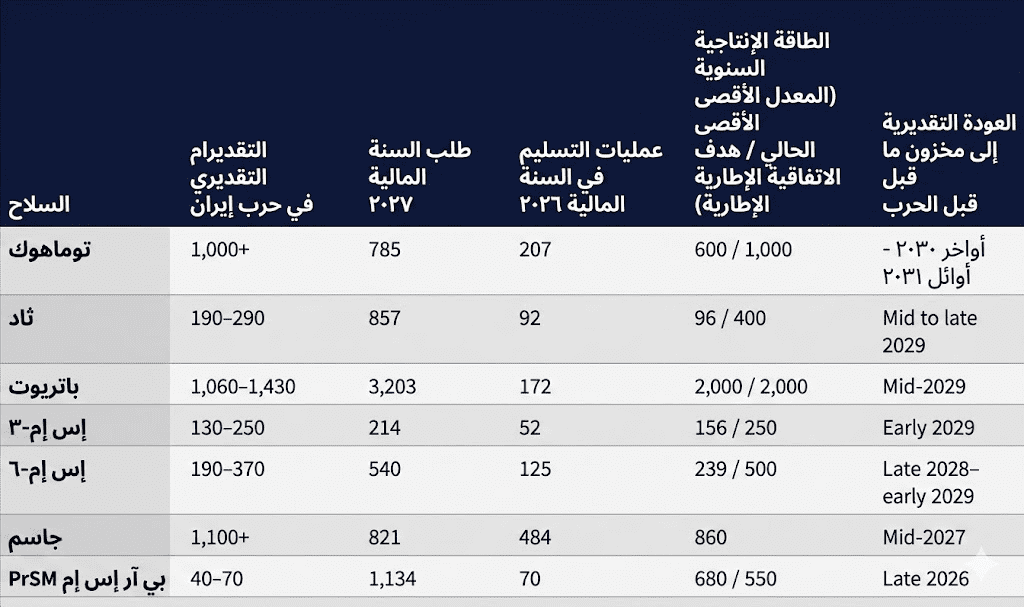
Note: The current maximum production rate represents the additional production capacity achievable using existing facilities. The Trump administration has signed multi-year framework agreements with industry, which in most cases expand production capacity beyond the current additional capacity level. Production capacity does not equal the actual production rate because budgets may not fund production at full capacity. No new production capacity target has been announced for JASSM. The target production capacity for SM-3 is estimated based on the FY2027 budget materials, as the press releases on the framework agreement do not specify a quantity. The table combines variants of a given missile system: SM-3 Blocks IB and IIA have been reported together, as have the baseline PrSM program and the second increment.
Source: Authors' calculations based on the US Department of Defense FY2027 budget and previous budgets. The technical note at the end of this commentary explains the methodology for estimating delivery dates. Expenditures and estimated stockpiles are discussed in Mark F. Cancian and Chris H. Park, "Last Rounds? The State of Key Munitions at the Ceasefire in the Iran War," Center for Strategic and International Studies, 21 April 2026.
Campaigns against Iran and its proxies, and, for Patriot interceptors, assistance to Ukraine, have intensified the problem. Alongside replenishing its own stockpile, the United States must also meet the requests of allies and partners. Decisions on how to allocate new production have already caused bilateral tensions, and these tensions will continue over the next few years as demand exceeds supply.
The Trump administration recognises how urgent the matter is. The allocation of a large budget for munitions procurement in the 2027 presidential defence budget, which stands at $1.5 trillion, reflects these concerns about the shortage of munitions stockpiles. An additional war supplemental budget to fund munitions is expected, as the Department of Defense seeks to compensate for what was spent in Operation Epic Fury and then build stockpiles above pre-war levels. The administration has also signed a series of framework agreements with industry to expand munitions production capacity, which could accelerate future deliveries.
The figures in this article illustrate the deliveries of the seven key munitions to US stockpiles in the coming years.
- The red columns indicate cumulative additions to US stockpiles each quarter.
- According to the latest budget justification books, bright red columns indicate the expected arrival date of FY2027 orders. The slow delivery of most munitions is due to relatively low funding levels in previous years.
- The grey columns indicate current stockpile levels, with the shaded areas representing the difference between the lower and upper estimates.
- The green line shows the maximum possible stockpile growth rate. This line assumes that: (1) the industrial sector achieves the production capacity targets set out in the framework agreements, (2) the industrial sector continues producing at this level, and (3) all shipments go to US stockpiles rather than to allied stockpiles. This line shows how the delivery schedule could improve as production capacity increases.
- The black line represents missile stockpiles before the 2026 Iran war. The black line intersects the stacked columns when missile shipments equal pre-war stockpiles.
Years to Replace Tomahawk Missiles
Tomahawk purchases averaged 86 missiles over the past ten fiscal years (FY2015 to FY2026), with most orders coming from the US Navy. While Raytheon seeks the capacity to produce more than 1,000 Tomahawks annually, the current annual production rate is below 200 missiles, due to the small size of previous orders. Current orders will begin to replace the more than 1,000 Tomahawks expended during the Iran war, but they will not be sufficient to fully restore stockpiles to pre-war levels.
The US Navy requested 785 Tomahawk missiles in the FY2027 budget, a significant increase over previous years. Based on the Department of Defense's current delivery forecasts, these missiles will begin arriving in US stockpiles in March 2030, after a 34-month production period. The US stockpile will replace the TLAMs fired at Iran by late 2030.
Figure 1: Tomahawk Missile, US Stockpile
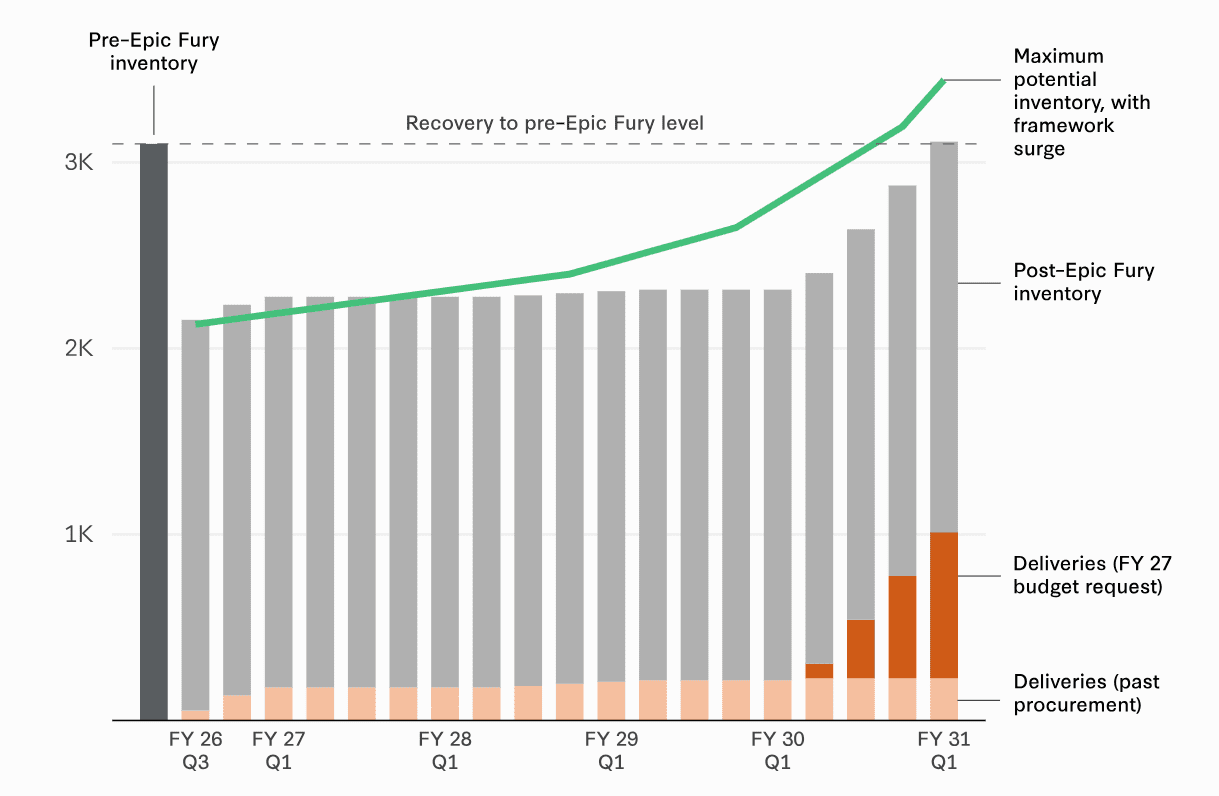
Note: "Deliveries (prior purchases)" includes TLAMs purchased in FY2022 and later. Missiles purchased in earlier years have already been delivered.
Source: Authors' calculations based on the US Department of Defense FY2027 budget materials.
Allied orders must also be met. Reports indicate that 400 missiles earmarked for Japan may be delayed, as the US Department of Defense gives priority to refilling US stockpiles, although a Japanese destroyer recently completed the necessary modifications. Australia has also purchased more than 200 missiles, and the Netherlands 175.
THAAD System
The large procurement request in the FY2027 budget reflects the urgent need to rebuild THAAD stockpiles after their intensive operational use in Operations Epic Fury and Midnight Hammer.
Budget documents from previous years anticipated no missile deliveries to the United States between August 2023 and April 2027, with missiles purchased in FY2021 to begin arriving thereafter. The updated timelines in the FY2027 documents show that earlier orders have already begun delivery, while FY2025 purchases are scheduled for delivery during 2026. To address the potential near-term shortfall, delivery dates were reordered to prioritise US needs over those of allies and partners.
The US Army requested 857 THAAD interceptors in FY2027. Deliveries are expected to begin in mid-2029, thereby completing the replacement of air defence assets used in the Iran war by the end of 2029.
Figure 2: THAAD System, US Stockpile
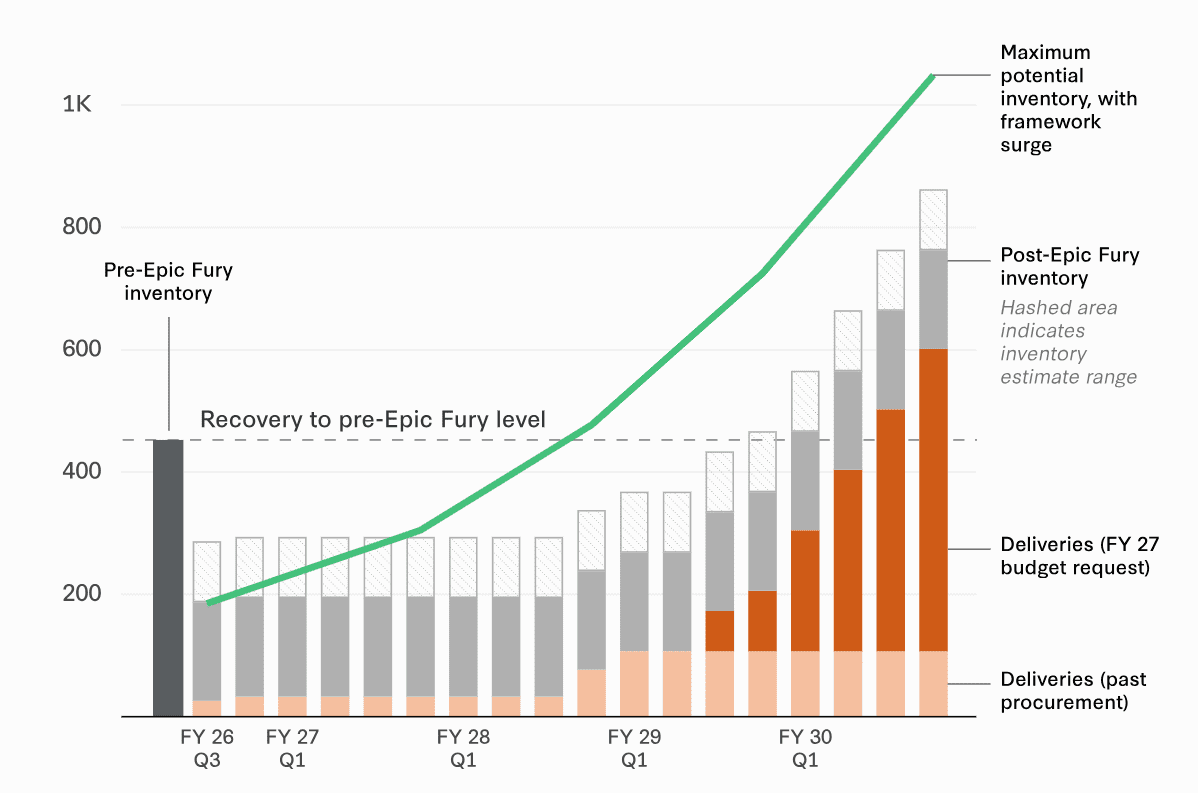
Note: Owing to the reordering of THAAD deliveries, the pre-war stockpile estimate has been adjusted to 452 missiles, from 360 in the "Last Rounds?" analysis. "Deliveries (prior purchases)" includes THAAD interceptors purchased starting in FY2025. Interceptors purchased in earlier years have already been delivered.
Source: Authors' calculations based on the US Department of Defense FY2027 budget materials.
Delivery schedules in the budget documents indicate that THAAD production is currently running at an accelerated rate of 96 interceptors per year. Lockheed Martin, by providing additional facilities and tooling, plans to increase production capacity to 400 missiles per year, an increase necessary to meet the large procurement requests of the United States and its allies. Accumulated allied orders include a Saudi order for 360 interceptors in 2017, part of which has been delivered, as well as an Emirati deal to purchase 96 in 2022. Additional orders are expected, as Saudi Arabia and the UAE consumed a large part of their stockpiles defending themselves against Iranian missiles during the initial campaign.
Patriot
Patriot deliveries present a dilemma for the United States, given its need to replenish its stockpile, to help Ukraine defend against Russian missile attacks, and to meet the needs of 17 other countries that use this interceptor. Current production of the latest variant, the PAC-3 Missile Segment Enhancement (MSE), is about 650 interceptors per year, with half going to the United States and half to allies and partners. The expected annual production rate, using existing tooling and facilities, is 2,000 missiles. Lockheed Martin intends to raise the rate to the required level.
Because the US averaged 225 missile purchases per year over the past decade, shipments received in earlier years will not be sufficient to cover expenditure in full. The United States will therefore have to wait for the 3,203 Patriot missiles requested in the Army's FY2027 budget, with deliveries expected to begin in May 2029.
Figure 3: Patriot, US Stockpile
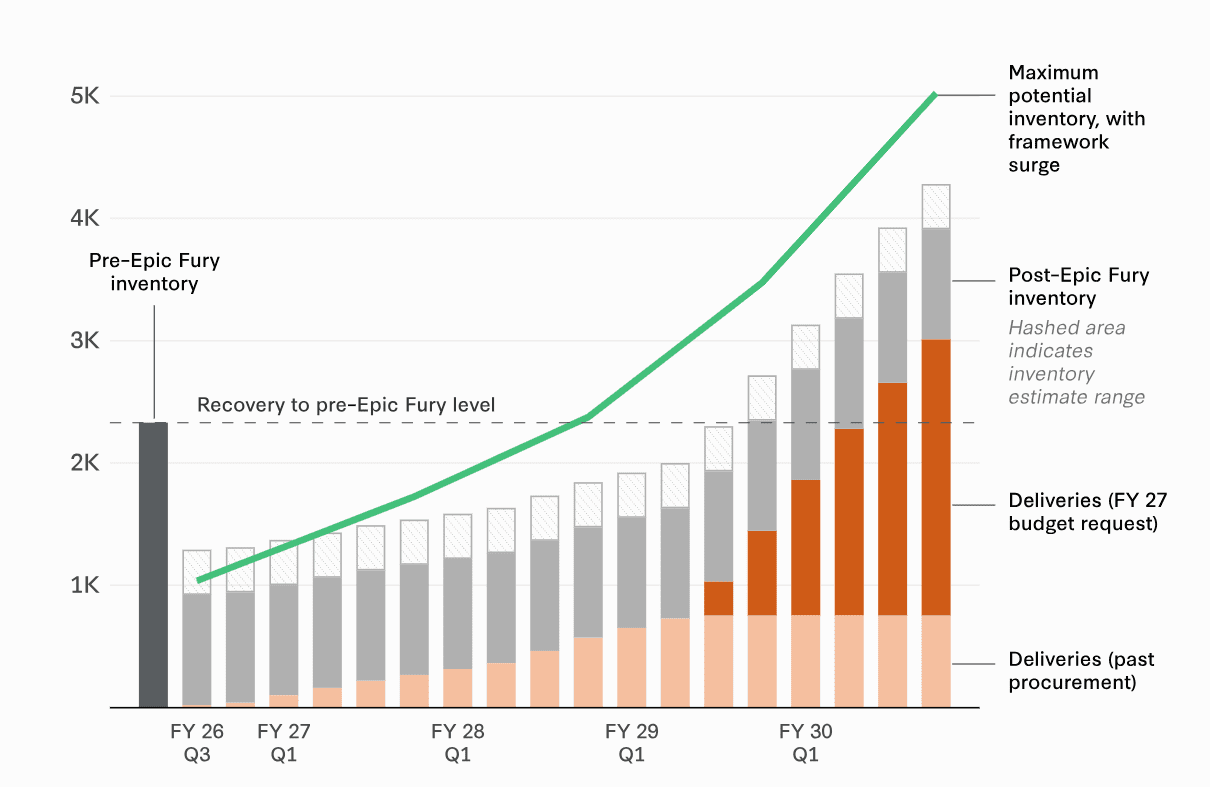
Note: "Deliveries (prior purchases)" includes Patriot interceptors purchased in FY2023 and later. Interceptors purchased in earlier years have already been delivered.
Source: Authors' calculations based on the US Department of Defense FY2027 budget materials.
The United States continues to send Patriot missiles to Ukraine, alongside other weapons and munitions. Missiles contracted under the Ukraine Security Assistance Initiative during the Biden administration are delivered to Ukraine as soon as they are manufactured. The Prioritized Ukraine Requirements List (PURL), a new mechanism under which NATO states pay for weapons held in US stockpiles, has contributed to a temporary increase in Patriot deliveries to Ukraine. Both delivery mechanisms may be affected by the Trump administration's efforts to prioritise US needs, which could delay future deliveries to Ukraine.
Other allies are also waiting for Patriot shipments. Since 2020, US allies and partners have purchased approximately 1,900 MSE interceptors, and more than 700 missiles of earlier variants such as the PAC-2 and GEM-T.
Table 2: Major Arms Sales Notifications Since 2020 (PAC-3 MSE)
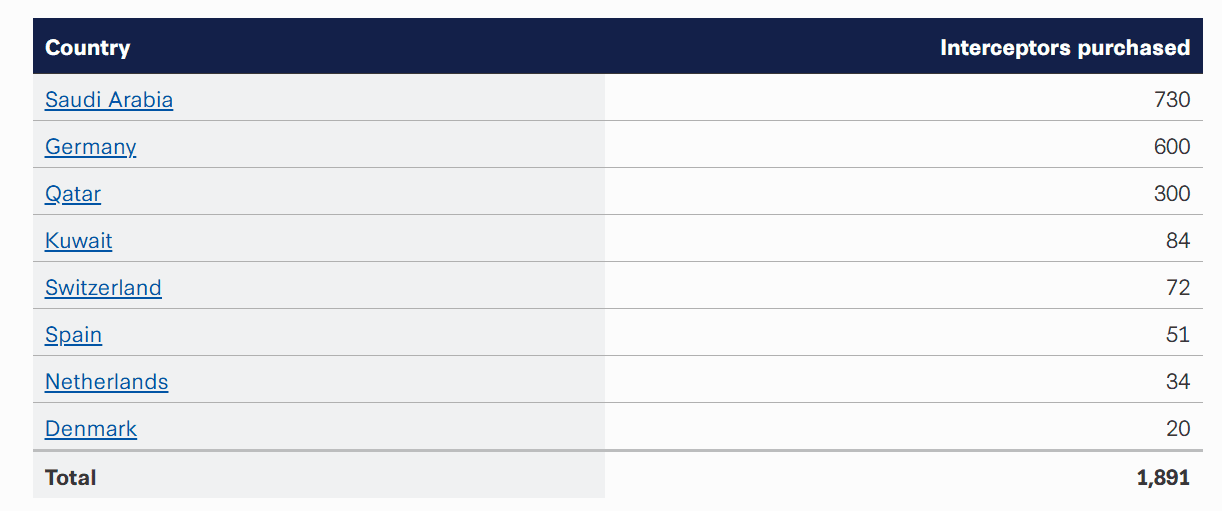
Source: Defense Security Cooperation Agency, US Department of State.
سنوات عديدة لاستبدال
صواريخ SM-3 وSM-6
The ship-launched SM-3 and SM-6 interceptors saw less use than land-based launch systems. A CNN report, citing sources in the US Department of Defense, indicated that the actual use of Standard Missiles in Operation Epic Fury was closer to the lower end of the estimates in the munitions inventory study conducted by CSIS. This low level of use reflects the distance of US naval assets, in the Arabian Sea and the eastern Mediterranean, and the limited range of Iranian fire, most of which targeted Gulf states. No warship capable of firing these air defence interceptors was operating inside the Arabian Gulf before the ceasefire.
Figure 4: SM-3, US Stockpile
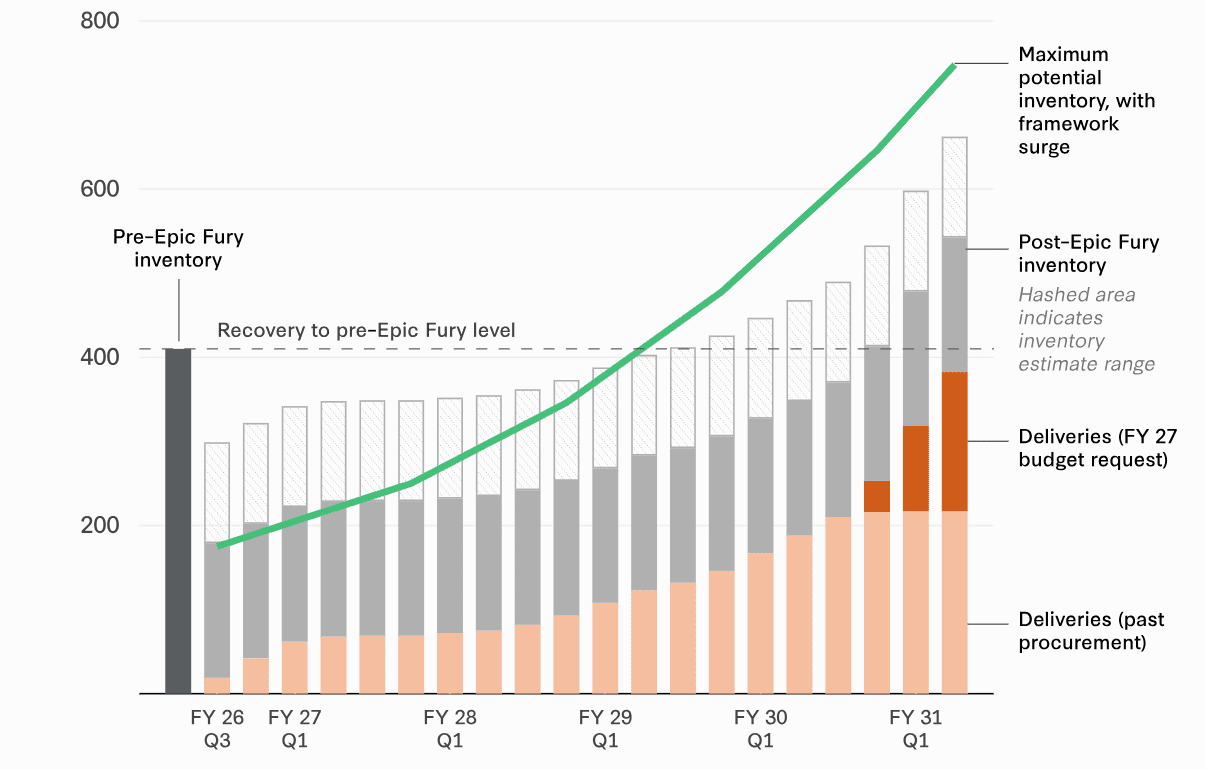
Note: This includes SM-3 Block IB and Block IIA variants. The United States resumed purchasing Block IB missiles after temporarily suspending them. "Deliveries (prior purchases)" includes Block IB missiles purchased starting in FY2024, and Block IIA missiles purchased starting in FY2020. Missiles purchased in earlier years have already been delivered.
Source: Authors' calculations based on the US Department of Defense FY2027 budget materials.
Figure 5: SM-6, US Stockpile
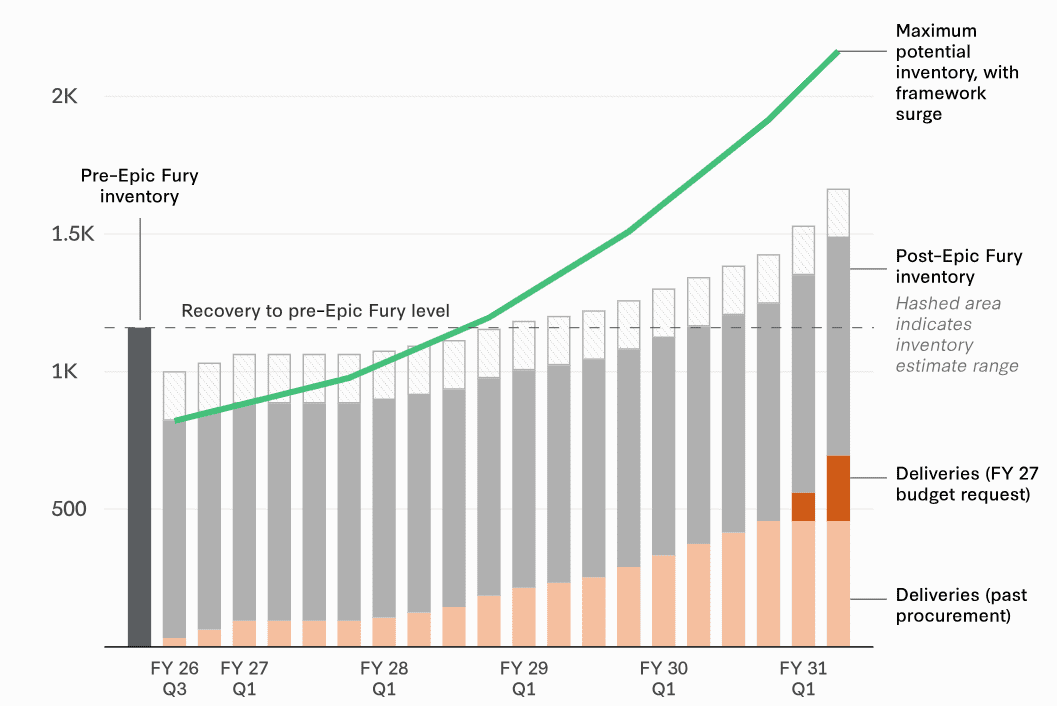
Note: "Deliveries (prior purchases)" includes SM-6 missiles purchased in FY2023 and later. Missiles purchased in earlier years have already been delivered.
Source: Authors' calculations based on the US Department of Defense FY2027 budget materials.
Production of both missiles takes a long time. The Missile Defense Agency and the Navy requested large quantities in the FY2027 budget: 78 SM-3 Block IB, 136 SM-3 Block IIA, and 540 SM-6. These orders will take 36 to 39 months to begin delivery once Congress approves the appropriations. Because previous orders were small, stockpiles will not return to pre-war levels until early 2029, despite the relatively low use during the campaign.
Months to Replace JASSM
The US forces began this campaign with a large stockpile of JASSM missiles. The Air Force bought large quantities of these long-range cruise missiles from the start of the second millennium, at a rate of approximately 500 missiles per year over the past decade. To meet these orders, current production appears to have already reached the peak of its production capacity, unlike the other munitions discussed in this article. Furthermore, the missile was not used in operations until 2018. Accordingly, although more than 1,100 JASSM missiles have been consumed, US stockpiles will recover relatively quickly as previous orders are delivered.
Figure 6: JASSM, US Stockpile
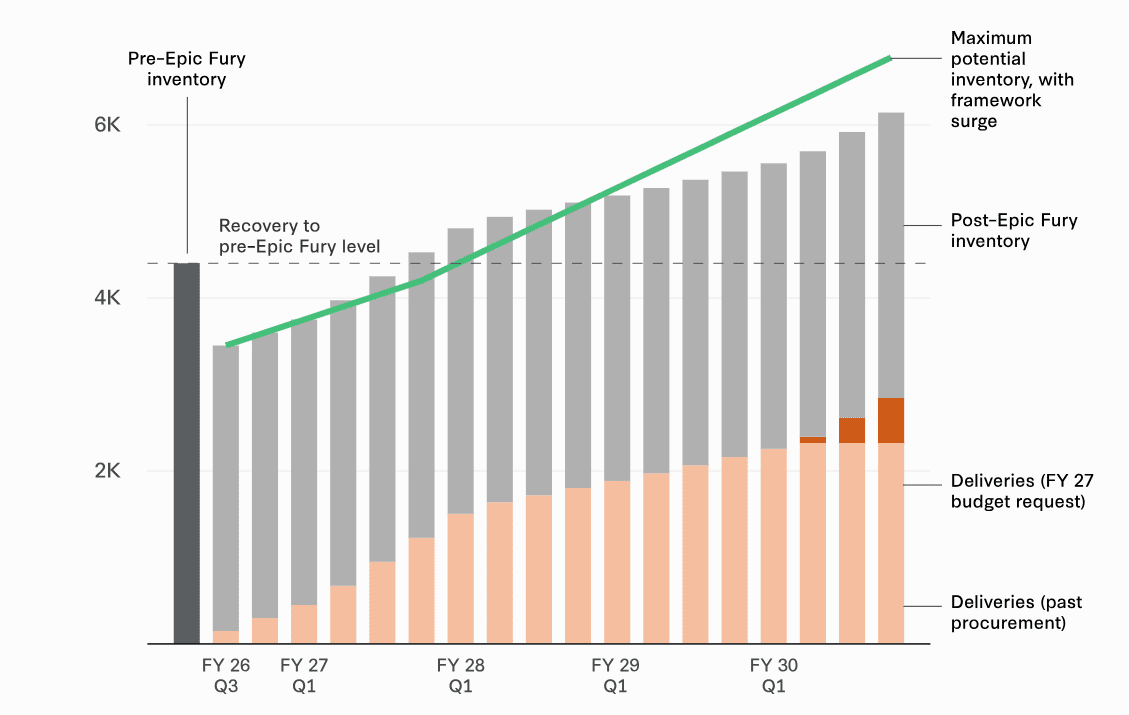
Note: The figures include both JASSM variants: Extended Range (ER) and Extreme Range (XR). Procurement of ER missiles ended in fiscal year 2025, while procurement of XR missiles began in fiscal year 2024. "Deliveries (prior purchases)" includes JASSM missiles purchased in fiscal year 2023 and later. Missiles purchased in earlier years have already been delivered.
Source: Authors' calculations based on US Department of Defense budget materials for fiscal year 2027.
Over the past five years, US allies requested nearly 1,200 JASSM missiles, including 821 from Poland and 120 from the Netherlands.
Precision Strike Missile
The PrSM stockpile was small at the start of this campaign because the Army did not receive approval for full-rate production and fielding until last July. As a result, use was limited, despite its high effectiveness, and replacing expenditures will take only a few months.
Figure 7: PrSM, US Stockpile
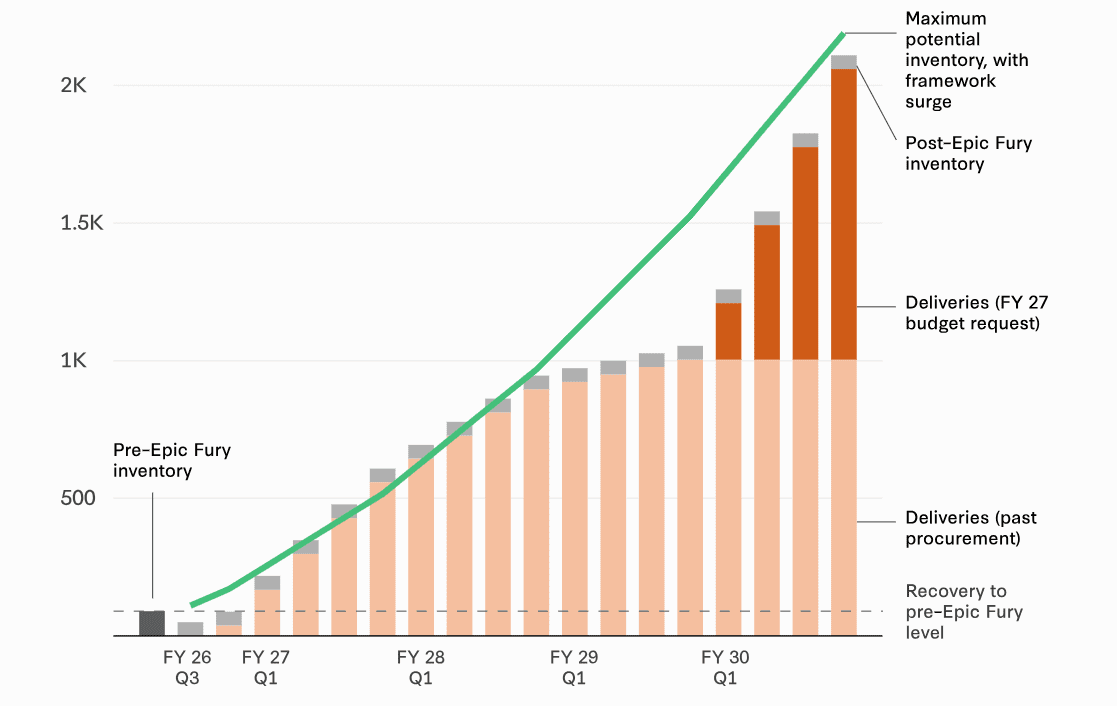
Note: The term "Deliveries (prior purchases)" includes PrSM missiles purchased in fiscal year 2023 and later. Missiles purchased in earlier years have already been delivered.
Source: Authors' calculations based on US Department of Defense budget materials for fiscal year 2027.
Large procurement orders in the past few years, and the purchases expected in fiscal year 2027, keep production at its expected capacity. All shipments will go to the US stockpile for now. Although the export of the basic version of the PrSM system to Australia and the United Kingdom has been approved, no foreign sales have yet been announced.
Technical Note on Estimating Munitions Delivery Timelines
Munitions inventories are classified, and some delivery schedules are not available. Nevertheless, sufficient general information is available to make estimates with the accuracy needed to inform the policy debate.
The Center for Strategic and International Studies (CSIS) estimates of when purchased missiles enter US stockpiles relied primarily on two criteria: production rate and supply duration. The US Department of Defense presents three different production rates in its annual budget materials:
- Minimum Sustaining Rate of Production (MSR): The rate required to maintain a continuous production process.
- Economic Order Quantity Rate (1-8-5): One eight-hour shift per day, five days a week.
- Maximum Production Rate: Increasing production capacity using multiple shifts with "tooling available or from the prior year."
Even when using existing facilities, achieving additional production capacity is costly and time-consuming, as it requires hiring additional staff and resolving supply chain constraints. The production table in the Department of Defense's P-21 program budget shows the position of current production rates between the predetermined production rate and the additional production rate for individual systems. Discrepancies in reporting between weapons systems complicate the analysis. Justification books also generally omit delivery schedules for missiles purchased through reconciliation. This adds further uncertainty to the assessment of fiscal year 2027 purchases, since most of the missile funding is listed in the reconciliation request. Where data is unavailable, delivery schedules were estimated using the latest supply durations, compared against production capacity limits.
The framework agreements between the Trump administration and the industrial sector set ambitious production capacity targets, which would significantly increase deliveries over the next five to seven years as new facilities come online.
However, production capacity does not equal actual output. To illustrate the potential increase in production, the "maximum potential stockpile, with framework increase" curve in this analysis—represented in green—is depicted as a linear annual increase from current production capacity to the industry's announced targets.
Supply time refers to the number of months between Congress's allocation of funds and the delivery of missiles. As Figure 8 shows, this time can be divided into three parts:
- Administrative supply time: Measured between the allocation of funds and the signing of the contract. After Congress allocates funds, the Department of Defense takes several months to negotiate and sign a contract with defense companies. Multi-year procurement aims to reduce this time.
- Production supply time: Measured between the award of the contract and the first delivery. Supply time lengthens when demand exceeds the contractor's capacity or when deliveries to allies and partners are scheduled between US deliveries.
- Full batch production time: Purchases for a given year are delivered over several months. This time is measured between the first and last delivery, and is usually less than 12 months.
For example, JASSM missiles purchased in the fiscal year 2027 budget are expected to be contracted six months after the start of the fiscal year (the administrative lag). The first missile in this batch is expected to be delivered 36 months after contract signing (the production lag). It will take another 11 months until all missiles are delivered (batch production).
Figure 8: Expected Timeline of Purchases
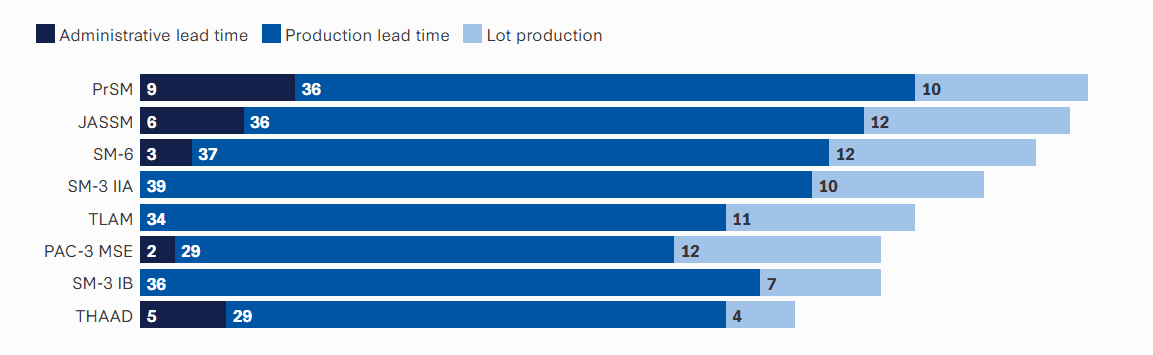
Note: The timelines in this figure are the Department of Defense's latest projections and may vary depending on industry capacity and related orders. The figure only includes the expected administrative time lag after funding becomes available. Some administrative procedures take place earlier, because they do not require funding.
Source: Authors' calculations based on US Department of Defense budget materials for fiscal year 2027.
The Future of Munitions Stockpiles
Additional munitions funding began under the Biden administration and accelerated under the Trump administration. Congress has supported this funding, reflecting bipartisan agreement on the issue. As a result, the problem today is no longer money, but time. Expanding production capacity and building these complex systems takes time.
Accordingly, there will be a period of weakness lasting several years until stockpiles return to their previous levels, and several more years before they reach the levels desired by war planners. The US Department of Defense will have to develop plans to address this gap. Some munitions can be substituted, but this involves trade-offs. Alternative ground-attack munitions, for example, have shorter or medium ranges and increase the vulnerability of launch platforms. Alternative counter-drone systems are also expensive.
Nevertheless, the situation in the Western Pacific is not entirely bleak. The world has witnessed the skill of US military forces, not only in the conflict with Iran, but also in operations against Venezuela and the Houthis. China fully understands that it lacks modern combat experience and that it did not perform well in its last war against Vietnam in 1979. This disparity in experience may help preserve deterrence until munitions stockpiles are restored.
Our colleagues in the Defense and Security Department, Seamus Daniels and Wes Rumbaugh, provided valuable comments on an earlier version of this article. We also thank Hunter McDonald and Sabina Hong for their rapid review and coordination.
This commentary was written in support of a project funded by the Smith Richardson Foundation.
Mark F. Cancian (retired Marine Corps Reserve colonel) is a senior adviser in the Defense and Security Department at the Center for Strategic and International Studies (CSIS) in Washington, DC. Chris H. Park is an adjunct fellow in the Arleigh A. Burke Chair in Strategy at CSIS.
Center for Strategic and International Studies.


