


In a scene that sums up the escalation of settler violence in the occupied West Bank, three Palestinian families in the village of Qusra, south of Nablus, have been under siege for several days, while Israeli occupation forces have seized 16 Palestinian homes in the village and its surroundings and turned them into military sites, according to a local official.
The case prompted the US Ambassador to Israel, Mike Huckabee, to describe the siege of the homes as a "terrorist act," but at the same time he defended the broader Israeli settlement movement, arguing that the problem lies with a "few" settlers, not with the settlement project itself.
Families under siege and homes turned into military sites
The crisis began on Sunday, when Israeli settlers set up tents and temporary structures between Palestinian homes in the Ras al-Ain area on the outskirts of Qusra, blocked the roads leading to it with stones, and then besieged three homes, one of them belonging to a Palestinian family one of whose members holds American citizenship.
According to the head of the Qusra village council, Abdul Azim al-Wadi, the three families had remained besieged inside their homes for the fourth day, while Israeli forces continued to deploy in the village and its surroundings.
Al-Wadi said the Israeli occupation army informed the council that the military operation would continue until Sunday morning, while an Anadolu correspondent saw Israeli soldiers stationed inside a number of Palestinian homes.
The measures were not limited to the siege. Local sources reported that water and electricity had been cut off to the besieged homes, and that food, water and medicine supplies were prevented from reaching them.
At the same time, the Israeli army imposed a curfew in Qusra and ordered commercial shops to close, with a wide deployment of forces, vehicles and bulldozers.
US Ambassador: "a terrorist act"
In the United States, the case drew political attention, particularly as one of the besieged families includes a US citizen.
The US Ambassador to Israel, Mike Huckabee, described what is happening as a "terrorist act" aimed at intimidating and harassing the family, and said the US Embassy had been directly informed of the case and that Israeli forces and police had moved at its request to remove the settlers whom he described as "terrorists."
However, Huckabee's position did not extend to condemning the settlement project itself.
In subsequent remarks, the ambassador sought to portray what happened as an isolated incident carried out by a minority of extremist settlers, saying that "the settlers are not the problem," but rather "the troublemakers" or those who act outside the law.
He also praised settlers who condemn these attacks, in a stance that distinguishes between "moderate" settlers and settlers who practise violence.
Israeli soldiers among the settlers
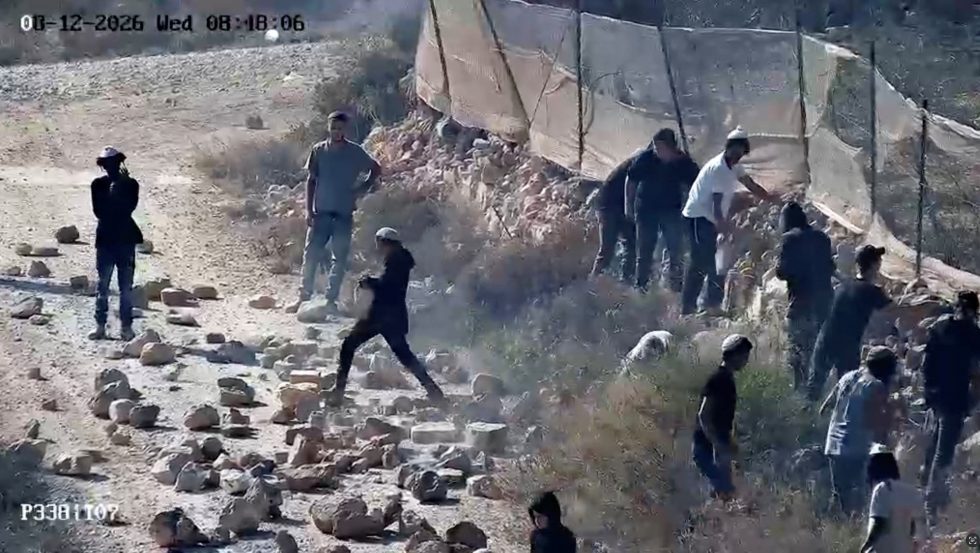
However, another account raises questions about the limits of the separation between the settlers and the Israeli forces.
Louay Reddy, a Palestinian American living in the state of Ohio, said he had been following on surveillance cameras what was happening at the home where his brother and his 18-year-old nephew were besieged.
According to his account, his brother called the police for help, and when a unit of the Israeli occupation army arrived, he did not feel that the soldiers provided protection for his family; rather, he said, they were seen interacting amicably with the settlers.
Footage also showed Israeli soldiers praying with the settlers, while the army announced that it would take disciplinary measures against the soldiers concerned.
These events bring back to the forefront a question larger than the Qusra incident: can settler violence be regarded as a phenomenon separate from the military and political system operating in the West Bank?
16 Palestinian homes under military control
Alongside the siege of the homes, the head of the Qusra council said the Israeli army had seized 16 Palestinian homes and turned them into military sites.
The forces justified their presence by saying they were working to dismantle an illegal settlement outpost established near the village amid rising tensions.
However, the Palestinian Commission against the Settlements and the Wall warned that the establishment of the outpost was not a passing development, noting that settlers had attempted eight times to establish an outpost in the Jabal Ras al-Ain area, which has a high and strategic position overlooking wide areas.
The commission says attempts to seize the homes began about four months ago, which prompted family members to take turns staying in them to prevent their seizure.
Settlement between "an isolated incident" and an integrated project
Palestinian Christian theologian Munther Isaac holds that focusing on "a few extremist settlers" ignores the root of the problem, which is the settlement movement itself, and considers that settlement is based on the seizure of Palestinian land and enjoys empowerment and protection from the Israeli state.
Here lies the paradox in Huckabee's remarks: he condemns the siege of the homes as a terrorist act, yet he defends the settlement structure spreading across the occupied Palestinian territories.
Accordingly, the issue concerns not only whether a particular settler attacked or besieged a Palestinian, but the broader question of seizing land, changing its demographic reality, and entrenching a permanent settler presence there.
Figures reveal the scale of the phenomenon
Palestinian figures point to the widening scope of violence in the West Bank.
During July alone, the Commission documented 2,256 attacks in the West Bank, of which 1,458 were carried out by Israeli forces and 798 by settlers.
The Commission also warned that the Qusra siege could develop into a lengthy operation aimed at isolating Palestinian families and pushing them to leave their homes.
It cites what happened in the neighbouring village of Jalud, where it says settlers seized a Palestinian family's home on 22 July after besieging it for more than three months.
Qusra: a miniature picture of the struggle over land
What is happening in Qusra goes beyond a single new attack in the West Bank; it brings together in one scene settler violence, the Israeli military presence, the seizure of homes, attempts to establish settlement outposts, and pressure on Palestinians to push them off their land.
If the US ambassador has described the siege of the families as a "terrorist act," the continued conversion of Palestinian homes into military sites, and the attempts to establish settlement outposts around them, raise a deeper question:
Is the problem merely a "small extremist minority," as Huckabee says, or is what is happening in Qusra part of a broader course to reshape the reality of the West Bank on the ground?


