


The economic repercussions of the war raging in the region have not remained confined to the states directly involved in the confrontation; they have extended to one of the world's richest countries and one with the largest financial reserves: Qatar.
The Financial Times, citing three informed sources, revealed that Doha has cut the budgets of some government bodies by as much as 30%, and reduced foreign aid funding by about 85%, in an attempt to deal with the sharp decline in revenues from liquefied natural gas, which forms the backbone of Qatari revenues and exports. The newspaper did not specify the total value of the expenditures covered by the cuts, while Qatar's budget for 2026 amounts to about $61 billion.
However, Doha later objected to the picture presented by the report. Majed Al-Ansari, spokesperson for the Qatari Ministry of Foreign Affairs, said the figures relating to the reduction of government bodies' budgets and foreign aid were "inaccurate", and that a large part of them had been taken out of context. He explained that what was raised regarding budget cuts of up to 30% relates to precautionary measures, and does not include salaries or capital projects.
Nevertheless, the dispute over the size of the cuts does not negate the broader economic problem: Qatar is facing a major shock in the sector on which it relies to finance the state.
When Hormuz Becomes a Qatari Vulnerability
For years, gas gave Qatar economic and political weight far exceeding its geographic and demographic size. The current crisis, however, has exposed the other face of this strength: heavy reliance on exporting gas through a highly sensitive maritime route.
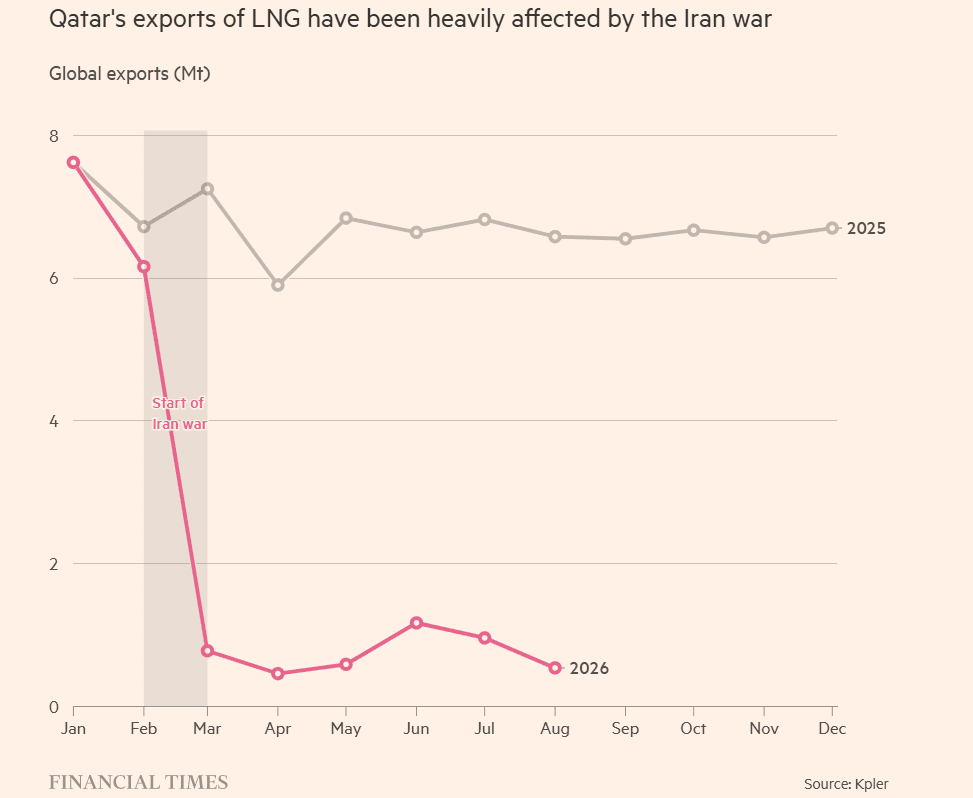
The latest data shows the scale of the shock. According to an analysis published by Reuters on 26 August, Qatar's liquefied natural gas exports fell by a staggering 96% during the first six months of the war. The country exported only 18 cargoes, compared with 509 cargoes in the same period of the previous year, according to ICIS data. Reuters estimates Qatar's loss at about $24 billion in gas sales over that period.
This is not a crisis of falling energy prices that can be partially offset by increased production; it is a crisis of access to markets.
Saudi Arabia and the UAE can divert part of their oil exports to routes that bypass the Strait of Hormuz, whereas Qatar depends to a greater degree on the strait to transport liquefied natural gas by sea. Consequently, the geographic location itself becomes a source of pressure on its economic model.
An economist at Goldman Sachs estimated that losses in energy export revenues for Qatar and Kuwait currently range between $1.5 billion and $2 billion a week.
From Abundance to Setting Priorities
This is where the issue of spending cuts gains its significance. In normal times, a rentier state with large surpluses can finance domestic spending, massive projects, external investments and international aid in parallel. But when the main revenue source suffers a prolonged blow, the state begins to reorder its spending circles.
From this angle, if the Financial Times' estimates regarding the large reduction in foreign aid are accurate, they would carry particular significance, because external spending is more easily cut quickly than salaries, essential services and strategic projects inside the country.
The government's affirmation that precautionary measures do not include salaries or capital projects, in turn, indicates that Doha is trying to protect domestic economic activity and to avoid turning the revenue crisis into a deeper contraction through cuts to essential spending.
Here, fiscal policy appears closer to an attempt to absorb the shock: cutting what can be postponed or dispensed with, while preserving as far as possible the most sensitive domestic commitments.
The Sovereign Wealth Fund: The Major Line of Defence
Even so, Qatar differs radically from a country facing a revenue crisis without savings.
It owns one of the largest sovereign wealth funds in the world, as the Financial Times estimates the assets of the Qatar Investment Authority at about $500 billion. The population also does not exceed roughly 3.2 million people. These reserves give the state considerable capacity to compensate for the shortfall in revenues and to maintain liquidity and economic stability.
This means that, at the present stage, the question is not that Qatar is approaching a financial crisis in the conventional sense, but rather the price it will pay if the disruption to gas flows lasts for a long time.
Reserves can buy time, but they cannot indefinitely compensate for the loss of tens of billions of dollars in exports without affecting spending, investment or the volume of assets available to future generations.
For this reason, the Financial Times quoted Tarek Yousef, a researcher at the Middle East Council on Global Affairs, as saying that authorities may consider further large cuts in public spending next year if the crisis extends into the final quarter of 2026.
An 8.6% Contraction: A Rapid Reversal in Forecasts
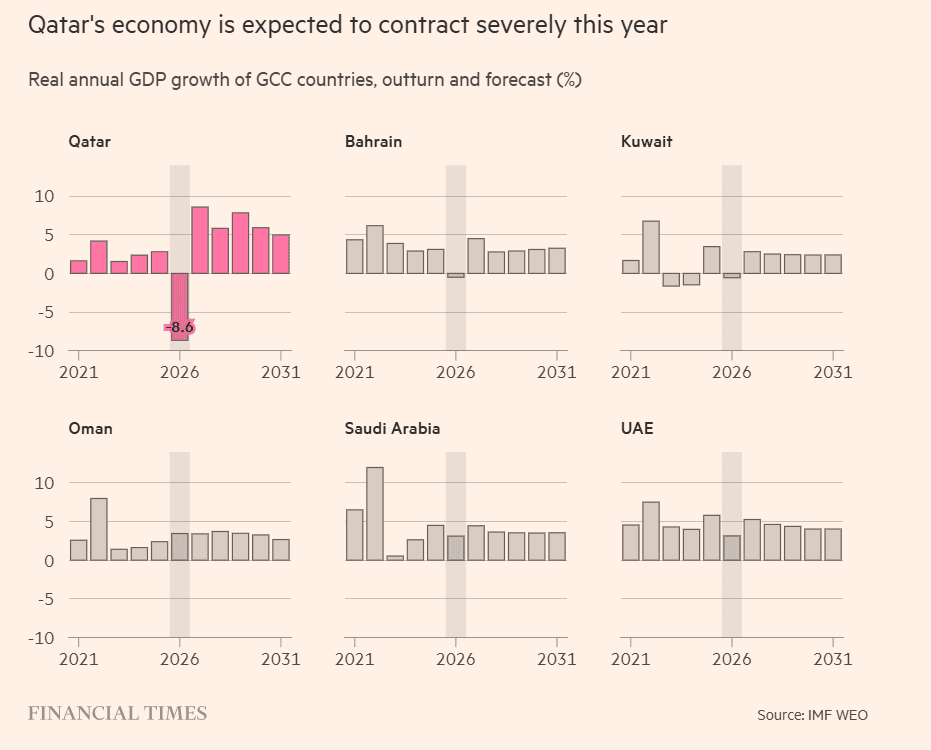
Perhaps the most telling indicator of the scale of the shift is the International Monetary Fund's projection that Qatar's gross domestic product will contract by 8.6% in 2026, the largest projected contraction among the Gulf Cooperation Council states.
Notably, the picture was radically different at the beginning of the year. In February, before the full effects of the current crisis had emerged, the IMF spoke of "favourable economic prospects" for Qatar, and projected average growth of around 4% over the medium term, driven by the planned large expansion of gas production and growth in non-hydrocarbon sectors.
This shift from forecasts of strong growth to a contraction of 8.6% within a few months reveals how closely the Qatari economy is tied to the uninterrupted functioning of the gas and export system.
The Problem Extends Beyond Qatar
The crisis, however, carries a significance that goes beyond the Qatari economy itself. Over past decades, Gulf states have spent vast sums diversifying their economies and building sectors such as tourism, aviation, financial services, technology and real estate. Nevertheless, the current shock shows that energy exports still play a central role in financing the state and its capacity to spend and invest.
In the Qatari case, an additional dimension appears: economic diversification does not necessarily mean diversifying government revenue sources to the same degree.
Tourism, aviation, real estate and services may grow, but the loss of most gas exports within a short period remains a shock that these sectors would find difficult to compensate for.
For this reason, the current crisis represents a real test of what "economic resilience" means in the Gulf states: does it mean owning vast financial assets that allow the shock to be absorbed for years, or building an economy capable of generating alternative revenues when the energy sector is disrupted?
Aid and External Influence
There is also a political dimension. For Qatar, foreign aid and investment have not been merely humanitarian or financial activity; they have been among the tools of its international presence, alongside mediation, diplomacy, media and investment.
Accordingly, if it becomes clear that the reduction in foreign aid funding, at the scale reported by the Financial Times, is sustained rather than a temporary measure, the effects of the crisis may extend from the budget to some instruments of Qatari foreign policy.
Caution is warranted here, however: Doha has disputed the accuracy of the figures the newspaper reported, and therefore the 85% figure should not be treated as a confirmed government number.
A Crisis That Exposes the Paradox of Qatari Power
The paradox is that Qatar is not a country poor in energy or weak financially; rather, the very source of its strength has become, in this crisis, the source of its exposure.
The vast gas reserves created Qatar's wealth and global standing, but the concentration of liquefied natural gas exports and its geographic dependence on the Strait of Hormuz mean that the disruption of a single maritime corridor is capable of producing a major financial and economic shock.
Nevertheless, Doha's ownership of a sovereign fund estimated at around half a trillion dollars gives it room for manoeuvre that most economies do not have when facing a similar crisis. The question at present, therefore, is not whether Qatar can bear the shock, but how long the shock will last, what it will cost, and what the state will have to sacrifice if it continues.
If gas exports return quickly to their normal levels, the cuts may remain a temporary precautionary phase. If the disruption in Hormuz persists and gas exports remain halted through the end of the year and beyond, austerity measures may become the start of a broader reordering of state priorities: among domestic spending, major projects, sovereign investments and foreign aid.
In that case, the crisis will have revealed a lesson extending beyond Qatar to the entire region: oil and gas wealth provides a vast capacity to absorb crises, but it does not eliminate the risks of depending on a single source of wealth, or on a single geographic corridor for reaching the world.


