

Political Disputes, Dwindling Financial Support, and Rising Insurgents: Are We Seeing the Signs of a Collapse of the Mogadishu Government?
Turmoil appears to be on the horizon in Somalia.
The country is experiencing political division, al-Shabaab has resumed its attacks with force, and foreign partners are questioning the value of continuing to pump money into the faltering federal system in the capital, Mogadishu.
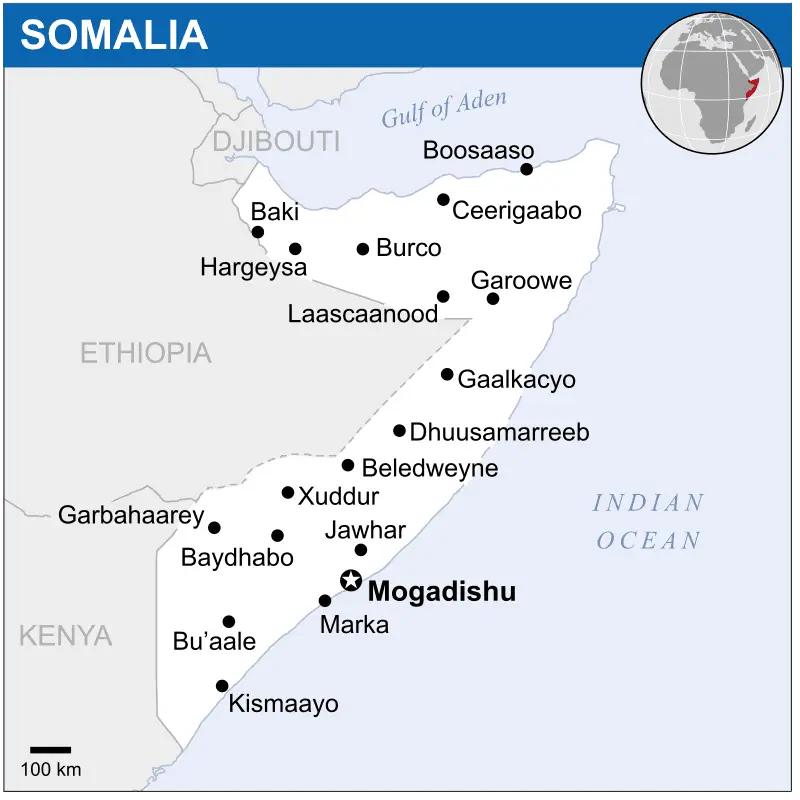
Ahead of the elections scheduled for May 2026, the government plans to change the electoral system from an indirect system to a general popular vote. This has provoked strong resistance from opposition politicians and two of Somalia's federal member states, Puntland and Jubaland.
These divisions, in turn, have diverted Mogadishu's attention away from the war with al-Shabaab, allowing the Islamic group to regain a large part of the territory the government seized in 2022 and 2023.
What further weakens the government's defences is that foreign aid, especially funding for the African Union Support and Stabilisation Mission in Somalia (AUSSOM), which helps the government fight al-Shabaab, is declining or in doubt.
Collapse is not imminent, but the status quo is increasingly shaky.
The Dispute Over Elections
The system consists of a central government in Mogadishu alongside seven member states that hold considerable delegated powers. (Somalia counts Somaliland as one of its member states, although Somaliland has declared independence and operates on the ground accordingly.)
The member states, for their part, are responsible for local government, including maintaining their own police forces and the "Darwish" military-police units.
Foreign affairs, national defence, immigration and monetary policy fall under Mogadishu's authority.
However, the 2012 Provisional Constitution left the allocation of other executive powers to future negotiations between the federal government and the member states. More than a decade later, Somali politicians have made little progress in distributing these powers.
Mistrust and political divisions between the centre and the regions have hindered smooth working relations, making it difficult to address the many problems the country faces.
The failure of the Somali political class to answer the enduring questions about the distribution of power and resources leads to heated disputes, especially at election time.
Nothing illustrates this better than the disagreements being fuelled by the approach of the 2026 polls.
In 2024, President Hassan Sheikh Mohamud amended the 2012 constitution, including controversial plans to change the country's electoral model.
Since the early twenty-first century, Somalia has held indirect elections, in which clan elders select members of parliament, who in turn choose the president.
In 2016, clan elders began selecting electoral colleges to choose members of parliament.
Mohamud proposed a shift to a general popular vote, but his critics argue that Somalia is not ready to expand the electorate to this extent, pointing to the practical obstacles facing the registration of millions of voters in a country where vast areas suffer from insecurity.
Initially, Mohamud also wanted all adult residents to vote to choose the president rather than having parliament choose him.
Many prominent political figures, including two former presidents and three former prime ministers, oppose these changes.
They argue that the proposed new system would unfairly benefit the incumbent president, as his administration dominates most of the newly established institutions that would implement the changes, including the electoral college.
They also fear it would provide him with a pretext to extend his term while officials work to organise the voting process across the country.
The states of Puntland and Jubaland form the other main bloc opposing the proposed changes.
In previous elections, the two states selected their representatives sent to Mogadishu selectively and strictly, and they wish to retain this authority.
They also believe Mogadishu already holds considerable influence, and that the proposed changes would increase that influence.
Puntland, in particular, often clashes with what it considers the excessive dominance of the central government in Mogadishu. For its part, Mogadishu says the authorities in Puntland demand more than they should regarding the administration of state affairs.
Nevertheless, the federal government continues its preparations for direct elections.
Local council elections in Mogadishu remain scheduled for the end of October, while presidential elections are to be held by May 2026.
In August, in response to widespread criticism, the government made significant concessions during its discussions with opposition figures, including abandoning the idea of direct presidential elections and retaining the current system.
Some opposition members accepted the amended plan, but others insist on further amendments.
They say Mohamud has not retreated enough from voting plans they see as impractical. But they have offered few concrete alternatives.
Little time remains for both the government and the opposition to agree on a workable voting system that ensures elections take place on schedule.
And if President Mohamud instead seeks to extend his term, as his critics say, he will face stronger resistance.
Puntland and Jubaland are also likely to boycott the vote if their concerns are not addressed.
Any attempt to proceed with a presidential election in which residents of large parts of the country do not take part would deepen divisions between Mogadishu and the member states, and could lead to violence.
al-Shabaab's Gains
The electoral dispute is hampering the government's efforts to build a united front against al-Shabaab (Harakat al-Shabab al-Mujahideen), which has been fighting the government since 2007 and has recently made steady gains, exploiting the government's political paralysis, the inexperience and weak training of the Somali National Army, and long-standing clan grievances that undermine effective cooperation among them against the insurgents.
In February, the group launched an attack in the Middle Shabelle region of central Somalia, territory that the government and its allied clan militias had seized in 2022 and 2023.
In July, al-Shabaab also advanced into Hiran, the region north of Middle Shabelle, and took control of areas that had been under government control since 2014.
A parallel offensive in Lower Shabelle, west of Mogadishu, raised fears that the capital itself was at risk.
A combination of Somali government forces and Ugandan troops, operating bilaterally and under the banner of the African Union Support and Stabilisation Mission in Somalia (AUSSOM), with support from Turkish and American air forces, managed to contain the insurgents in Lower Shabelle between August and October.
Overall, however, al-Shabaab's position on the battlefield is better than it was at the start of the year.
Sharp Decline in International Spending
The insurgents' successes are coinciding with a sharp decline in international spending on development and humanitarian aid, although these cuts are not directly linked to the government's setbacks.
During the presidency of Donald Trump, the United States allocated only $150 million to programmes in Somalia in 2025, compared with $770 million allocated in 2024.
European countries that invested heavily in Somalia over the past two decades are asking whether their billions were well spent, given the continued dysfunction of the government and the advance of al-Shabaab.
Mogadishu, which still relies on foreign aid to fund its budget and security forces, is concerned about the continuing decline in resources.
New donors, such as Turkey and Gulf states, are seeking to expand their role in Somalia, but this is unlikely to compensate for the drop in Western aid.
The waning enthusiasm for Somalia is especially evident in the difficulties AUSSOM faces in securing adequate funding.
So far, the mission has received only 27 percent of its $166 million budget for 2025.
The European Union has contributed up to €2.7 billion toward paying African troops in Somalia since 2007, but its contributions have been shrinking each year.
Repeated appeals from the European Union to other foreign partners to provide more have yielded little. Many had hoped the United Nations would cover a large share of the mission's costs in 2025, but the United States did not support the required measure in the Security Council.
Brussels has temporarily allocated €60 million to the European Peace Facility (an EU fund supporting the military and defence capabilities of partner states, regional and multilateral organisations) for Somalia for 2025, but it is unclear how these funds will be divided between AUSSOM and the Somali National Army.
The AU mission is unlikely to leave the country, but the lack of full funding will have a negative impact.
Somalia's neighbours, especially Ethiopia and Kenya, are keen to keep their troops in AUSSOM in place to ensure al-Shabaab does not threaten their national security, and to maintain independent forces in the country.
But the anticipated budget shortfall will weaken the mission's capacity.
It will also accelerate the shift away from one multilateral security framework toward another that relies more heavily on a set of bilateral arrangements between Mogadishu and troop-contributing countries, as Somalia seeks to fill the gaps.
As a result, the total number of foreign forces in Somalia may not decline, but a larger number of them are likely to operate outside the African Union framework.
The future is likely to bring contractual agreements between Somalia and troop-contributing states, which are likely to be more volatile than the current arrangement.
International Crisis Group
: Translation of the original report
"Helping Somalia Move Beyond a Shaky Status Quo", International Crisis Group.


