


Wasl News: Nuclear Site 99 in Syria: US Reaches Understandings with Israel to Neutralise a Secret Nuclear Site
Senior American and Israeli officials told Axios that the administration of President Trump has reached secret understandings with Israel, the new Syrian government and the International Atomic Energy Agency (IAEA) providing for the removal of nuclear materials stored at a secret site inside Syria. The IAEA is expected to soon begin the process of extracting and transporting the materials, in a step aimed at neutralising a potential threat and preventing any regional escalation.
The agreement follows months of diplomatic negotiations conducted behind the scenes, and is only now being announced. American officials maintain that the deal demonstrates the effectiveness of the new US approach towards Syria, in which Washington leveraged its growing relationship with the new Syrian government to resolve a sensitive security crisis that could have led to a military confrontation.
خلفية الموقع النووي السري
Bashar al-Assad's regime developed a secret nuclear programme centred on the Al Kibar reactor. After the Israeli bombing of the reactor in 2007, the bulk of the programme was destroyed, but some inactive research and storage sites remained. After the fall of the regime, the IAEA signed an agreement with the new Syrian government that allowed it to visit the Al Kibar reactor and other sites linked to the former nuclear activities.
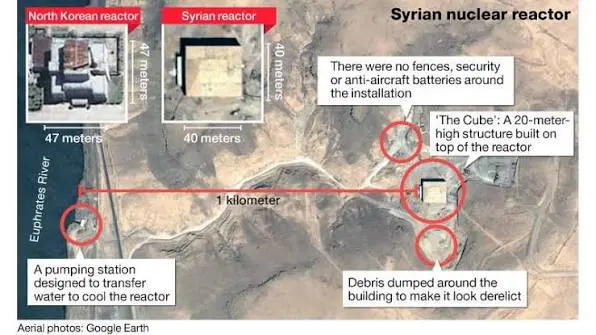
One of these sites is known as "Site 99", which Israel has monitored closely for two years. According to Israeli and American sources, the Assad regime stored at it nuclear materials left over from the Al Kibar project, among them "yellowcake", a powder extracted from uranium ore that could later be used in the nuclear fuel cycle, in addition to residues and other materials. Although these materials are not suitable for making a conventional nuclear weapon, they could be used to manufacture a "dirty bomb" that disperses radioactive material.
التفاهمات والضغوط الدبلوماسية
Immediately after Assad's fall, Israeli forces bombed the entrances to the site to prevent access to it. Israel and the United States discussed the best ways to deal with "Site 99" for more than a year, in close coordination between the National Security Council at the White House and the office of the Israeli prime minister.
Israel made clear that it would not accept the materials remaining in place, and threatened to bomb the site again if they were not moved or if signs appeared of an attempt to reach them. Nevertheless, the American and Israeli sides concluded that the optimal solution was to obtain the Syrian government's approval for the transfer.
When the issue was raised with Damascus, senior Syrian officials said they had not been aware of the existence of the materials. A US official said that "very few people in the United States, Israel and Syria knew about this", noting that the Syrians had become "good partners" in such sensitive files.
Several weeks ago, Israel observed movements that raised concerns of a possible Syrian retreat, or even Turkish assistance in reaching the materials. Washington asked Israel to refrain from any military action, and brought the IAEA into the process. This resulted in an agreement, signed three weeks ago between the agency and the Syrian government, to remove the materials.
الوضع الحالي وأهمية المتابعة
The materials remain at the site, but US officials expect the disposal of the nuclear materials to begin soon and to be completed before the end of the year. One of them said: "We believe everyone is satisfied with the outcome."
Researchers such as Charles Lister of the Middle East Institute believe the new Syrian government is seeking to resolve the sensitive files inherited from the Assad regime, including nuclear and chemical weapons, in order to facilitate the restoration of its international standing. The agreement is seen as evidence of diplomacy's ability to contain remaining nuclear threats and prevent an escalation that could involve Israel, Syria and perhaps Turkey.
It should be noted that the White House, the IAEA and the office of the Israeli prime minister have so far declined to comment officially.
Also read: Terrorism and the New Syrian Regime
Source: Axios
Translated and edited by: Wasl News
Follow us on Telegram:
We currently face technical restrictions that prevent our channel from appearing in Telegram's global search.
To bypass this block and ensure our content reaches you without restrictions, we have created this alternative channel. We ask everyone to join it immediately to follow all the latest news:


