

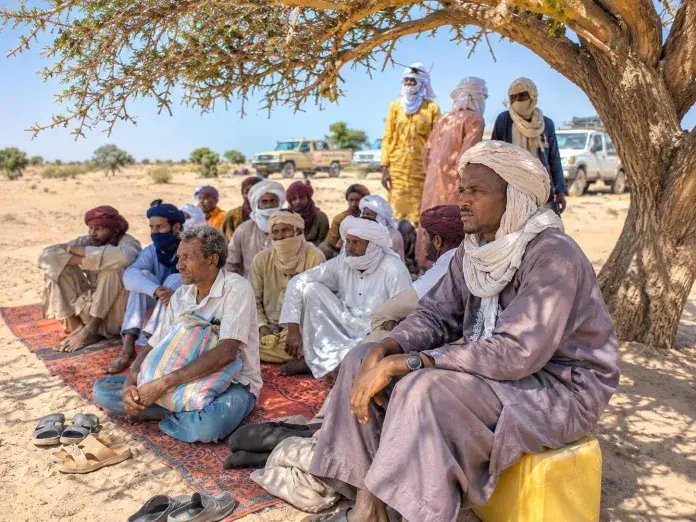
At a time when the Arab Mahamid in Niger face the risk of mass expulsion from the country, accusations are mounting against the military regime in Niamey of pursuing a series of security and livelihood measures aimed at squeezing them, creating conditions to strip them of their rights and pushing them to leave lands where they have settled for decades.
In the latest developments, the military regime in Niger announced the discovery of an empty arms cache in the Bonegarat area, in the Kabelawa sector of the Diffa region in the east of the country, claiming that the weapons that had been inside were prepared for smuggling into Nigeria, specifically to the group "Boko Haram."
In response, sources among Niger's Arabs accused the military regime in Niamey of fabricating the weapons seizure in the Diffa region, where the Arab presence is concentrated, with the aim of finding security pretexts to accuse the Arabs of supporting "terrorism," in preparation for revoking their citizenship and expelling them from the country.
These accusations raise concerns that the counterterrorism file is being used to give a security cover to measures targeting an entire population group on the basis of its ethnic affiliation, rather than pursuing those involved in any crimes through individual evidence and fair judicial procedures.
We had previously documented the escalation since last July of measures targeting the Arab Mahamid in Niger, including demands that they hand over citizenship documents and the confiscation of their property, in developments that preceded the wave of security accusations and attacks that local sources are speaking about today.
From Revoking Citizenship to Creating a Hostile Environment
According to local sources, the military regime in Niger has begun resorting to multiple methods to create conditions for the expulsion of the Arab Mahamid, and to circumvent external pressures that, according to the sources, have prevented the start of procedures to withdraw their official documents and citizenship.
The sources indicate that these methods are not limited to administrative and security procedures, but extend to restricting the essentials of daily life, through the closure of schools and the destruction of water sources, threatening residents' ability to remain in their areas and to preserve their livelihoods.
When schools are closed to children, water sources on which residents and their livestock depend are destroyed, and people are threatened with losing their documents and legal identity, departure can become the result of coercion and deprivation, even in the absence of a direct order of expulsion.
The danger of these measures lies here: state administrative and security tools may be turned into means of pushing residents to leave their homes under living conditions that cannot be endured, which later allows their departure to be portrayed as voluntary.
Armed Attacks Amid Absence of Security Protection
Amid Arab resistance to these coercive measures, local sources accused the military regime of recruiting armed groups to target their population concentrations, in serious accusations that warrant an independent investigation.
Among the incidents reported by the sources, the Angel Kolo area was subjected to two armed attacks on 6 and 14 November of this month, during which gunmen targeted shops, looted their contents, and then set them on fire.
According to the sources, the authorities in the Diffa region did not move to open an investigation into the attacks or to send forces to protect residents and prevent their recurrence.
The danger of these attacks is not limited to the material losses suffered by shop owners, but extends to undermining the sense of security and weakening economic activity in Arab areas, and threatening families' ability to remain there.
Whether or not the involvement of official bodies in these attacks is proven, the failure of the authorities to protect residents and investigate the crimes raises serious questions about the state's responsibility to protect its citizens without discrimination.
Parallels with Israeli Policies Toward Palestinians Inside Israel
These developments call for comparison with a set of policies to which Palestinians inside occupied territory are subjected, where manifestations of economic discrimination and administrative restriction intersect with the spread of organized crime and weak security protection in Arab towns.
Palestinian figures and institutions have long accused Israeli authorities of failing to confront organized crime gangs in Arab society, and of pursuing discriminatory policies that contribute to worsening the economic, social and security conditions of Palestinians.
The points of similarity between the two cases lie in the convergence of several factors that threaten the stability of the population: restrictions on the essentials of life, security suspicion linked to collective identity, declining protection from attacks, and economic and administrative pressures.
This comparison does not necessarily imply a complete identity between the two contexts, or the existence of coordination between the authorities in the two countries. However, it highlights the danger of using the tools of the state, or refraining from fulfilling its duties, to weaken a population group's ability to uphold its rights and remain in its homes.
Counterterrorism or Collective Punishment?
Combating groups designated as terrorist does not grant any authority the right to hold an entire tribe responsible for actions that some of its members are accused of, let alone stripping thousands of people of their citizenship, depriving their children of education, or destroying their water sources.
Ethnic or tribal identity must not become a presumption of guilt, nor should counterterrorism become a pretext to justify mass displacement.
The seriousness of the case increases given that the Arab Mahamid are not merely individuals crossing borders; rather, among them are generations born and raised in Niger, whose lives and economic and social interests are tied to its lands.
Stripping these people of their official documents threatens to create a statelessness crisis, the effects of which may extend to future generations and deprive thousands of people of their basic rights to education, work, movement and healthcare.
A Tragedy Taking Shape Far from the World's Eyes
What the Arabs of Niger are subjected to calls for urgent action: to investigate the accusations against the military authorities, to document attacks on residents and their property, and to prevent any arbitrary measures of citizenship revocation or mass expulsion.
Tragedies of displacement do not always begin with convoys of the expelled at the border; they may begin with a security accusation, the confiscation of an identity document, the closure of a school, the destruction of a well, or an attack that passes without accountability.
When these measures accumulate, and security, education, water, livelihood and identity all become threatened, remaining in one's homeland becomes a daily struggle.
The world should not wait for thousands of displaced people to appear on the border between Niger and Chad before recognizing the gravity of what is happening to the Arab Mahamid. Preventing displacement from occurring is preferable to merely relieving its victims after it has taken place.


