


In the small town of Young in the Australian state of New South Wales, where the region is known for cherry growing, a new mosque has opened. It is one of the largest mosques in regional areas of Australia, reflecting the rapid growth of the Muslim community and the increasing movement of part of it beyond the major cities.
The new mosque can accommodate about 1,000 worshippers, and its size is nearly five times that of the previous mosque, which was no longer able to hold worshippers, especially during Friday prayers, when some were forced to pray outside it.
The new mosque in Young, which belongs to the Lebanese Muslim Association of Australia, serves the Sunni Muslim community in the area.
From a small mosque to a centre for 1,000 worshippers
Abdul Ghanem, one of the worshippers who has lived in Young for years, says the old mosque was full during Friday prayers, to the point that some worshippers prayed outside it, which made building a larger mosque an urgent necessity.
Ghamel Khair, of the Lebanese Muslim Association of Australia, which owns the mosque, confirms that the Muslim community in the town is growing at a rapid pace and that the old mosque no longer suits the size of the current community.
The new facility, for which planning took years, is now able to accommodate about 1,000 worshippers, providing more space for worship and for social and religious activities.
Muslims make up more than 4% of the town's population
Recent census figures reveal a notable Muslim presence in Young.
Of a population of about 11,000, Muslims made up 4.4% of the town's residents according to the most recent census, while the mayor of Hilltops Council believes the proportion may have since risen to around 10%.
This presence is not limited to a single group. According to those running the mosque, a large part of Young's Muslims are of Lebanese origin, alongside individuals from Southeast Asia and Egypt.
The small rural town has thus become home to a multi-background Muslim community that gathers around the mosque, the Islamic school and various community activities.
Why are Muslims moving from Sydney to Young?
The story of the Muslim community's growth in Young is not linked only to external migration, but also to the movement of Muslim families from Australia's major cities to regional areas.
Abdul Ghanem, who moved from Sydney to Young about ten years ago, says he was not the only one to choose to leave city life in search of a more closely knit and quieter community.
He notes that some migrants who came to Australia originally come from villages and small areas, and therefore find in regional towns an environment closer to the way of life they were used to.
The mayor of Hilltops Council, Brian Ingram, also believes that the presence of the mosque and the Islamic school has become a factor attracting Muslim families seeking a place where they can practise their faith and preserve their culture.
This means Islamic institutions play not only a religious role but have also become a factor in determining where some Muslim families settle within Australia.
The mosque: more than a place of prayer
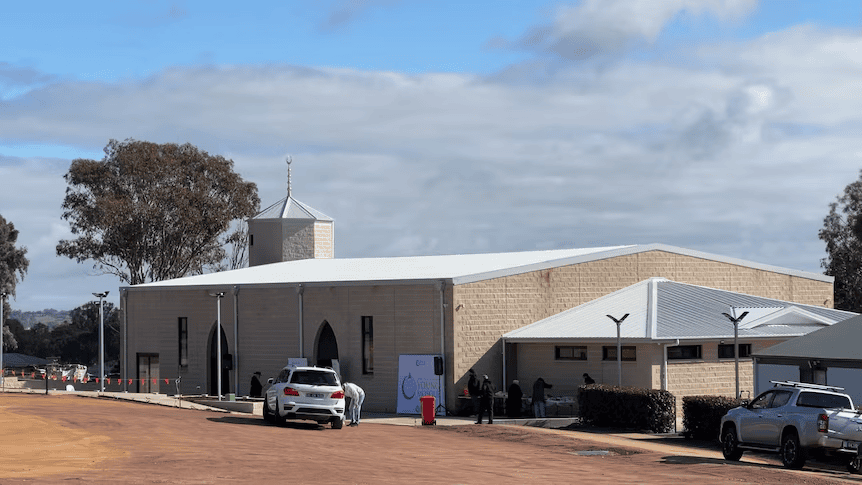
For Muslim community leaders, the new mosque is not merely a building for performing prayers.
The mosque has become a gathering space for a diverse community and a place for communication among Muslims, in addition to its role in introducing Islam to local residents.
Among the community's activities in the area are providing free meals across the Hilltops region and organising open days during which residents can ask their questions about Islam and get to know Muslims up close.
Ghamel Khair believes these activities help build bridges with the wider community and affirm that Muslims in Young do not live in isolation, but seek to be part of the social life of the area.
"We are not an isolated island"
Those running the mosque see the growth of Young's Muslim community as reflecting a broader shift in the nature of the Islamic presence within Australia.
After generations of settlement, Muslim communities are no longer confined to the neighbourhoods and cities where the first waves of migration settled, but have begun to expand geographically into regional areas.
Ghamel Khair says that the Muslim community, as it enters the fourth and fifth generations in Australia, no longer lives within "islands" or closed enclaves, but has become part of the country's multicultural fabric.
For him, Young represents an example of the continuation and success of Australian multiculturalism.
"Our doors are open to everyone"
The new mosque seeks to present another face of the Muslim community in Young, one based on communication, openness and participation in local life.
Ghamel Khair affirms that the community does not fear questions about Islam, and that the mosque's doors are open to everyone.
This message carries particular importance in a small town, where direct acquaintance between residents has more impact than stereotypes that may form through news or social media.
Rather than being a closed space for Muslims alone, those running it want the mosque to become a space that non-Muslims can also visit and through which they can get to know their Muslim neighbours.
Young: a model for a new phase
The opening of the new mosque in Young is not merely an expansion of an Islamic building, but reflects a shift in the map of the Islamic presence within Australia.
At the same time, the community's growth poses its own challenges, from maintaining trust with local residents to confronting stereotypes, and dealing with issues that may involve individuals from the community without allowing them to be turned into collective judgement.
Yet the message the Muslims of Young want to convey is clear: the new mosque is not only a place where rows of worshippers fill, but a sign that Muslims have become a more firmly rooted part of social life in Australia's regional areas.
Perhaps Ghamel Khair's words sum up the whole picture: Muslims in Australia do not live on isolated islands, but have become part of the fabric of a multicultural society.


