


Recent historical research in Kazakhstan's archives has revealed new details about the forced deportations carried out by the Soviet Union against the Chechens and Ingush in 1944, particularly the conditions of their transport in overcrowded railway wagons, the number of deaths recorded during the journey, and the harsh living conditions faced by survivors in the places of exile.
Chechen historian Mairbek Vatchagaev, in statements published by the Caucasian Knot website on 17 November 2026, said he had come across documents never before studied by researchers while working on new publications about the Stalinist deportation of the Chechen and Ingush peoples.
He explained that his research in recent years covered regional and civil archives in several parts of Kazakhstan, including Kostanay, Pavlodar, Aktobe, Karaganda and Almaty, with the aim of building a more accurate picture of the conditions of transport and forced settlement in exile.
According to the researcher, these documents make it possible to see details that were not clear in earlier historical accounts, especially the discrepancy between official instructions regarding the transport of the deportees and what they actually experienced during the journey.
Operation "Lentil": the deportation of two entire peoples
The tragedy dates back to 23 February 1944, when Soviet security agencies began carrying out an operation codenamed "Chechevitsa" (Lentil), under orders from the Stalinist leadership, to deport the Chechens and Ingush from their historical homeland in the North Caucasus to Kazakhstan, Kyrgyzstan and other parts of the Soviet Union.
The operation took place during the Second World War, after Soviet authorities accused the two peoples of collaborating with Nazi Germany; these were collective accusations that provided no legitimate basis for punishing entire populations, including women, children and the elderly.
According to a historical study published by the "Mass Violence and Resistance" project of the Sciences Po Institute of Political Studies in Paris, the deportation operation involved some 478,000 people, including about 387,000 Chechens and 91,000 Ingush, over approximately seven days. More precise figures appear in Soviet records indicating the deportation of 478,479 people.
The operation did not stop at uprooting the population from their homes. It was followed by the abolition of the Soviet Chechen-Ingush Autonomous Republic and the reorganisation of its territory, and the imposition of a system of forced residence on the deportees in remote areas of Central Asia.
54 people in a wagon of about 18 square metres
Among the most notable details presented by Vatchagaev were the findings of his study of the records of the trains used to transport the deportees.
He explained that the freight wagons used in the operation were originally designed for transporting livestock, and that the actual numbers of passengers exceeded what some official transport arrangements had stipulated.
He cited documents on the sixth convoy, which reached the city of Ust-Kamenogorsk in Kazakhstan, showing 51 people in one wagon and 54 in another, although the area of each wagon was slightly more than 17.5 square metres.
The deportees carried their belongings in the same wagons, and a stove for heating was placed in the centre of each wagon, reducing the space available to passengers. According to the researcher, the stove was lit once a day while the train was stopped, with one bucket of coal allocated to each wagon.
Opportunities to use sanitary facilities were extremely limited, making the journey a harsh experience particularly for the sick, children and the elderly.
These details reveal the gap between what the Soviet authorities officially planned and the reality the deportees were forced to endure during their transfer to places of exile.
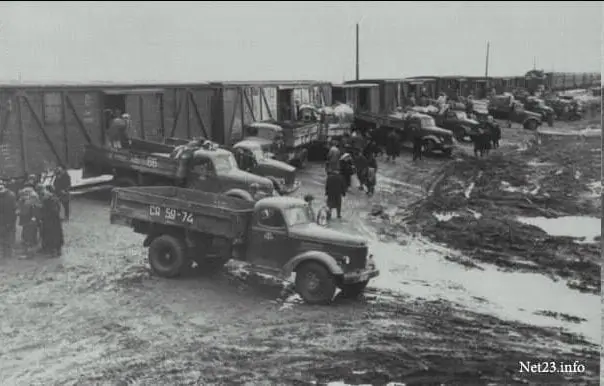
This is an image of the forced deportation of the Chechen Muslims to the unknown land of Siberia, in which 180 convoys set out, carrying 493,269 Chechens, of whom 1,272 died on the way!
Journeys lasting weeks and records documenting deaths on the way
Vatchagaev's research showed that the trains covered distances ranging between 2,500 and 3,500 kilometres, depending on each convoy's destination, and that most journeys lasted between two and three weeks.
He noted that the convoys moved slowly because of the large number of wagons and long stops, and that overcrowding, cold and health conditions contributed to the spread of disease among passengers.
According to what the researcher cited from a Soviet report issued after the operation ended, 1,272 deaths were recorded during the transport of the deportees, alongside the birth of 56 children during the journey.
Vatchagaev, however, questions whether this figure is complete, and believes that the records he studied for some convoys indicate that the actual number of deaths may have been higher than the authorities announced.
He explained that guard lists included references to people who died on the road, bodies left at unnamed stations, passengers taken off trains on suspicion of infectious diseases, as well as births recorded inside the trains.
No new final figure for deaths can be stated with certainty; the historian stressed that settling the matter requires access to all convoy lists preserved in Russian archives, documents he has not yet been able to consult in full.
Exile: shortages of supplies and hardship after arrival
The suffering of the deportees did not end with the arrival of the trains in Kazakhstan and Kyrgyzstan. Another stage began, marked by difficulty in obtaining food, housing and work, and by the restrictions on residence imposed by the Soviet system on those it termed "special settlers".
Vatchagaev presented a document from the Kostanay regional archive, dated 7 March 1945, indicating the failure of plans to meet the needs of the deportees about a year after their arrival.
He said that these documents, together with local correspondence and reports, reveal administrative shortcomings and poor distribution of the resources that were supposed to be allocated to the deported population.
In their general lines, these findings are consistent with historical studies that examined the situation of the deportees in Kazakhstan and documented the difficulties relating to shelter, nutrition, work and adaptation to the climate and social conditions.
The historian believes that the importance of the new documents lies not in changing the basic facts known about the deportation, but in adding details that help understand how Soviet decisions were implemented and the impact they left on families' lives.
Family testimonies bring the tragedy back into focus
The findings announced by Vatchagaev sparked discussion among Chechens and Ingush whose families preserved memories of the deportation.
On 20 November 2026, the Caucasian Knot website published a report on readers' reactions to the historian's research, including family testimonies describing hunger, disease and the loss of relatives during the journeys or after arrival in exile.
Among these testimonies was an account of a girl who was forced to work in a workshop repairing railway wagons in the city of Almaty when she was twelve years old.
Another participant spoke of the disappearance of a child relative after he contracted typhus and was taken off the train, with the family never learning what became of him.
These accounts remain personal testimonies passed down through generations, but they reflect the importance of combining official documents with oral memory in order to understand the human dimensions of the deportation.
Return after Stalin: a tragedy whose effects have not ended
After Stalin's death in 1953, the Soviet authorities began easing the restrictions imposed on the peoples who had been deported.
In January 1957, the Chechen-Ingush Autonomous Soviet Socialist Republic was re-established, opening the way for large numbers of deportees to return to the North Caucasus.
But return did not mark the end of all problems: many found that their homes and lands had changed ownership or had come under other administrative units, while long-standing disputes over land and the right of return continued.
The consequences of that era remain present in historical and social issues in the North Caucasus, including the question of returning the historic Okhotsk area to the Akkin Chechens in Dagestan.
Why are these documents surfacing now?
Vatchagaev explained that his research forms part of efforts that have continued for decades to study the Stalinist deportation, drawing on documents that became available after the collapse of the Soviet Union and on materials preserved in regional archives.
He noted that he is working on the publication of several books covering the different stages of the deportation, and that his forthcoming works will include documents from Kazakhstani archives.
This stage means that the study has not yet been published in its final form, and that the findings announced so far rely on the documents the historian has reviewed and explained in his press statements.
The researcher also stresses the importance of publishing the original documents and making them available to scholars, so that conclusions can be reviewed and official records compared with personal testimonies.
The significance of this research lies in the fact that it does not simply retell the tragedy of the deportation of nearly half a million Chechens and Ingush, but seeks to document the details of the lives of people uprooted from their homes, from the overcrowding inside railway wagons to the years of deprivation in exile.
More than eight decades after the operation, the disclosure of documents held in the archives remains an essential step towards understanding the scale of what the two peoples endured, correcting shortcomings in the official records, and preserving the memory of the victims and of the generations who inherited the effects of the tragedy.
---
References
- Caucasian Knot, 17 November 2026: The Chechen Historian Established Little-Known Details of the Deportation of Chechens and Ingush. The primary source for Vatchagaev's statements and details of the documents.
- Caucasian Knot, 20 November 2026: The Study of the Deportation of Chechens Reminded of the Stories of Families Who Survived It. Family testimonies and reactions to the research findings.
- Sciences Po, Mass Violence and Resistance: The Soviet Massive Deportations: A Chronology. Historical documentation of the deportation operation and the figures of those deported.
- Sciences Po, Mass Violence and Resistance: The Massive Deportation of the Chechen People: How and Why Chechens Were Deported. Historical study of the context of the deportation and its consequences.


