

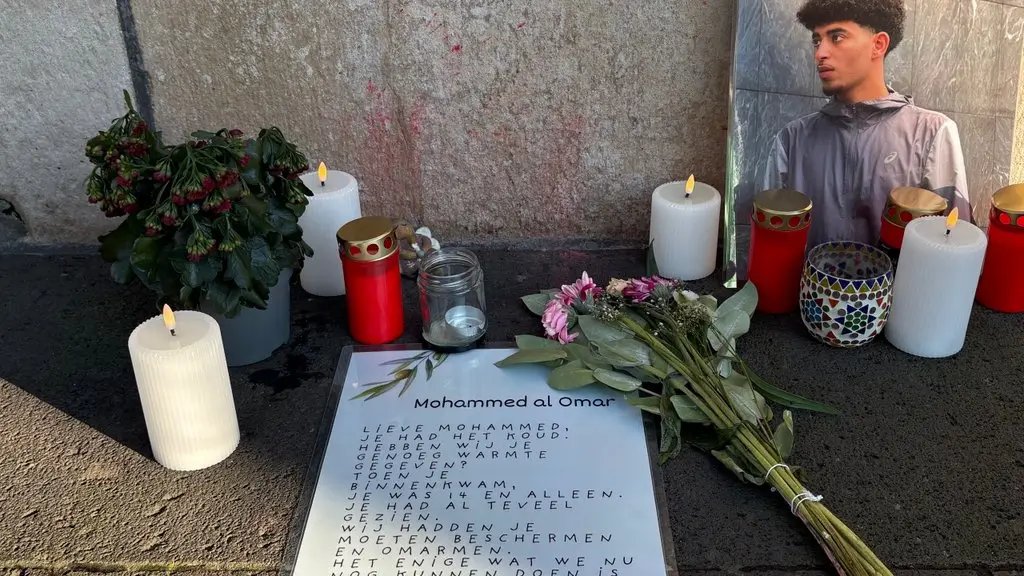
Abdul Karim al-Omar and his family left Syria in search of safety for their children, and he never imagined that they would end up in the Netherlands facing a harsh choice: allowing his eldest son into his home and risking the loss of his other children, according to his account.
But the son, who knocked on his father's door pleading because of the bitter cold, was later found dead inside an abandoned freezer near the family's home.
The death of the young Syrian man Mohamed al-Omar, aged 19, in the Dutch city of Utrecht has sparked a wave of grief and debate over the responsibility of social welfare institutions, known in Arab and Muslim communities as "the Sociale," the limits of their intervention in family life, and the effectiveness of the measures they take in the name of protecting children.
"Father, let me in, I am cold"
On Tuesday, 24 November 2026, Mohamed's body was found inside a freezer placed on the pavement on Timmerstraat, in the Buurt of Pijlsweerd in Utrecht, according to a Dutch police statement. The police later confirmed that he was 19 years old, after their initial statement had said he was twenty.
The young man had sought refuge in the Netherlands in 2021, at around the age of fourteen, before his family joined him in 2024 under family reunification procedures.
According to his father's testimony to Dutch media, Mohamed faced psychological problems and problems related to drug use and bad company, which led the family to seek help from the competent social welfare authorities.
But the father says that the request for help ended with a warning not to allow his eldest son to remain in the home, for fear that it would negatively affect his other children, and that he was told his other children could be taken from him if he allowed Mohamed to return.
On a bitterly cold night before his body was found, Mohamed knocked on the door of the family home, asking his father to let him in and shelter him from the cold.
But the father, according to his testimony, did not open the door, out of fear of losing his other children.
The family believes that Mohamed then went to the abandoned freezer, seeking shelter from the cold, before he was found dead on Tuesday, according to local press coverage.
The police have not yet announced the precise medical cause of death.
A father between two fires: when a request for help becomes fear of losing the children
In testimony relayed by Dutch media from Nael Shami, an acquaintance of the family, he described the difficult situation the father lived through, after finding himself caught between fear for the fate of his eldest son and fear of having his other children taken away.
The father had originally turned to the competent authorities seeking help in dealing with his son's problems, but the family says the guidance they received was that Mohamed should not be allowed to stay in the home.
Here lies one of the most painful aspects of this incident: how can a family that asked for help to protect one of its children find itself forced to close its door on him for fear of losing its other children?
Investigation into the responsibility of social welfare institutions
On Thursday, 26 November, the Dutch police and public prosecution service announced that the investigations had revealed no indications of a criminal offence behind the young man's death, according to the local newspaper DUIC.
However, this finding does not settle the question of the administrative and professional responsibility of the bodies that were monitoring his case and his family's situation.
The Mayor of Utrecht, Sharon Dijksma, announced an investigation to determine the role of the bodies responsible for social welfare, the nature of the information they held, and the guidance they provided to the family.
The body the father specifically accuses is the local social support team "Buurtteam Ondiep," rather than a single official body formally called "the Sociale," as is common in circulating discourse among Arab communities. The team confirmed its involvement in following up on the family, according to local coverage.
Mohamed's tragedy is not an isolated case of refugee problems
Social welfare workers, in a Dutch media report, warned that Mohamed's death reveals a broader problem faced by refugees who arrived in the Netherlands without their families while still children.
A number of these young people face psychological trauma linked to wars, flight routes and separation from family, in addition to the risks of homelessness, addiction and exploitation by criminal gangs.
Psychological treatment and addiction treatment services face major obstacles, including long waiting lists and a shortage of places for treatment, at a time when these young people need support suited to their circumstances.
Documented shortcomings in the Dutch child protection system
The criticism directed at the social welfare and child protection system in the Netherlands is not limited to testimonies from affected families. Official Dutch institutions have documented numerous shortcomings in this system.
In April 2023, the Dutch Court of Audit issued a report addressing the authorities' failure to deal with the continuing problems in the child protection system, despite earlier warnings about its condition.
In February 2025, the research and data centre of the Dutch Ministry of Justice and Security, "WODC," published the findings of a study covering 456 files of children who were forcibly removed from their families in 2018.
The study revealed that only 39% of these children had been returned to their families by the end of 2023, and it documented the need to improve the support provided to parents and communication with families during removal and reunification procedures.
The study recommended improving the support provided to families and involving parents and children in the procedures relating to their reunification.
Muslim families: additional challenges
Muslim migrant and refugee families face additional challenges in dealing with European social welfare systems, linked to language barriers, cultural and religious differences, unfamiliarity with local laws, and the trauma they carry from countries of war and conflict.
A study published in 2024, based on in-depth interviews with ten Syrian refugees in the Netherlands, found that stereotypes associated with their Muslim and Syrian identity add psychological and social burdens to their suffering from displacement.
A paper for healthcare professionals in the Netherlands also stressed the importance of care that takes account of refugees' cultural backgrounds, respects their circumstances and needs, and works to build trust with them.
These findings underline the need to take the complaints of these families seriously, to investigate possible abuses, and to provide legal safeguards that prevent measures disproportionate to the nature of the problems they face.
The responsibility of Islamic institutions in Europe
This incident raises again an important question about the role of mosques, Islamic centres, and human rights and social associations in supporting Muslim families in Europe.
The need is no longer limited to providing material assistance or organising religious activities, but extends to building a specialised system to protect the family, providing legal, educational and psychological counselling, caring for young people at risk of addiction, homelessness and deviance, and helping parents understand their legal rights and duties.
There is also a clear need for lawyers, social advisers and psychological specialists able to support these families, liaise with official bodies, and work to address problems before they worsen.
It is important that a Muslim family has someone to turn to when it faces a crisis with one of its children, and that it is not left alone before complex administrative and legal systems, whose mechanisms and ways of challenging their decisions are often unknown to families.
A painful farewell and questions still without answers
The funeral prayer for Mohamed was held at the Omar al-Faruq Mosque in Utrecht. The municipality announced that it would cover the cost of his funeral and the transfer of his body to Syria, where he is expected to be buried in his homeland, according to the regional broadcaster RTV Utrecht.
But covering the funeral costs does not replace answering the questions his death has raised, nor reviewing the procedures that preceded it, and determining whether his life could have been saved.
The father, who turned to care institutions seeking help to save his son, ultimately found himself bidding him farewell to his final resting place.
While investigations into the role of the social authorities in this tragedy continue, one question must not be absent from public debate: how can children be protected and their interests safeguarded without protection measures themselves becoming a source of fear, family breakdown and greater suffering for families?
The tragedy of Mohamed al-Omar calls for a serious pause to consider the reality facing Muslim families in the diaspora, and the responsibility of the authorities, social institutions and Muslim communities themselves to protect children, care for the vulnerable, and prevent such tragedies from happening again.


