


"My Only Crime Was My Identity": Rohingya Teacher Recounts Seven Months in Arakan Army Detention
For seven months, Nur Alam disappeared into a dark detention centre controlled by the Arakan Army. It was not because he had committed a crime, nor because he had carried a weapon, but because he was a Rohingya Muslim. He was simply a village teacher and a father, taken from his home, his hands tied in front of his daughters, and pushed into a world of torture, humiliation and fear. His only crime was his identity. This is the story of how a respected member of his community became a prisoner in his own country, and how he survived to tell the truth.
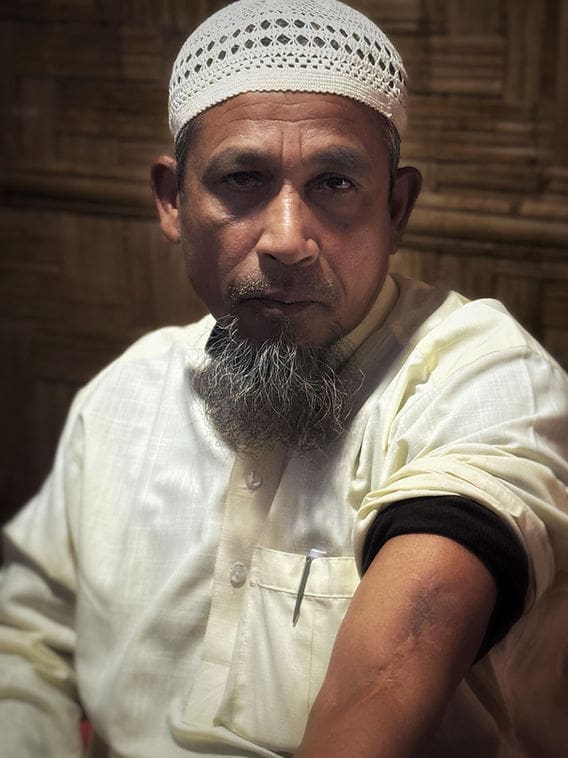
Nur Alam, 56, is a Rohingya detainee held by the Arakan Army. He is a resident of Byramphoro village (Minglar Gyi), Maungdaw Township, Arakan State, Myanmar. Before his arrest, Nur Alam lived a stable and dignified life with his family. He taught at a hafizkhana (a school for memorising the Holy Quran) at the large school in his village, and he also farmed rice fields to provide for his family.
On 21 Dhu al-Qadah 1445 AH (29 May 2024), at about 5 p.m., Arakan Army rebels stormed Byramphoro village, firing indiscriminately without any clear military objective, and took positions in different parts of the village. In the evening, at around 8 p.m., two members of the Arakan Army forcibly entered Nur Alam's house, breaking the door and entering his home by force.
He was then taken to the village road, where Arakan Army rebels had already detained four other Rohingya from neighbouring villages, accusing them of supporting Rohingya armed groups. A resident of Byramphoro village explained that these detainees had no connection to armed groups and were arrested merely for being Rohingya adults. They were detained without cause and subjected to physical torture.
At around 8:30 p.m., the detainees were transferred to "Naymyi-6" in Kyauk Hlay Khar village, where they were held overnight without food or water. On the morning of the following day, at about 5 a.m., they were moved to "Nakaka-10" (Infantry Battalion-10) in Zin Paing Nyar village. There, Arakan Army rebels collected all the personal data of the detainees and filmed videos of them.
It is reported that he was beaten and brutally tortured morning and evening for 14 consecutive days.
Afterwards, with their eyes covered, the detainees were transferred to "Nakaka-7", Bu Li Market, where the Arakan Army rebels had seized a former military base months earlier. Nur Alam was taken into a dark room, where he was subjected to continuous torture.
Nur Alam said: "In that dark room, they fired shots to frighten me. They kicked me and punched me while shouting 'Kalar', and they were drunk."
During the period of detention, they received a small amount of food and water only once a day. They received no medical care, and the wounds from the beatings became infested with insects and discharged pus.
Nur Alam said: "We were treated like animals. I asked them: What is my mistake? Why am I being arrested? Can you tell me what crime I committed in the village? Their response was mocking laughter."
The detainees were forced to work as porters and were assigned night duties at highly dangerous points during army attacks, which Nur Alam describes as the most dangerous and terrifying moments, as they were under armed guard.
On 14 Dhu al-Hijjah 1445 AH (21 June 2024), in the early morning at around 6 or 7 a.m., they were ordered to go and cut trees and shrubs within the boundaries of "Nakaka-7".
In the Arakan Army detention centre, there are also other ethnic minorities, who were subjected to continuous torture.
Nur Alam said: "A Mro (Murong) hill man was shot because he appeared to be sleeping, but he was not sleeping. I was there too. In fact, human life has no value in their eyes at all, and they can kill people of other ethnicities as if they were flies."
After seven months in detention, Nur Alam was released after a large ransom was paid. Arakan Army members returned him to Byramphoro village and handed him over to his wife after extorting 4,700,000 Myanmar kyat (about 2,000 US dollars).
Nur Alam said: "Before I was released, an officer took the money from my wife through a villager."
His arrest and torture caused severe harm to him and his family, physically, emotionally, psychologically and materially.
In 1446 AH (late December 2024), about a month after his release, Nur Alam fled with his family to Bangladesh to escape the escalating threat of drone attacks by the Arakan Army and airstrikes by Myanmar's military government. Their children are still suffering from the trauma of the violence they experienced.
The family now lives in a refugee camp in Cox's Bazar. While they receive essential food aid and cooking gas (LPG), they have not been given adequate shelter support.
Nur Alam said: "I was able to build a shelter with very weak materials. It is unsafe, and there is no one to guarantee our safety here. I want nothing more than justice for those who tortured me because of my religion and my identity as a Rohingya. The international community must ensure that both the Arakan Army and the Myanmar government are held accountable for the crimes they committed against our people."
Nur Alam affirms that if the Rohingya were granted their rights to citizenship, safety and dignity, they would immediately return to their ancestral homes, leaving behind the aid they receive in the camps.


