

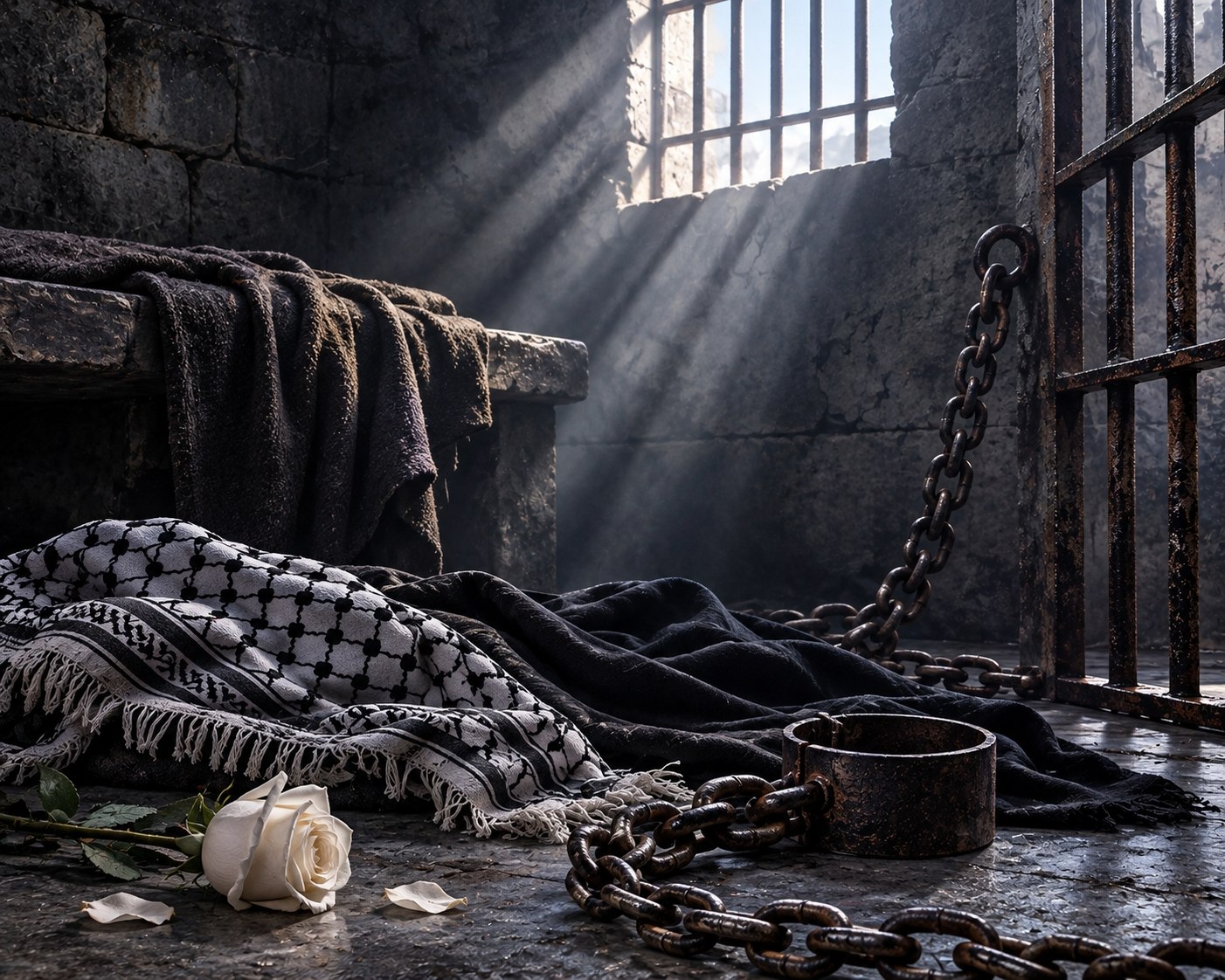
Muslim women are arrested, their freedom taken, and they are abused behind bars. Their dignity is violated in the prisons of the occupation and the detention centres of oppressors, and images of some of them, shackled and surrounded by weapons and humiliation, emerge to the world, unable to repel it or find a way out.
Then the days pass, the months follow, and some of them remain waiting for relief, while others' fate is unknown, and some families sleep hoping for news that reassures them that they are still alive.
Faced with these scenes, the question grows more urgent: where is the Ummah in the face of these injustices? Where are those with ability and responsibility? And what is the meaning of brotherhood if its effects do not appear when trials intensify and the Ummah is called upon for help?
The captive women do not expect us merely to grieve for them; they expect us to act, each according to his ability, so that they are not left alone to face injustice.
"Hasbunallah wa ni'mal wakeel": A Word of Strength, Not a Pretext for Helplessness
"Hasbunallah wa ni'mal wakeel" (God is sufficient for us, and He is the best Guardian).
How great is this word! How true it is when it comes from the heart of a believer who knows that God is sufficient for him, that the whole matter is in His hand, and that He, glory be to Him, is the best Protector and the best Helper.
The believers said it when people frightened them about their enemies, and it became a symbol of steadfastness, not surrender. God the Exalted says:
﴿Those to whom people said, "Indeed, the people have gathered against you, so fear them." But it increased them in faith and they said, "Sufficient for us is Allah, and He is the best Disposer of affairs."﴾ [Aal-E-Imran: 173].
And on the authority of Ibn Abbas, may Allah be pleased with them both, he said: "'Hasbunallah wa ni'mal wakeel' was said by Ibrahim, peace be upon him, when he was thrown into the fire, and it was said by Muhammad ﷺ when they said: 'Indeed, the people have gathered against you, so fear them.'" Narrated by al-Bukhari.
This word is therefore not a sign of weakness, nor a mark of cowardice, nor the stratagem of the helpless; rather, it is among the greatest things a believer seeks help with against injustice and hardship.
But the reliance on God that Allah commanded His servants does not cancel the taking of means, just as sincerity in supplication does not drop the obligation of action from one who is able.
The fault does not lie with a Muslim who can do nothing but raise his hands to the sky; his supplication may be more sincere and more effective than the deeds of many. The fault lies with one who has the ability to help, yet turns away from it, dealing with supplication as though it had freed him from all responsibility.
How great is the difference between a helpless person who is sincere in his supplication and an able person who neglects his duty.
From Pained Zeal to Active Support
It is easy to be moved by the scene of a captive woman, to write words of anger and sorrow, and to denounce the violation of the sanctity of Muslims.
But what comes after that?
Do we seek a way to support her? Do we raise her cause to the level of struggle for her liberation? Do we demand her rights, stand by her family, and keep her case from being forgotten? Or do we settle for a moment of emotion that ends when the clip we watched ends?
What is required of every Muslim is not what he cannot do, nor should an individual bear the responsibility of an entire nation; duties vary according to ability, position and responsibility.
But what is truly painful is that there are those who possess wealth, a platform, influence, decision-making power or the capacity to affect change, yet the captive women receive no share of their effort.
What meaning does responsibility have if it disappears when it is needed? And what value do speeches that glorify the dignity of Muslims have, while their women are left in detention without serious follow-up or continuous demands for their freedom?
Sincere zeal does not stop at emotion; it seeks action that benefits the wronged and repels harm from them.
When the Image of a Captive Woman Becomes a Tool of Humiliation
Among the most cruel scenes of this tragedy is that a Muslim woman is photographed shackled, surrounded by those who detained her, and then her image is published before the world without her consent.
A woman who may have been very careful to cover herself and protect her privacy finds her image forcibly taken from her and turned into material for circulation, defamation and blackmail.
What greater oppression is there than for a person to be deprived of freedom and then deprived of the right to protect her image and privacy?
Whoever photographs a captive woman with the intent of humiliating her does not only violate her freedom; he seeks to multiply her psychological and social suffering and turn her ordeal into a spectacle or a display.
More painful still is that some sympathisers take part in circulating these images, believing they are supporting her, without realising that they widen the circle of harm the aggressor intended to inflict on her.
Supporting a captive woman does not mean republishing the scene of her humiliation, but exposing the violation without repeating the violation of her privacy.
Captivity, coercion or photographing a woman does not diminish her dignity or honour; the shame lies entirely with the one who wronged and assaulted her, not with the one on whom the crime was committed.
The protection of a captive woman's dignity and privacy must be part of defending her, not an matter overlooked amid anger and fervour.
Where Is the Ummah in Relation to Its Captive Women?
In Palestine, women are held in Israeli occupation prisons, and human rights reports describe violations affecting the rights of female detainees and the conditions of their detention.
In East Turkestan, Kashmir, Myanmar and elsewhere, Muslim women face various forms of arrest, restriction, persecution and displacement, amid considerable variation in the ability of independent institutions to reach them and document their conditions.
Although the events and the responsible parties differ, one question remains: have these injustices become familiar occurrences that awaken in the Ummah nothing but passing sorrow?
Islam made supporting the wronged one of the requirements of faith-based brotherhood.
God the Exalted says: ﴿And if they seek your help in matters of religion, then you must help.﴾ [Al-Anfal: 72].
And the Messenger of God ﷺ said: "A Muslim is the brother of a Muslim: he does not wrong him, nor does he forsake him." Narrated by al-Bukhari and Muslim.
"Nor does he forsake him": that is, he does not leave him to the one who wrongs and assaults him.
How can we invoke these meanings and then not ask ourselves what we have given to those we know are being subjected to injustice?
The cases of captive women should not turn into seasons of anger that come to an end, nor should their suffering be reduced to news that tops the headlines for days and then disappears.
Their rights do not lapse with the length of detention, and the duty to strive for their vindication does not end when media attention turns away from them.
Support Is Not a Slogan but a Responsibility
The Messenger of God ﷺ was the most reliant of people upon God, yet he was also the most diligent in taking the means, in exerting his utmost effort and in working for the interests of Muslims.
When the Muslim emigrants returned from Abyssinia, their settlement in a safe land was not a gift that came without effort; it was the fruit of a prophetic direction to seek a place where they could be safe in their religion and their persons.
Thus seeking help from God was never a substitute for action; it was a source of strength, patience and steadfastness in carrying it out.
Today, a Muslim is not asked to do what he cannot, but to know the place of his ability and not waste it.
Scholars and preachers must remind people of the rights of the wronged, and must not allow their causes to become forgotten news.
The media must document violations honestly, keep the cases of female detainees present, and protect their privacy from defamation and exploitation.
Human rights and humanitarian institutions must follow up on the conditions of captive women, document what happens to them, and seek to secure their protection, their contact with their families, and the release of those unjustly detained.
Those with ability and influence must use what they have to stop the violations and work for the liberation of the oppressed.
Muslims in general must support the families of detained women, back credible advocacy efforts, and avoid contributing to the spread of anything that increases the harm to captive women or puts them at risk.
Support is not noise without effect, nor recklessness that adds to the affliction, but a sincere exertion of effort to repel injustice and secure the interest of the wronged.
Whoever is unable to do all of this should not belittle his supplication, nor be blamed for what God has not made a way open for him to do.
Do Not Let the Length of the Ordeal Become a Cause of Forgetting
Among the gravest things that can befall an Ummah is that it becomes accustomed to scenes of injustice until it loses its capacity to be moved by them.
To see a captive woman today and be angered, then to see her tomorrow and feel only a little stir in the heart, until images of shackles, prisons and exhausted faces become an ordinary part of the news.
This habituation is more dangerous than mere silence, because it extinguishes the sense of responsibility and makes the continuation of injustice something that calls for no reckoning and no action.
Muslims should not accept for themselves that their free women become mere numbers on lists of detainees, images passed around on screens, or sad stories they recall only when a new incident occurs.
Every captive woman has a name, a family and a right to freedom and dignity, and every wronged woman has a cause that must not be allowed to die through neglect.
Fulfilling our duty to her does not mean multiplying our grief over her, but searching for what we can do on her behalf, and continuing to demand her rights, however long the road may be.
"Hasbunallah wa ni'mal wakeel": Let Action Be Sincere Alongside Supplication
O Ummah of Islam!
Captive women do not need only our anger; they need sincere support, and people who keep their causes present in their conscience and their work, and who refuse to let time fold the pages of injustice as though nothing had happened.
Do not make supplication a target of blame, and do not let action be absent in the name of supplication.
Do not burden the helpless with what they cannot bear, but do not excuse the able for their negligence, nor those in authority for abandoning their duty.
How ugly is silence when speech is capable of repelling injustice, and how ugly is inaction when the ability to help is present!
Let us all repeat: "Hasbunallah wa ni'mal wakeel," not as the conclusion of our duty, but as provision for our hearts on the path of fulfilling it.
We pray to God to free the oppressed from captivity, we take the means available to us, we help those we are able to help, and we demand the rights of those whose voices we can raise.
Saying "Hasbunallah wa ni'mal wakeel" is not cowardice, and helplessness is no shame for one who has exhausted his effort.
Rather, forsaking is to possess a way to support the wronged and yet choose to leave him alone, until words become a substitute for action and silence becomes an excuse for negligence.
Hasbunallah wa ni'mal wakeel, yes; in God we place our trust, and with whatever means of support we have, we act.
An Ummah that keeps the covenant of brotherhood does not forget its captive women, nor abandon the wronged to their fate as long as it possesses a lawful way to repel injustice from them.
And it is enough of a shame to pursue a whole nation that its free women are held captive in the hands of occupiers, and enough of a cause to awaken consciences and to require preparation and struggle to establish justice on earth.


