


In a move reflecting a notable shift in Morocco's position within the Palestinian landscape, Morocco became in July 2026 the first Arab and African country to deploy military forces within the International Stabilization Force (ISF) in Palestine, which emerged from U.S. President Donald Trump's plan for Gaza. Rabat says the participation aims to support peace and stability and provide humanitarian assistance, while Moroccan activists believe it could place the kingdom in a position of participation in arrangements for the post-war period and occupation.
On 15 July, Morocco signed in Rabat a formal agreement to participate in the force, in the presence of Moroccan Foreign Minister Nasser Bourita, the Director General of the "Board of Peace," Nickolay Mladenov, alongside defence officials and the international force commander Jasper Jeffers.
The participation comes under the directive of King Mohammed VI, in his capacity as Supreme Commander and Chief of Staff of the Royal Armed Forces and Chairman of the Al-Quds Committee.
The initial plan spoke of deploying some 500 Moroccan military personnel to a displacement camp in the city of Rafah in southern Gaza, before the number was reduced to about 200 soldiers, according to what Al Jazeera reported. The force is expected to operate in coordination with the Israeli army, while Morocco's Ministry of Defence has not disclosed in detail the nature of the tasks the Moroccan soldiers will carry out.
Between the field hospital and security tasks
Rabat seeks to present its participation primarily from a humanitarian angle, as the official discourse has focused on Morocco's contribution to establishing a field hospital inside Gaza, considering its participation in the force a reflection of the kingdom's commitment to peace, international cooperation and regional stability.
However, this characterisation faces criticism from Moroccan activists supportive of the Palestinian cause, who argue that talk of humanitarian aid does not answer the fundamental question: what military role will the Moroccan forces play in a force that is supposed to take charge of security arrangements in Gaza?
An analysis published by Middle East Eye indicates that the ambiguity surrounding the mission of the Moroccan forces heightens the concerns of opponents of normalisation, especially as the Moroccan Ministry of Defence has not announced clear details about the force's rules of operation, its tasks and the limits of coordination with "Israel."
Sa'id Sadiqi, professor of international relations at Sidi Mohamed Ben Abdellah University in Fez, believes the field hospital should be viewed as a humanitarian initiative rather than a military project, arguing that Morocco's participation could give it an opportunity to regain a more visible diplomatic presence in the Palestinian question, alongside its traditional role through the Al-Quds Committee and the Bayt Mal Al-Quds Agency.
However, this view collides with a more complex political reality: the Israeli occupation has not provided clear indications of withdrawing from Gaza and the occupied Palestinian territories, and figures in the Israeli right, including Finance Minister Bezalel Smotrich, have called for expanding settlements within the Strip.
Here arises the question that haunts the Moroccan participation: can an international force impose stability in Gaza while the occupation remains in place, or will the mission in practice turn into managing the post-war reality according to Israeli and American conditions?
Normalisation faces a new test
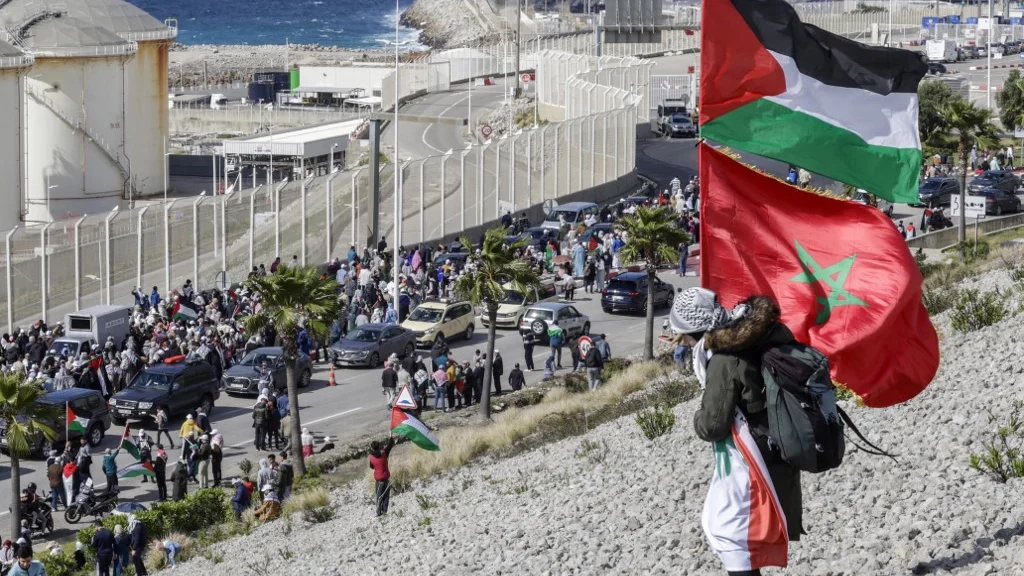
Morocco's participation does not come in isolation from the course of Moroccan-Israeli relations over recent years. Since the resumption of relations between Rabat and Tel Aviv, areas of cooperation between the two sides have expanded, including diplomatic, security and military cooperation.
On the other hand, broad sectors of Moroccan society have maintained a position rejecting normalisation, especially with the continuation of the Israeli war on Gaza.
This gap between the official position and public sentiment makes participation in the stabilisation force more sensitive, as activists fear that Moroccan-Israeli relations could shift from political and security cooperation to direct military involvement in Gaza arrangements.
Pro-Palestinian activists say that the entry of Moroccan forces into the Strip within a force operating in coordination with "Israel" could be understood as a contribution to imposing security arrangements on the Palestinians, particularly if the force's mission includes disarming the resistance.
Anger in the Moroccan street
Criticism has not been limited to the details of the mission but has extended to the very principle of participation.
Moroccan activists view the joining of Moroccan forces to the international force as, in their view, a new step in the course of normalisation with the Israeli occupation, and some fear that Arab forces will become part of security arrangements imposed on the Palestinians instead of being a tool to protect civilians and end the occupation.
Activists describe the participation as "complicity" with what they consider a continuation of Israeli policies in Gaza and the West Bank, while others argue that any Arab military presence should be conditioned on ending the occupation and guaranteeing the rights of the Palestinians, rather than consolidating new security arrangements inside the Strip.
Voices from the Moroccan pro-Palestinian movement say that relying on the United States and "Israel" to provide security and stability for Arab states is a risky bet, especially amid rising regional tensions.
In contrast, Sa'id Sadiqi, professor of international relations, argues that Morocco's participation does not necessarily mean strategic alignment against any party, nor should it be interpreted as abandoning the Palestinian cause, noting that Rabat is trying to balance its foreign policy with the continued broad popular support for the Palestinians.
Morocco: the Arab exception in the Gaza force
The debate is intensified by the specificity of the Moroccan participation. According to the report, Morocco is the only Arab and North African state deploying military forces within the international force, alongside countries such as Kosovo, Albania, Kazakhstan, Indonesia and Uganda.
Egypt, which borders the Gaza Strip directly, limited its participation to training and logistical support.
This makes the Moroccan step more prominent and places Rabat before a double political test: on the one hand it wants to maintain its image as a supporter of the Palestinian cause and chair of the Al-Quds Committee, and on the other it deepens its cooperation with "Israel" and the United States.
The sensitivity of this contradiction increases with the continuation of the war and its repercussions, as activists see that humanitarian assistance cannot be separated from the political and military context in which the international force operates.
Between diplomacy and political risk
For Rabat, participation may offer an opportunity to regain a more active role in the Palestinian file, especially as Morocco maintains relations with both Palestinian and Israeli parties, in addition to its position in the Al-Quds Committee.
However, this role carries significant political risks.
If the international force turns into a tool for imposing security arrangements on Gaza without a clear Israeli withdrawal or a political settlement guaranteeing the rights of the Palestinians, the presence of Moroccan soldiers could place Rabat in direct confrontation with part of Moroccan public opinion and intensify criticism directed at the course of normalisation.
Ambiguity remains the most prominent feature so far. Morocco has declared its commitment to peace and stability, but it has not sufficiently disclosed the nature of the military tasks its forces will perform inside Gaza.
Therefore, the real question concerns not only what Morocco will do in Gaza, but ultimately who this military presence will serve: protecting the Palestinians and helping them recover their lives, or participating in imposing post-war arrangements defined by Washington and Tel Aviv?
This question may determine not only the nature of Morocco's role in Gaza, but also the future of relations between Rabat and Tel Aviv and the limits of Moroccan public acceptance of this course.


