


Nearly nine years after the major wave of displacement that drove hundreds of thousands of Rohingya Muslims to flee Myanmar in 2017 (1438 AH), the refugee camps in southeastern Bangladesh are no longer a temporary stop for victims of a passing crisis. They have become a whole world in which more than a million people live, most of them stateless, and where daily life depends to a large extent on humanitarian aid.
Most Rohingya live in the Cox's Bazar area, where vast clusters of shelters spread across adjoining hills, while tens of thousands also live on Bhasan Char island. According to data from the Bangladeshi government and the United Nations High Commissioner for Refugees, the number of registered Rohingya in Bangladesh reached about 1.2 million by mid-2026, including more than 1.16 million in Cox's Bazar alone.
Behind these figures lies a highly complex daily life: families trying to secure food with what aid vouchers provide, children heading to temporary learning centres, women waiting for hours to access services, and young people watching their years pass amid severe restrictions on work and education, while return to Myanmar remains distant because the conflict continues and the conditions for a safe and sustainable return do not exist.
A City of Bamboo and Plastic
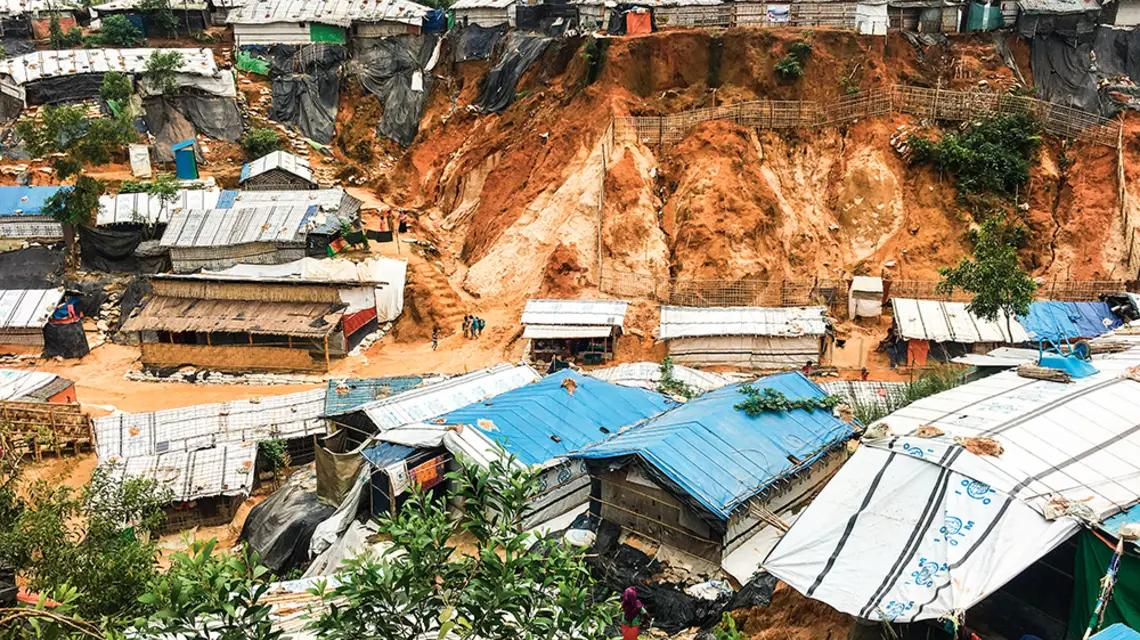
In Cox's Bazar, the camps do not resemble traditional cities. Thousands of small shelters, made mainly of bamboo, sheeting and light materials, are packed together on hillsides, separated by narrow lanes and, in many areas, unpaved roads.
This overcrowding is not only a livelihood problem; it makes every disaster more dangerous. During the monsoon season the hills become prone to landslides, the lanes become slippery and difficult to cross, and a small fire can quickly spread between closely spaced shelters.
In July 2026 (Safar 1448 AH), eight Rohingya refugees, including women and children, were killed after heavy monsoon rains caused landslides in several camps in Cox's Bazar. Reports indicated that shelters built on slopes stripped of trees were highly vulnerable to the rain, and the authorities moved around one thousand refugees from the areas most at risk.
Fires are another recurring threat. Earlier disasters have shown how fragile the camps are: in a major fire in the Balukhali camp in 1444 AH (2023), more than 3,000 shelters were destroyed and around 16,000 people were displaced, in addition to damage to health and education facilities and to water and sanitation networks.
Food: Counting Every Meal
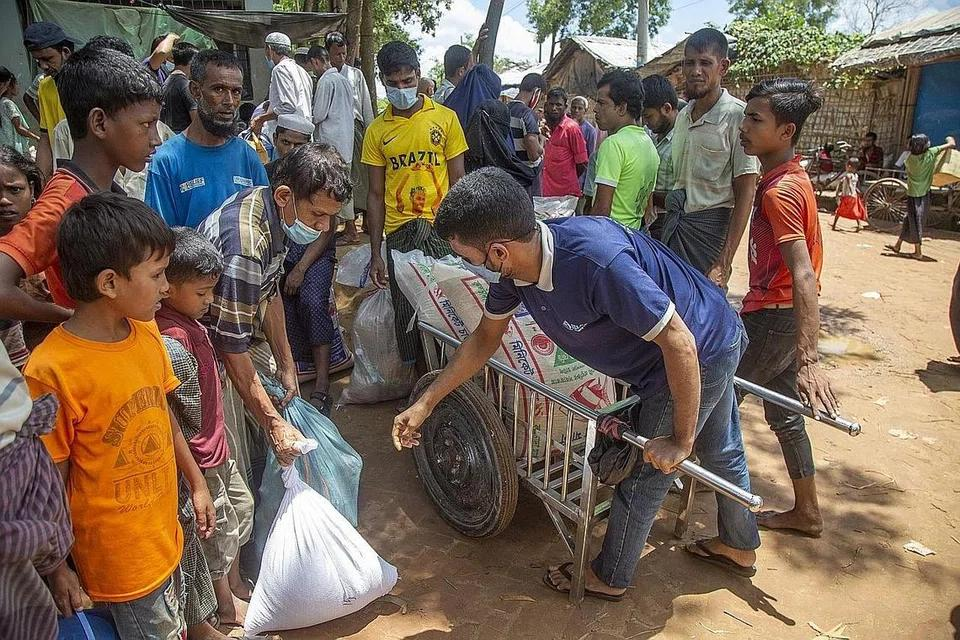
Food remains one of the most sensitive aspects of daily life in the camps, because most refugees have no stable source of income that would allow them to buy their needs independently.
The World Food Programme provides assistance mainly through electronic vouchers that can be used to buy food from shops designated inside the camps. But the international funding crisis forced the programme in 2026 (1447 AH) to shift to a system that sets the value of assistance according to the level of need of each household.
Families classified among the most affected by food insecurity receive 12 dollars per person per month in Cox's Bazar, while other categories receive 10 or 7 dollars per person depending on the assessment of their food situation. The World Food Programme says that all Rohingya households suffer from food insecurity to varying degrees.
In practice, this means a family must spread a very limited amount over a full month's food, which places rice, lentils, oil, vegetables and basic staples at the centre of the daily calculation and limits the ability to buy more varied food, especially for large families.
In early 2026 (1447 AH), the World Food Programme had warned of a funding shortfall of up to 147 million dollars for food and nutrition programmes for the Rohingya, at a time when the number of beneficiaries reached about 1.2 million people, including tens of thousands of new arrivals from Myanmar during 2024 and 2025 (1445 and 1446 AH).
Children of the Camps: A Generation Born in Exile
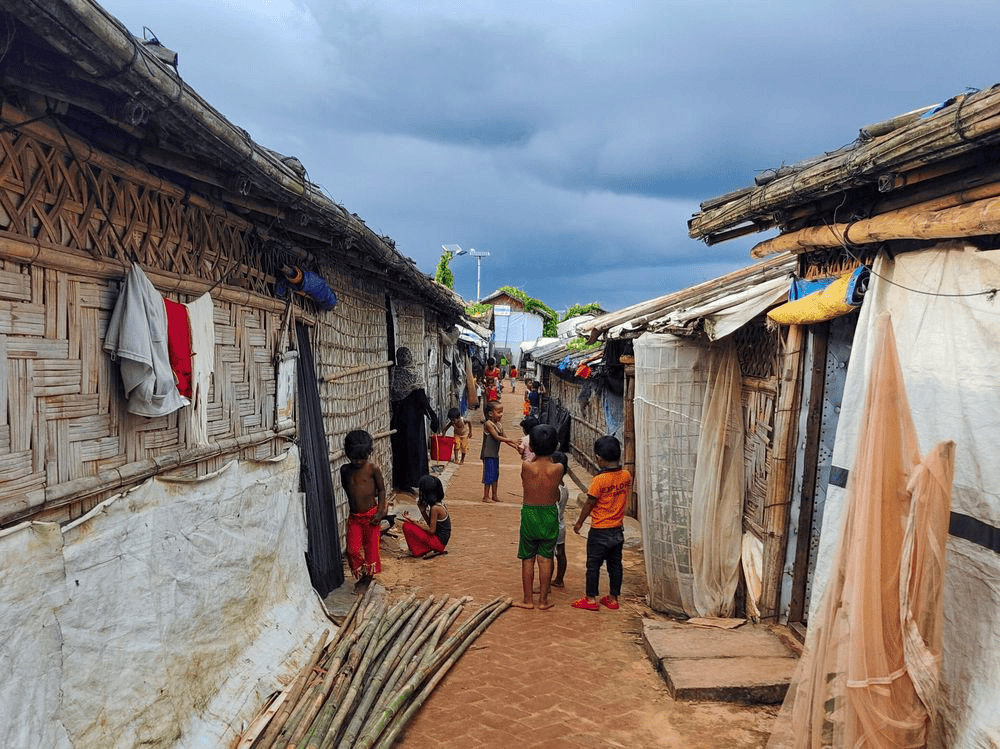
One of the harshest aspects of the crisis is that a large number of Rohingya children know no life outside the camp.
Children make up more than half of the population. By early 2026 (1447 AH), UNICEF estimated that more than 235,000 Rohingya children aged five to seventeen were out of school. The organisation says the absence of education increases the risk of child labour, early marriage, trafficking and exploitation.
Learning centres run by international agencies and their partners operate inside the camps, and curricula linked to the Myanmar curriculum are used in an attempt to preserve the possibility of children returning to the education system in their homeland in the future.
But the educational infrastructure itself is in crisis. In mid-2026 (1448 AH), UNICEF said an assessment covering 2,051 educational facilities revealed wide needs for maintenance and reconstruction; 286 centres needed full reconstruction because of collapse or lack of structural safety, while hundreds of other facilities remained without sufficient funding for repairs.
The problem is most acute for adolescents and young people, as opportunities for secondary and university education and vocational training are limited relative to the size of the population, turning years of prolonged exile for many into years of waiting with no clear path to the future.
Disease Spreads Faster in Crowded Places
Population density, poor shelter conditions, limited water and sanitation, and malnutrition all make the camps highly vulnerable to disease outbreaks.
During 2026 (1447 AH), Bangladesh faced a widespread measles outbreak that spread to the Rohingya camps. By mid-May, the World Health Organization had recorded 60 laboratory-confirmed measles cases inside the camps, with five associated deaths, prompting the authorities and international organisations to carry out a large vaccination campaign that reached more than 166,000 Rohingya children under five.
UNICEF data also showed that around 169,700 children under five were screened for wasting during the first half of 2026 (1447 AH), and about 6,800 children suffering from severe acute malnutrition received life-saving treatment.
Health challenges also include skin diseases and scabies, respiratory infections and diarrhoea, in addition to the continuing need for maternal health services, mental health care and care for people with chronic illnesses.
But the most serious problem now is funding. The World Health Organization has warned that from autumn 2026 (1448 AH), a shortfall could disrupt services in 13 primary health care centres, a field hospital and four health posts, potentially affecting access to care for around 400,000 people.
Fear Does Not End With the Flight
If the Rohingya fled to Bangladesh to escape violence in Myanmar, the camps themselves have not remained far from violence and crime.
In recent years, armed groups, smuggling networks and gangs have emerged inside the camps, and killings, kidnappings, extortion and clashes between different groups have occurred.
In September 2026 (Rabi al-Awwal and Rabi al-Thani 1448 AH), data from the Bangladesh Armed Police Battalion indicated that since 2021 (1443 AH) the camps had recorded about 787 kidnapping incidents involving 935 victims, while only 99 court cases had been opened. In July alone, a five-year-old boy was abducted from Camp 11, and the kidnappers demanded a ransom before releasing him after part of it was paid, according to sources cited by the Daily Star.
The newspaper says gunfire has returned to be heard in some camps in recent weeks after a period of relative calm, while residents have spoken of growing fear of going out at night.
Security thus becomes part of everyday life: families think not only about food and education, but about the safety of their children, who moves at night, and who controls certain areas, in a reality where it is difficult to enforce order within vast, densely populated communities.
Young People Between Unemployment and Idleness
Among the groups paying the price of the prolonged crisis are young people who arrived in Bangladesh as children and are now in their twenties.
Opportunities for formal employment inside the camps are very limited, and most available income-earning opportunities depend on humanitarian programmes, voluntary work or temporary jobs.
Some agencies offer small paid opportunities for work such as repairing roads and lanes, stabilising slopes and maintaining facilities, but cuts in humanitarian funding have sharply reduced these programmes. The UNHCR said some projects that once employed between 30 and 40 refugees are now able to employ only seven or eight.
The absence of work means not only a loss of income but also a deep sense of helplessness, especially among young people who cannot build an independent life or plan for marriage, study or a career.
Women: The Burden of Daily Life and Additional Risks
Women in the camps bear a large share of household burdens: preparing food, fetching water, caring for children and the sick, and following up on aid, in an environment that lacks privacy and space.
Humanitarian agencies repeatedly warn of rising risks of gender-based violence, exploitation and human trafficking, especially as poverty and insecurity increase.
المسلمون الروهينجا: تاريخ مثقل بالمجازر وحاضر يتكرر فيه الخذلان\
Water and Sanitation: A Service the World Notices Only When It Fails
Behind almost every shelter in the camp lies a complex network of wells, tanks, toilets and drainage channels run by humanitarian organisations.
In an area where hundreds of thousands live in very close proximity, any fault in drinking water or sanitation can quickly turn into a health crisis.
With the monsoon rains, water sources sometimes become contaminated or facilities are damaged, while flooding increases the risk of waterborne diseases. For this reason, cholera control campaigns and epidemic preparedness remain a permanent part of health work in the camps.
In 2026 (1447 AH), the United Nations and its partners launched an appeal for 710.5 million dollars to cover the minimum humanitarian needs of the Rohingya and the Bangladeshi host communities, an amount about 26% lower than the previous year's plan because programmes were scaled back and focused on the most urgent assistance.
This shortfall does not appear in a single line item; it extends to food, education, health, shelter repairs, sanitation, protection programmes and temporary work opportunities.
With each cut, families are forced to compensate for what they have lost in some way: eating less, postponing treatment, taking a child out of education, seeking informal work, borrowing, or risking travel outside the camp.
Temporary Camps That Have Become Whole Lives
When the camps were established, they were part of an emergency response to a mass displacement. But the children born in 2017 (1438 AH) are now of school age, the young people who arrived as adolescents are now adults, and entire families have spent nearly a decade within a space that was meant to be temporary.
This is the central paradox of Rohingya life in Bangladesh: everything in the camp is designed to be temporary, yet time itself has become long.
The shelter is temporary, education is limited, work is unstable, aid depends on donors, and return to the homeland is postponed to a date no one knows.
At the same time, a collective return to Myanmar does not appear to be near. Rakhine State still suffers from conflict, and the UNHCR affirms that the conditions necessary for a voluntary, safe, dignified and sustainable return have not yet been met.
Between Survival and Return
For many Rohingya, Bangladesh represents not an alternative homeland but a place of refuge. It has granted them escape from killing and persecution, but their lives there remain governed by displacement.
As the years pass, the question facing families changes.
It is no longer only: when will we be able to return? It has also become: what will happen to our children if we do not return?
What is the future of a generation born stateless, educated inside a camp, living on aid, and growing up hearing about a homeland they have seen only through their parents' stories?
This is why the Rohingya crisis today cannot be reduced to refugee numbers or bags of food. It is the crisis of an entire generation living between a homeland denied to them, a camp that was never meant to become a home, and a world in which aid recedes the longer the cause endures.


