


In the heart of the Punjab region, on the banks of the Ravi River, Lahore stands as one of the most renowned cities whose name is tied to the history of Islam in the Indian subcontinent. It was not merely a military station on the route of the conquests; over the centuries it became a political, cultural, literary and architectural centre that played a prominent role in shaping Islamic civilisation in South Asia.
With the shift of the weight of the Ghaznavid state eastward, then the rise of the Delhi Sultanate, and finally the Mughal era, Lahore became a link between the Islamic world in Khorasan and Central Asia and India.
From Border City to Ghaznavid Capital
Lahore entered a new phase of its Islamic history with the expansion of the Ghaznavid state into the Indian subcontinent during the fifth century AH / eleventh century CE.
Sources indicate that Sultan Mahmud of Ghazni consolidated his control over the city in the early fifth century AH / eleventh century CE, after which Lahore became an important Ghaznavid base in the Punjab region.
Following the defeat of the Ghaznavids by the Seljuks at the Battle of Dandanaqan in 431 AH / 1040 CE, and the gradual decline of Ghazni as a centre, the Ghaznavid centre of gravity shifted progressively eastward, and Lahore became the capital of the remaining part of the Ghaznavid state. The city thus moved from a frontier position to a political and cultural capital of wide significance.
Under the Ghaznavids, the features of a strong Persian Islamic culture began to take shape in the city, and writing and poetry flourished there, until Lahore became one of the most prominent literary environments in the Persian-speaking world outside Khorasan.
Lahore: City of Poets and Scholars
Lahore's political standing was not separate from its cultural role. In the Ghaznavid period, a class of poets and writers attached to the court emerged in the city, among the most prominent of whom were Abu al-Faraj al-Runi and Masud Saad Salman, who was born in Lahore in the fifth century AH / eleventh century CE and became one of the leading Persian poets in India.
Specialised studies indicate that Masud Saad Salman was among the earliest major Indian Persian poets, and that his poetry represents an important source for understanding the political and cultural environment in which he lived. Important parts of his poetry were also tied to the city itself, which became a recurring literary subject in his work.
Ali Hujwiri: A Name Linked to the City's History
Among the most famous figures associated with Lahore's history is Abu al-Hasan Ali ibn Uthman al-Hujwiri, known as Data Ganj Bakhsh, who lived in the fifth century AH / eleventh century CE.
Al-Hujwiri settled in Lahore and died there approximately between 465 and 469 AH / 1073–1077 CE. He left his famous book Kashf al-Mahjub, which became one of the influential works in the Persian Islamic heritage and spread in Persian-speaking scholarly environments in India, Central Asia and elsewhere.
The historical importance of al-Hujwiri for Lahore lies not only in his personal fame, but in the fact that through him the city became one of the early environments in the Indian subcontinent to witness the recording and transmission of Islamic heritage in the Persian language.
From the Ghaznavids to the Delhi Sultans
In 582 AH / 1186 CE Ghaznavid rule in Lahore came to an end after the Ghurids entered the city, and the region passed into a new phase of Islamic history in India.
After the death of Sultan Muiz al-Din Muhammad Ghori in 602 AH / 1206 CE, Qutb al-Din Aibak emerged in Lahore and later became one of the principal founders of the state that came to be known as the Delhi Sultanate.
Historical studies explain that Aibak, one of the leading Ghurid commanders, managed to build an independent political base in India, while Delhi became the most important political centre of the emerging state. Nevertheless, Lahore remained a pivotal city in the Punjab and a centre for scholars, writers and merchants.
However, the city's proximity to the routes coming from Central Asia made it exposed to conflicts and invasions. Lahore was attacked by the Mongols in the seventh century AH / thirteenth century CE, including the assault that led to its destruction in 641 AH / 1241 CE. The city then went through successive phases of reconstruction and fortification.
The Mughals: When Lahore Reached the Peak of Its Glory
The greatest transformation in Lahore's history came with the establishment of the Mughal state in India during the tenth century AH / sixteenth century CE.
The city came under the Mughal state in the first half of the tenth century AH / sixteenth century CE, and Emperor Akbar then granted it an exceptional status when he made it the imperial capital for a long period between 992 and 1006 AH / 1584 and 1598 CE.
During this phase the city expanded, its fort was rebuilt, its walls were extended, and it became the seat of imperial administration and a centre of trade, culture and the arts. Local sources state that Akbar's court remained in Lahore for fourteen years, and the city witnessed considerable urban growth during this period.
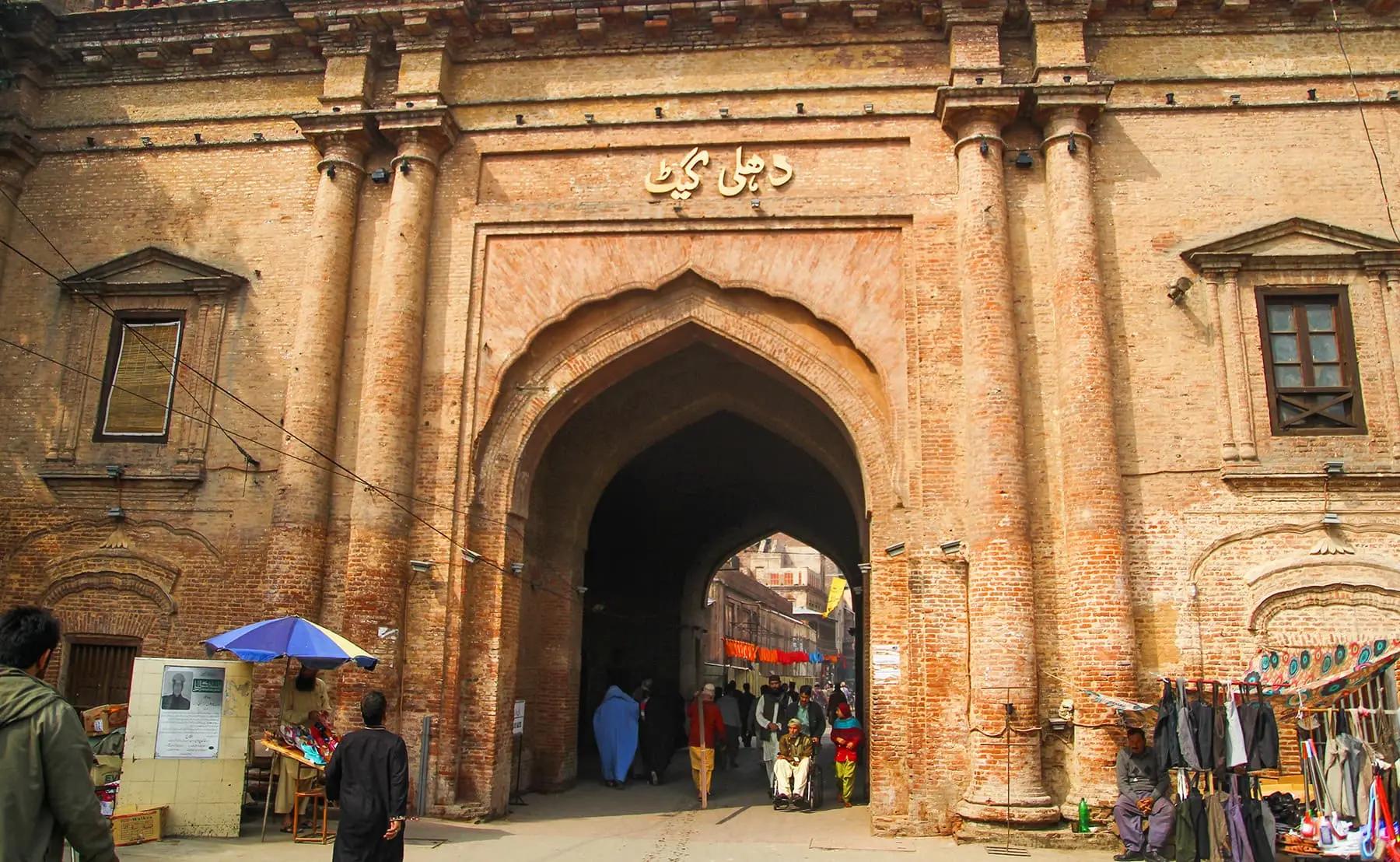
The Mughals' attention to the city did not end when the capital moved to Agra and elsewhere. Jahangir, Shah Jahan and Aurangzeb continued to add palaces, mosques, gardens and structures that made Lahore one of the wealthiest Islamic cities in Mughal architecture.
The Lahore Fort: A Imperial Memory
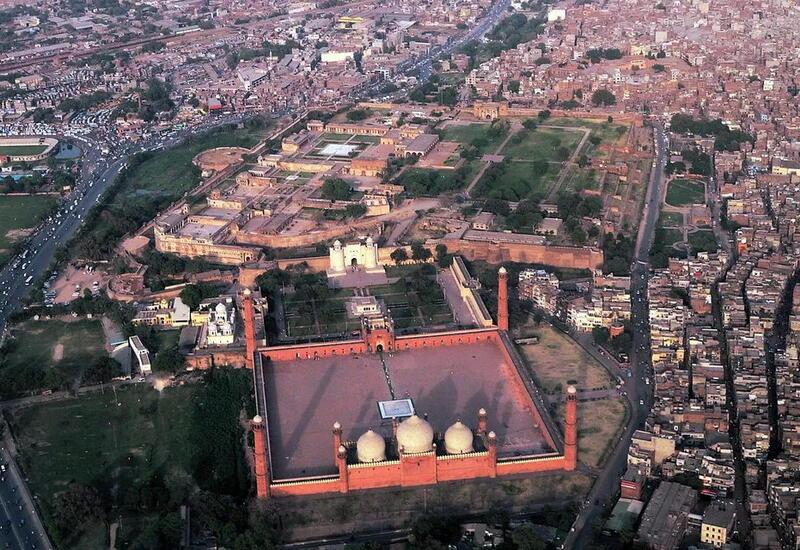
The Lahore Fort stands in the heart of the old city as a witness to the transformations it has undergone.
Emperor Akbar rebuilt the fort in fired brick in the tenth century AH / sixteenth century CE, and his sons and grandsons then added a large number of buildings and wings.
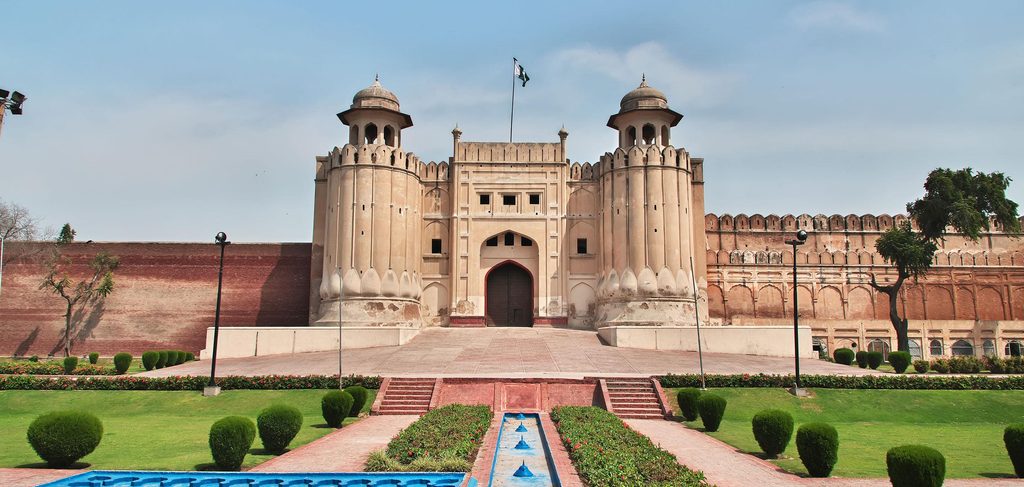
The complex contains a group of the best-known examples of Mughal architecture, among them the Diwan-i-Am (Hall of Public Audience), the Diwan-i-Khas (Hall of Private Audience), the Sheesh Mahal, the Moti Masjid, and the Alamgiri Gate, which was added during the reign of Aurangzeb in approximately 1085 AH / 1674 CE.
The fort thus became more than a defensive structure; it turned into a stone record of the stages of development of Mughal Islamic architecture in the subcontinent.
Badshahi Mosque: Lahore's Most Famous Landmark
If the Lahore Fort embodies the political power of the Mughal Empire, the Badshahi Mosque represents one of its most famous religious and architectural symbols.
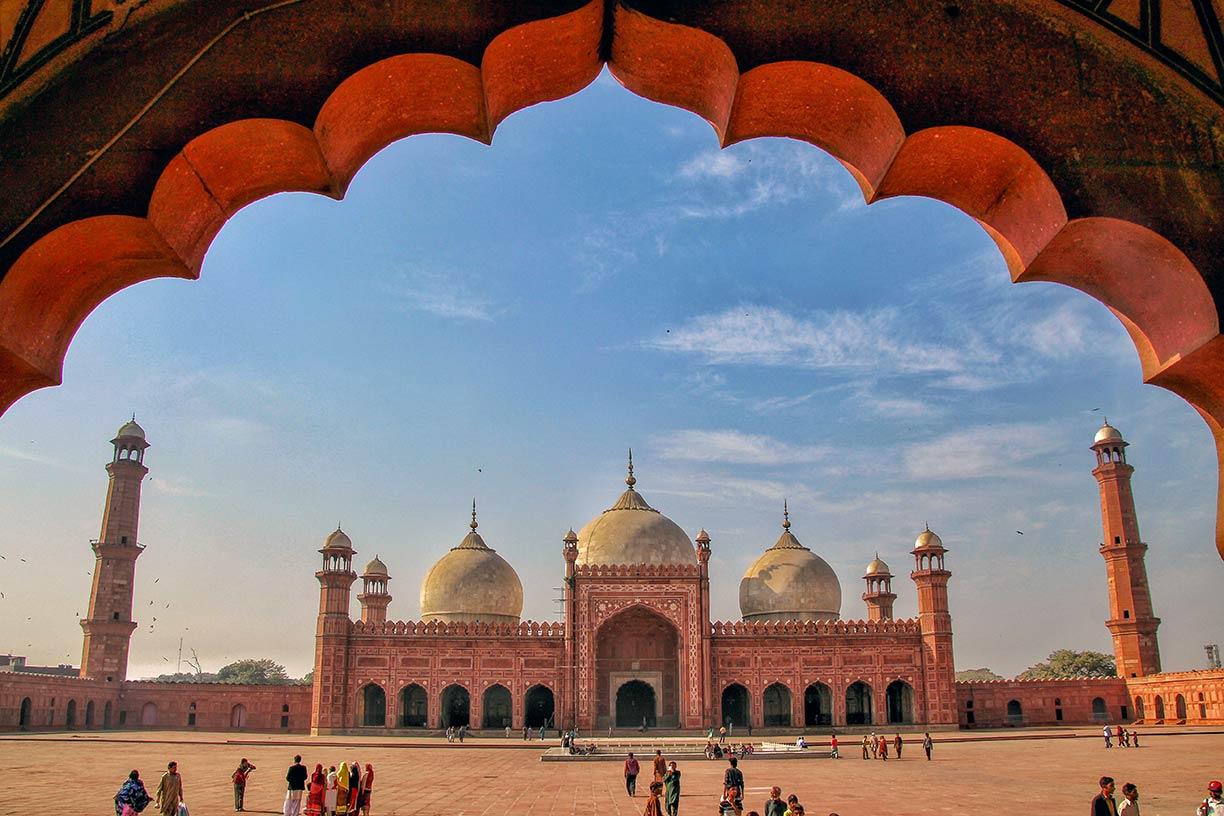
The mosque was built during the reign of Sultan Aurangzeb between 1082 and 1084 AH / 1671 and 1673 CE, near the Lahore Fort, and became one of the largest mosques built by the Mughal state.
The mosque is distinguished by its spacious courtyard, its three domes and its tall minarets, and by its use of red sandstone and marble in its architectural details. It remains to this day one of the most prominent Islamic landmarks of Lahore.
Wazir Khan Mosque and the Shalimar Gardens
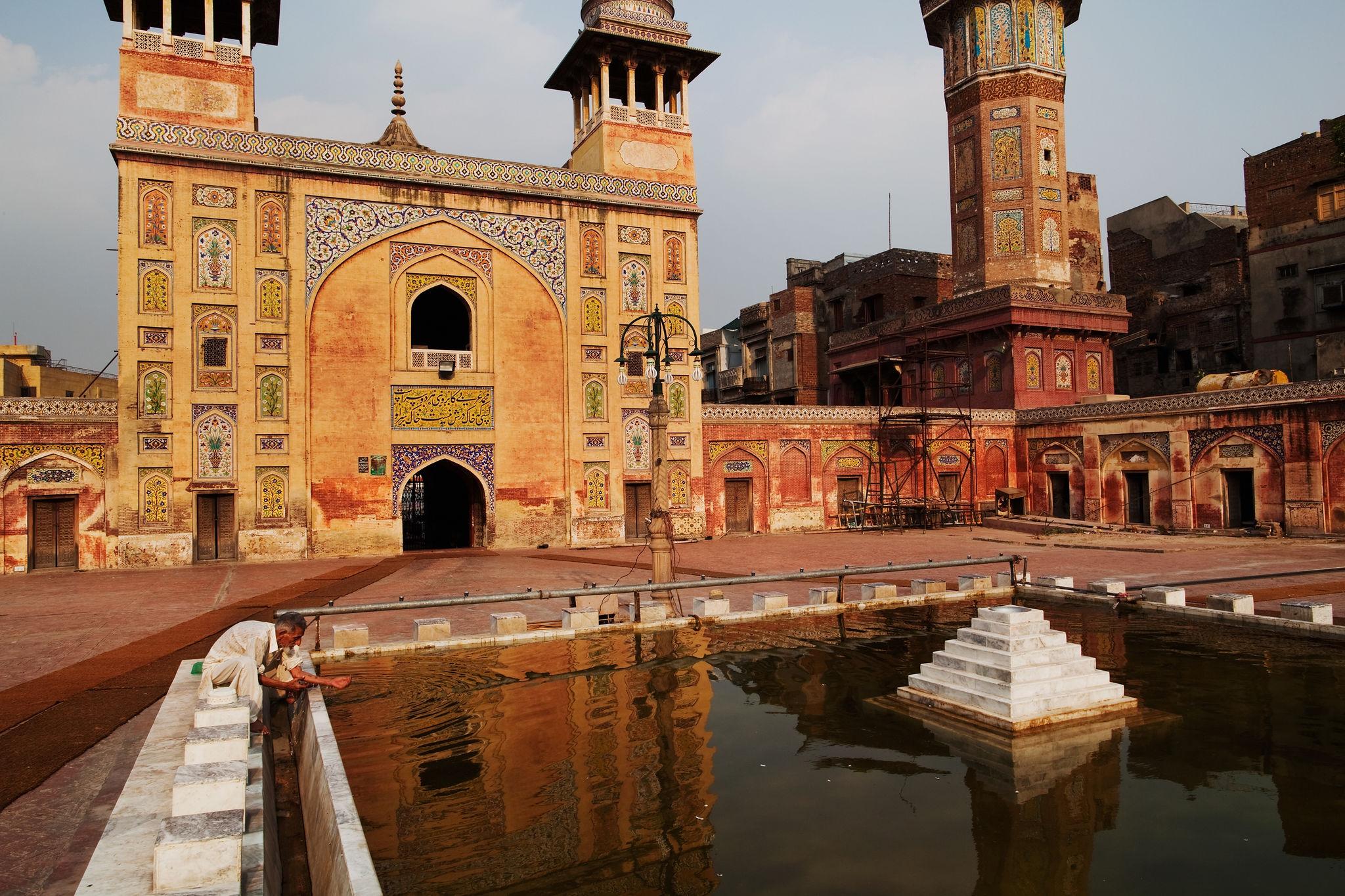
Islamic architecture in Lahore did not stop at palaces and fortresses. The Wazir Khan Mosque, built in the eleventh century AH / seventeenth century CE during the reign of Shah Jahan, represents a prominent model of Mughal Islamic decoration, with its coloured tiles and fine geometric and floral ornamentation.
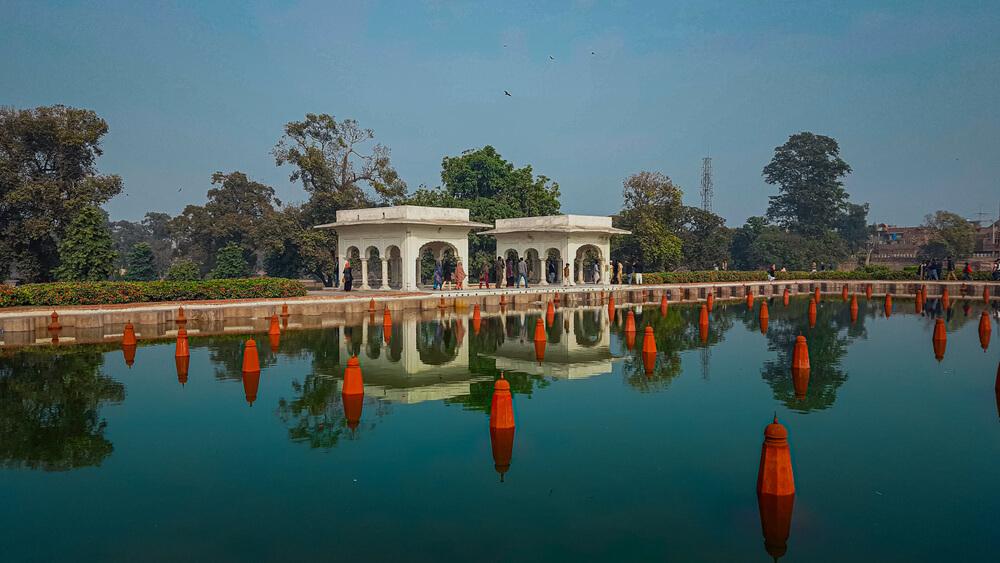
The Shalimar Gardens, created during the reign of Shah Jahan in the eleventh century AH / seventeenth century CE, embody the Mughal conception of Islamic gardens, based on the organisation of water, terraces, basins and fountains in an architectural composition that combines beauty and geometry.
Lahore: A City That Built a Bridge Between Two Worlds
Lahore's importance lies in the fact that it was never a city isolated from the Islamic world. Rather, it was a meeting point between Khorasan, Central Asia and the Indian subcontinent.
Through its routes, the Persian language, sciences, books, and administrative and literary elites travelled, while the city itself became an environment producing its own literary, artistic and architectural output.
For this reason, Lahore's history can be understood as part of a broader story: the story of the transfer of Islamic civilisation to South Asia and the formation of new urban centres that carried the sciences, languages and arts of Muslims to regions far from the early centres in Mecca, Medina, Damascus and Baghdad.
Despite the political transformations the city went through after the decline of the Mughal state, the traces of that period remained present in its urban fabric, mosques, markets and fortresses, so that Lahore today stands as one of the most renowned cities whose streets and architecture embody centuries of Islamic history in the Indian subcontinent.


