


The Kordofan region has become one of the most important and sensitive battlegrounds of the Sudanese war, as fighting between the Sudanese army and the Rapid Support Forces has intensified since late 2025, when the weight of the confrontations gradually shifted from Darfur to the region that forms the main link between western and central Sudan.
According to an analysis published by Al Jazeera on 1 October 2026 (20 Rabi' al-Akhir 1448 AH), based on data from the Armed Conflict Location & Event Data Project (ACLED), control of Kordofan is no longer merely a battle over three states, but a struggle over a strategic corridor separating the Rapid Support Forces' areas of influence in Darfur from the areas controlled by the army in central, northern and eastern Sudan.
Kordofan comprises North, West and South Kordofan states, where the areas of influence of both sides meet. In recent months the Sudanese army has managed to push the Rapid Support Forces out of large parts of North Kordofan, while areas in South Kordofan remain contested, and the Rapid Support Forces retain influence in the west.
Why has Kordofan become so important?
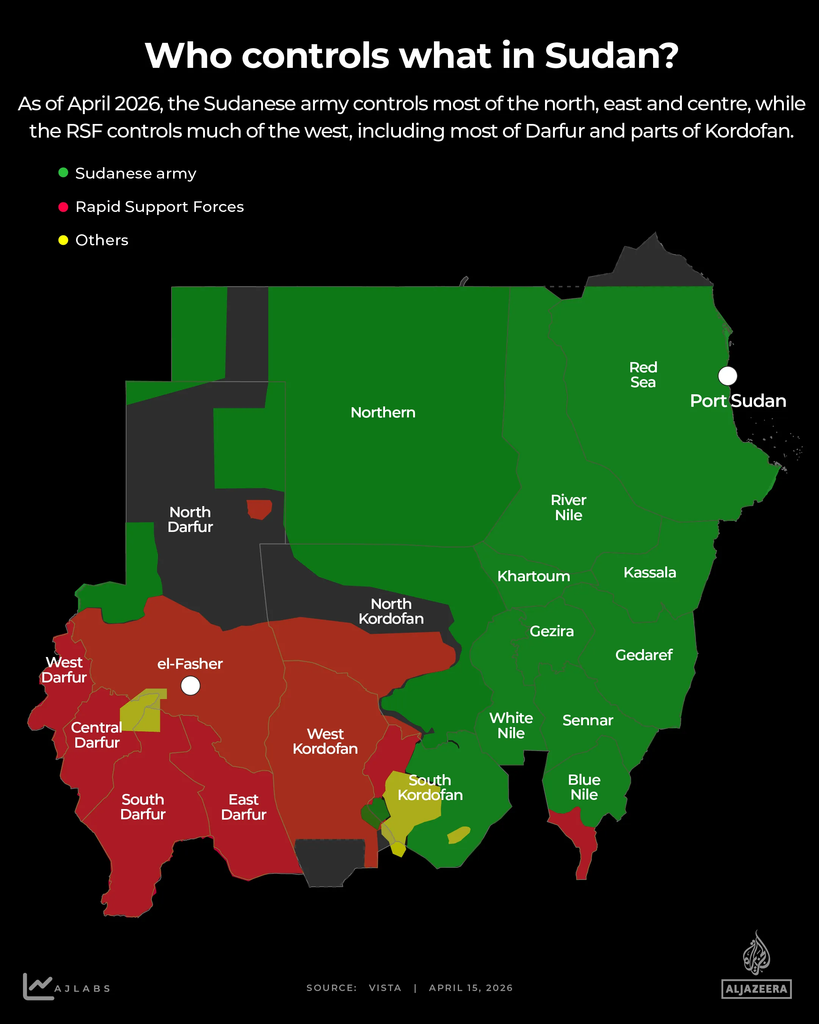
Kordofan's importance increased significantly after the fall of El Fasher, the last major city in Darfur under the control of the army and its allies, in October 2025.
Since then, a large part of the weight of operations has shifted eastward toward Kordofan, which geographically represents the gateway between Darfur, most of which is controlled by the Rapid Support Forces, and the areas under army control in central Sudan, the capital, and the north and east.
This location gives the battle a dimension that goes beyond local control: the Rapid Support Forces' advance eastward across Kordofan could open routes for them toward central Sudan, while an army advance westward would allow pressure on the Rapid Support Forces' lines of communication with Darfur.
El Obeid, the capital of North Kordofan, stands out as one of the most important points of conflict. The city is a major commercial and administrative hub linking central and western Sudan, and control of it or of the roads surrounding it directly affects the movement of forces and supplies between the two regions.
Nearly one in five attacks of the war occurred in Kordofan
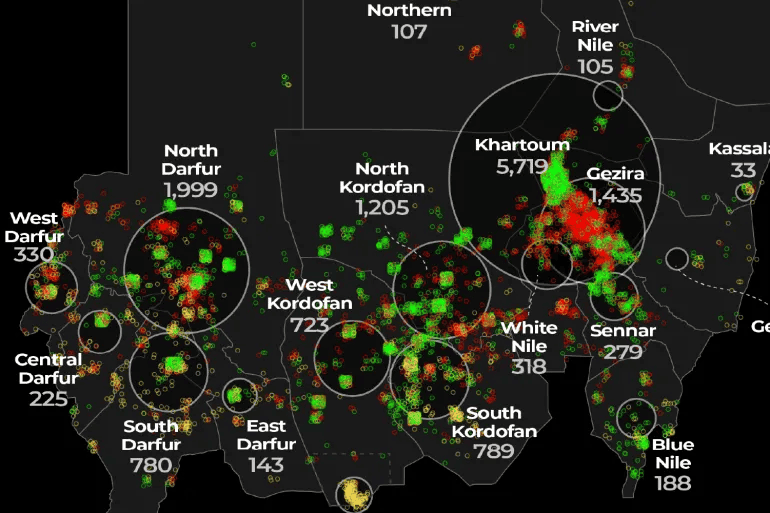
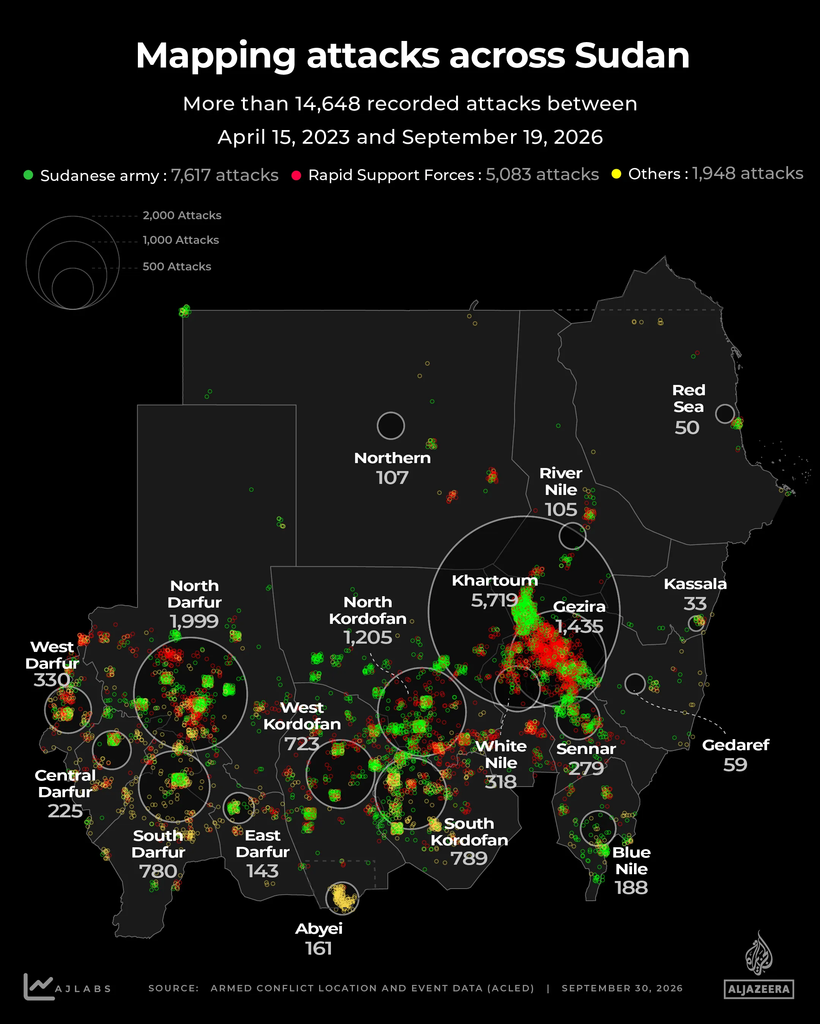
The data reveal the scale of the battle. From the outbreak of the war on 15 April 2023 until 19 September 2026, ACLED recorded 14,648 attacks and violent incidents linked to the conflict in Sudan.
Khartoum ranked first among the most affected areas with 5,719 incidents, or about 39% of the total, followed by North Darfur with 1,999 incidents, then Al Jazirah with 1,435.
The three Kordofan states combined recorded some 2,876 incidents, or nearly 19.7% of all attacks recorded in Sudan, meaning that roughly one in every five recorded attacks during the war occurred in the region.
Looking at Kordofan's details, North Kordofan was the most exposed to attacks, followed by South Kordofan and then West Kordofan.
In North Kordofan alone, a large part of the confrontations was concentrated in Sheikan locality, which includes the city of El Obeid, where 497 incidents were recorded, representing about 41% of the attacks recorded in the state.
In South Kordofan, Dilling emerged as the main focal point of fighting, followed by Kadugli and Al Quoz, while confrontations in West Kordofan were more widely spread among Babanusa, En Nahud, Al Khuwei and Abu Zabad.
According to the ACLED data on which the Al Jazeera analysis is based, Kordofan recorded at least 12,314 conflict-related deaths since April 2023.
Drones change the face of the battle
The battle of Kordofan is not fought on the ground alone, as armed drones have become an increasingly important element of the fighting.
Cities in North Kordofan are witnessing drone strikes at an increasing rate, and attacks have also hit civilian facilities.
On 9 September, a drone strike hit the College of Medicine in El Obeid, destroying parts of the building and killing a security guard, according to the college dean Abdelaziz al-Sheikh, speaking to Reuters.
A student named Amnia Abu al-Qasim had sat her exams at the college one day before the strike, and told Reuters that the destruction of the college made students feel that their dreams and their future had been destroyed along with it.
This comes within a broader shift in the Sudanese war, as drones have become a principal means used by the parties to the conflict to target sites located relatively far from traditional front lines.
Who carries out most of the attacks?
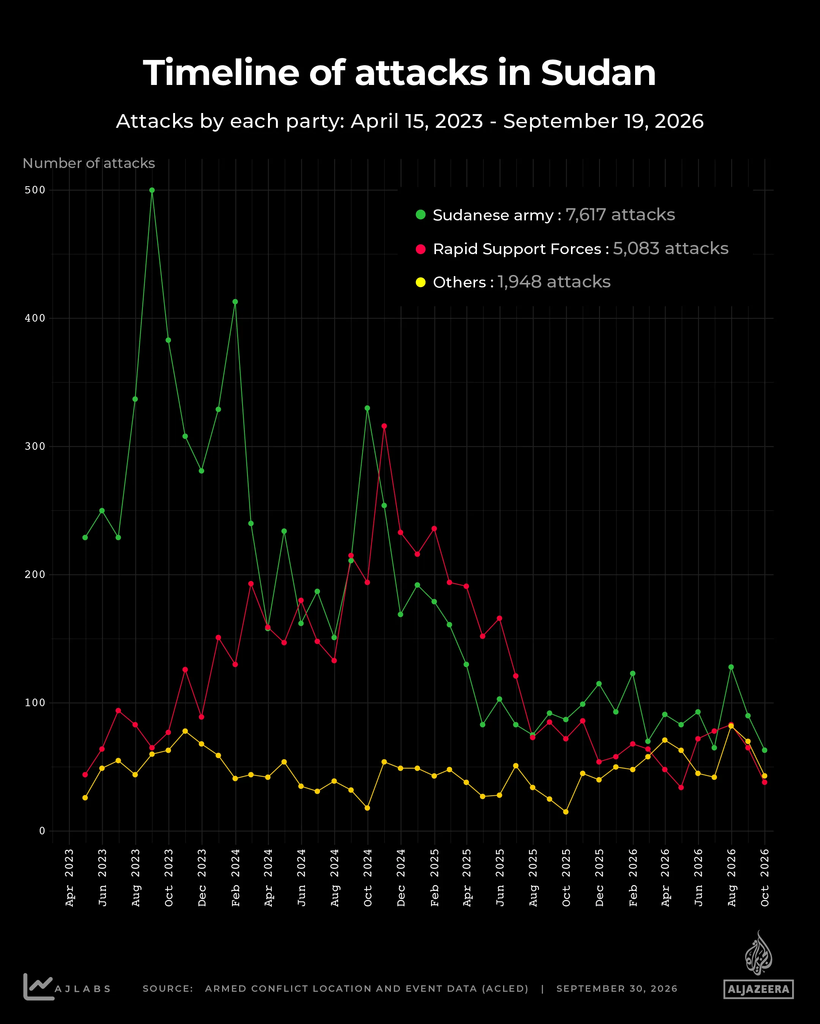
According to the analysis of ACLED data, the Sudanese army was linked to about 52% of the attacks recorded across Sudan between the start of the war and 19 September 2026, compared with 34.7% for the Rapid Support Forces and 13.3% for other actors.
However, these figures refer to the number of recorded violent events attributed to the parties, and do not necessarily mean that each party bears the same share of responsibility for civilian casualties or violations.
In Kordofan specifically, the army was linked to 1,323 incidents, or about 46% of the attacks recorded in the three states, compared with 920 incidents, or 32%, linked to the Rapid Support Forces, while 633 incidents, or 22%, were attributed to other actors.
The balance of military activity has changed during the war: the army recorded a larger number of attacks during the first year and a half, after which the Rapid Support Forces overtook it from late 2024 until mid-2025, before the monthly numbers of attacks for the two sides converged from August 2025 onward.
219,000 new displaced people from Kordofan
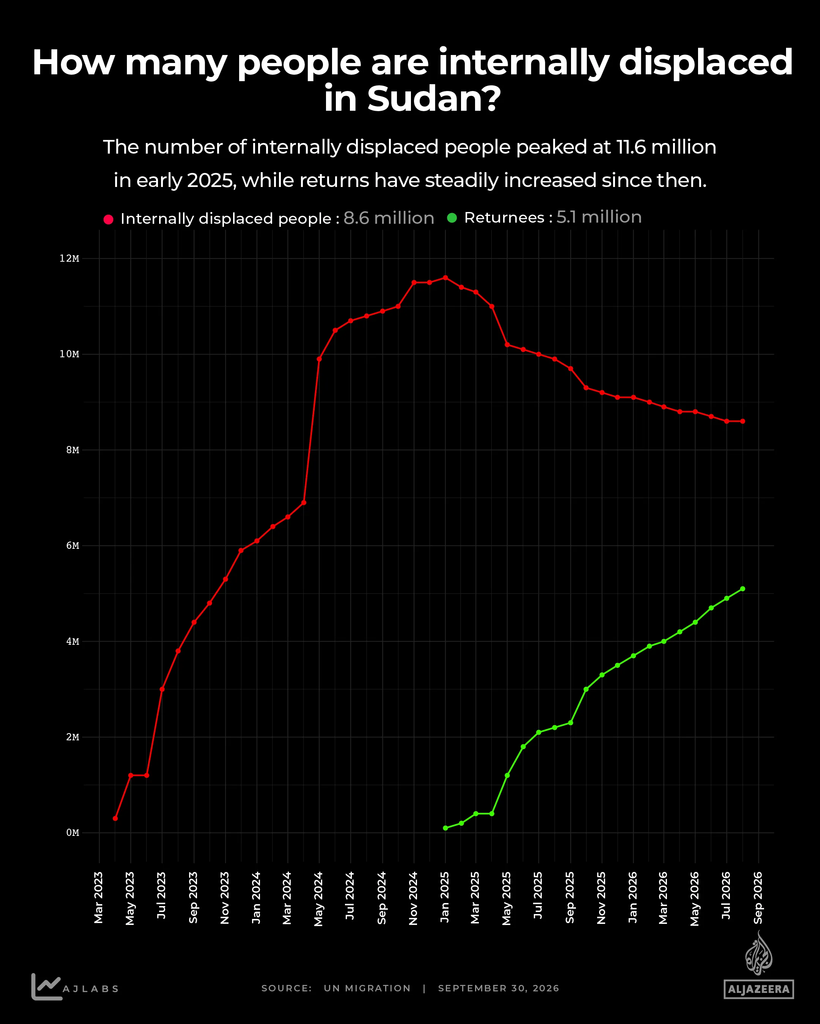
Alongside the military battle, the displacement crisis is worsening.
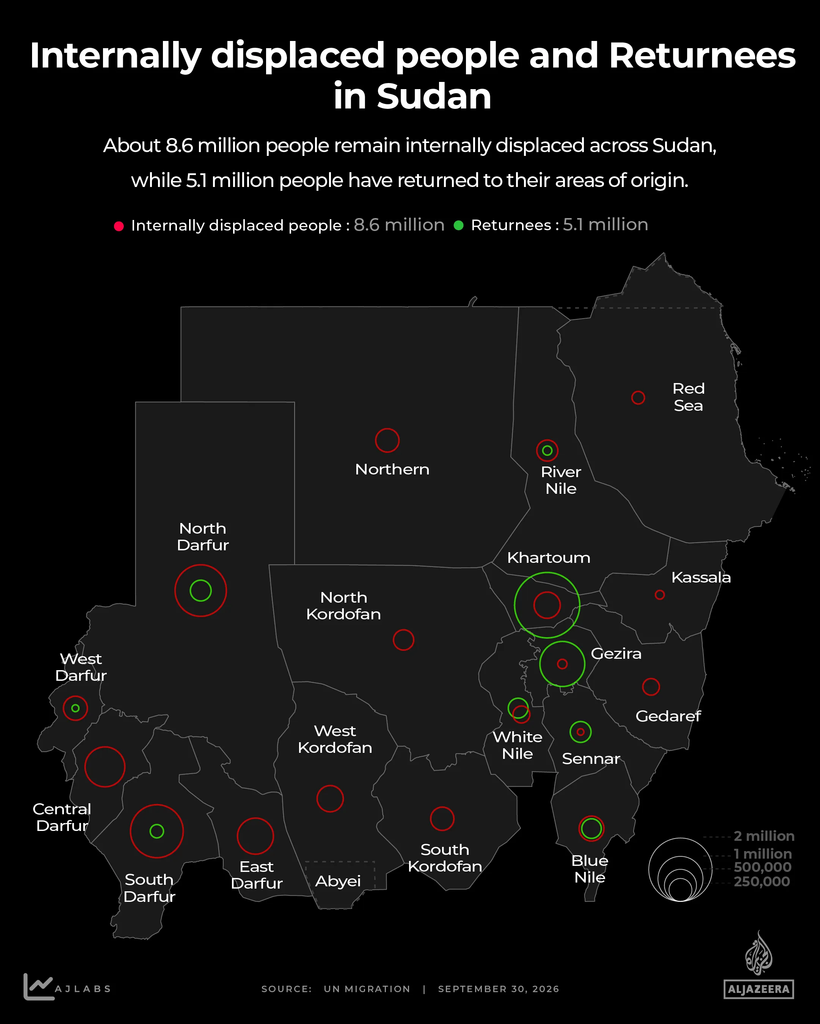
According to the latest United Nations figures cited in the report, some 8.6 million people remain displaced inside Sudan, despite the return of millions of Sudanese to areas the army has regained control of.
By August 2026, the number of returnees had reached some 5.1 million people, including some 2.7 million who returned to Khartoum.
The trend is reversed in Kordofan.
The International Organization for Migration says the number of people newly displaced from Kordofan since the escalation of fighting in October 2025 rose by 65% over four months, from more than 132,000 in February to at least 219,000 people by the end of June.
The organisation particularly warned of the danger surrounding the city of El Obeid, which hosts about half a million people, including more than 83,000 displaced persons, amid concerns that fighting around it could expand.
The Director General of the International Organization for Migration, Amy Pope, said that indicators of danger had become clear, as families flee violence and lose access to water, electricity and healthcare, in conjunction with flood damage.
Kordofan: the battle that may shape the next phase
More than three years after the outbreak of the war, developments show that Kordofan has become one of the main military and geographic knots of the Sudanese conflict.
The region lies between the army's centre of gravity in central, northern and eastern Sudan and the areas under Rapid Support Forces control in Darfur, while its roads and cities, foremost among them El Obeid, make control of it important for supply and movement lines between the east and west of the country.
As the use of drones escalates and battles continue on the ground, civilians pay the price through displacement, loss of livelihoods, and damage to services and infrastructure.
Thus the battle of Kordofan brings together in one area the most prominent features of the current Sudanese war: a struggle over territory and strategic corridors, an escalating drone war, new waves of displacement, and an exhausted economy pushing millions of Sudanese to seek the most basic means of survival.


