


Nuclear competition between Russia and the United States no longer revolves only around intercontinental ballistic missiles or conventional nuclear submarines. For years, Moscow has been pursuing systems capable of changing the very paths of an attack.
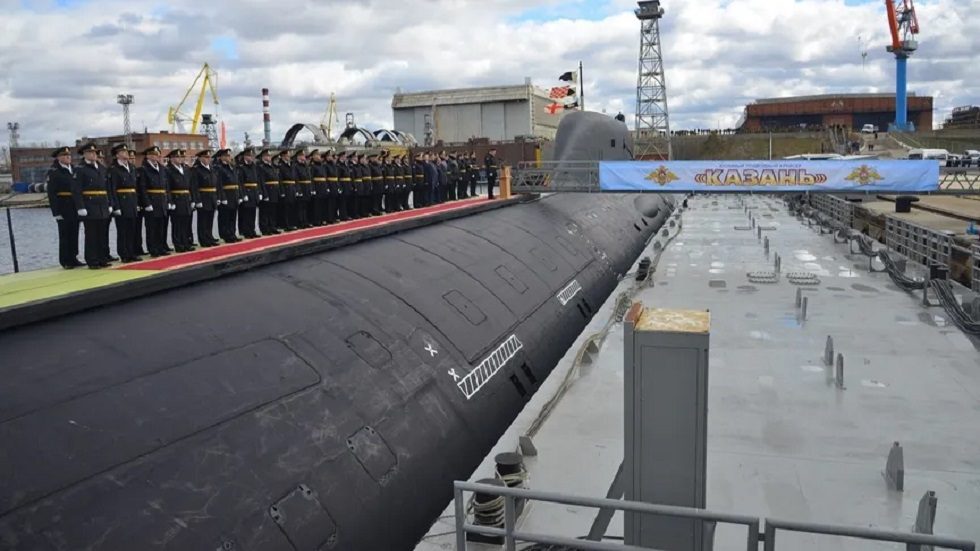
In the latest chapter of this effort, the submarine "Khabarovsk" has appeared at sea, formally entering the sphere of strategic attention as a platform designed to carry and launch the nuclear-armed unmanned torpedo "Poseidon", one of the most controversial Russian weapons.
This development comes at a particularly sensitive time for global nuclear security, after the expiry of the "New START" treaty between Russia and the United States in February 2026, leaving the world's two largest nuclear arsenals facing a more uncertain phase in terms of strategic limits and controls.
"Khabarovsk": A Submarine Designed for a Different Mission
Unlike conventional nuclear attack submarines, "Khabarovsk" was designed primarily to be a naval platform capable of carrying nuclear-powered unmanned vehicles, chief among them "Poseidon".
Reports indicate that the submarine can carry up to six torpedoes of this type, giving it a strategic role that goes beyond the concept of a conventional submarine that relies on launching missiles from underwater.
According to Russian reports, the submarine's departure to sea represents its first prominent practical test since construction began in 2014, corresponding to 1435 AH, after years of delay in its programme.
This delay does not diminish the significance of the step for Moscow, as it means the project has moved from the development and construction phase to naval testing, a stage more closely linked to the possibility of bringing the system into active service.
"Poseidon": Why Is It Described as a "Doomsday Weapon"?
The most striking element in the story of "Khabarovsk" is not the submarine itself, but the weapon it was designed to carry.
"Poseidon" is a nuclear-powered unmanned underwater vehicle, capable of moving beneath the surface of the sea over vast distances instead of following the conventional air routes of ballistic missiles.
Russia says the system is designed to cover thousands of kilometres at high speeds, with the ability to operate at depths that make detection and interception more difficult compared with conventional means of attack.
However, this description also carries a promotional dimension, as some of the capabilities and figures circulating about "Poseidon" originate from Russian statements or media, and sufficient independent data to verify all the operational details of the system is not publicly available.
A Weapon That Bypasses Conventional Defences
The core idea behind "Poseidon" is changing the path of a nuclear attack. A ballistic missile follows a trajectory that can be tracked by early-warning systems, satellites and long-range radars.
An unmanned underwater vehicle, by contrast, moves in a completely different environment and approaches its target through the depths of the seas.
In theory, this gives Moscow an additional deterrence route that may be difficult to address with systems designed primarily to counter ballistic missiles.
This is where the strategic value of "Poseidon" lies: not necessarily in being the most powerful Russian nuclear weapon, but in expanding the number of ways a nuclear weapon can be delivered to its target.
Six "Poseidon" Torpedoes Beneath the Surface
The capacity of "Khabarovsk" to carry up to six "Poseidon" torpedoes gives the submarine an important role in Russia's deterrence system.
The presence of these weapons on a nuclear platform capable of operating in the depths of the seas means that deterrent capability could be distributed away from land bases and tied to vast maritime areas that are difficult to monitor continuously.
"Poseidon" Is Not the Only Card
The importance of "Khabarovsk" is not limited to the nuclear unmanned torpedoes. Reports on the submarine indicate that it possesses or is associated with other weapons capabilities, including long-range cruise missiles, among them "Kalibr", "Onyx" and the hypersonic "Tsirkon".
This means the platform could combine different capabilities: stealth beneath the surface, the ability to carry strategic systems, and the use of long-range conventional weapons.
In this way, the submarine becomes part of a broader concept of developing multi-role naval platforms, rather than confining its role to nuclear deterrence alone.
A Project Delayed for Years, but Not Halted
Construction of "Khabarovsk" began in 2014, but the project faced long delays, and the submarine was expected to enter service earlier. The programme was extended for additional years amid complications related to the submarine's design and the development of its systems, as well as challenges facing Russia's military industries.
Its transition to the naval testing phase in 2026, however, reflects Moscow's decision to press ahead with the project despite these delays.
This step gains greater significance given the strategic environment in which it has emerged, as traditional constraints on the nuclear arms race between Moscow and Washington are weakening.
"Khabarovsk" After "New START": A Highly Sensitive Timing
The expiry of the "New START" treaty in February 2026 marked a pivotal juncture for the future of nuclear deterrence. The treaty was the last major framework placing limits on the strategic nuclear arsenals of Russia and the United States.
With this framework gone, developing new deterrence systems becomes more consequential, particularly those seeking to get beyond conventional means of detecting and intercepting missiles.
In this context, "Khabarovsk" cannot be viewed as an isolated naval project, but rather as part of a long Russian trajectory of developing strategic weapons capable of penetrating existing defence systems.
From Putin to "Super Weapons"
Russian President Vladimir Putin unveiled "Poseidon" in 2018, as part of a set of new strategic weapons that Moscow presented at the time as capable of overcoming United States missile defence systems.
The political and military aim of the announcement was clear: to affirm that the development of advanced defensive systems would not necessarily neutralise Russia's ability to deliver a nuclear strike.
Can "Poseidon" Create a "Nuclear Tsunami"?
The weapon's name has also been linked to sweeping claims about its ability to generate enormous sea waves or a "radioactive tsunami" when detonated near an adversary's coastline.
As announced, the weapon is designed to be an unmanned nuclear vehicle underwater, and the strategic idea behind it rests on reaching coastal targets via a long maritime route that is difficult to intercept with conventional means.
Scenarios of destroying coastal cities with huge waves, however, remain within the realm of claims and theoretical scenarios rather than a publicly demonstrated capability.
An Arms Race in a More Dangerous Nuclear Environment
The significance of "Khabarovsk" does not stop at Russia's borders. The introduction of a system of this kind into naval testing comes at a time when military competition among the major powers is intensifying and the agreements that once limited some aspects of the arms race are gradually eroding.
The United States, for its part, possesses a large fleet of strategic nuclear submarines and is working to develop new systems for deterrence, early warning and reconnaissance.
Russia's Real Message
The primary message carried by "Khabarovsk" may be less about its capacity to use "Poseidon" in an actual war than about demonstrating that Moscow possesses multiple options for deterrence.
In practical terms, the submarine says that Russia does not want the future of nuclear deterrence to be confined to ballistic missiles and conventional submarines, but instead seeks platforms and attack routes that are difficult for an adversary to anticipate or neutralise.
While the appearance of "Khabarovsk" does not mean a nuclear war is imminent, it reveals a more troubling trend: the shift of nuclear competition from a race to acquire weapons to a race to devise new ways of delivering them.
This is where the importance of the new Russian submarine lies. It is not merely another naval vessel in the Russian fleet, but a platform carrying a different vision of the future of deterrence, in which the nuclear threat could come along a route that missiles do not travel, from a weapon moving in silence thousands of metres beneath the water.


