


When Jumaa and Fadi Abu Asi went to look for firewood, their parents thought they would be safe. They were just young boys, nine and ten years old, and after all, a ceasefire had been announced in Gaza. Their mother, Hala Abu Asi, was preparing tea in the family tent in Khan Younis when she heard an explosion, a missile fired by an Israeli drone. She ran to the spot, but it was too late.
Their mother said they were killed at a "time when the bloodshed was supposed to have stopped." Abu Asi said: "After the ceasefire was announced, I felt some safety and believed it would no longer harm my children."
She is now focused on keeping her two surviving daughters alive. "I still hear the explosions and gunfire," she said. "I do not feel that the war has ended."
The toll from Israeli attacks in Gaza has fallen significantly compared with the previous two years of war, when an average of 90 Palestinians were killed each day, but large numbers of civilians are still losing their lives.
On average, Israeli weapons now kill seven people a day. This rate of violent deaths would be considered active conflict in many other contexts, raising questions about how accurately the term "ceasefire" describes the new situation.
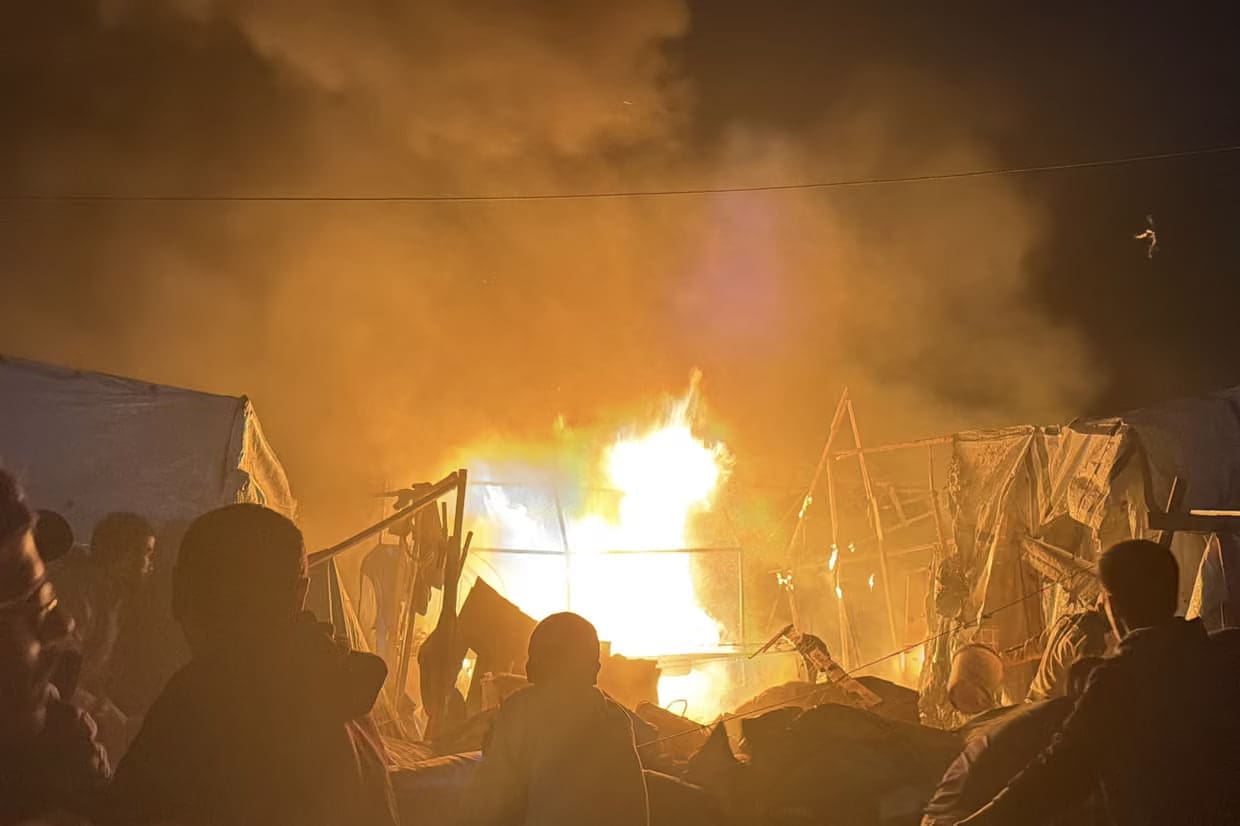
Tents burned in Khan Younis on 3 December in an Israeli strike that killed five people, including two children, in violation of the ceasefire.
Daniel Levy, a former Israeli negotiator and president of the US/Middle East Project, said: «It is something, if you like, you can call a ceasefire, which is very comfortable for Americans and for everyone who wants to get this off their TV screens and off their streets and off their annoying parliamentary and political agendas».
"This suits Israel very well. The pressure has dropped and they have destroyed the entire place, and they can still kill as they please."
Amnesty International said that Israel is still committing genocide in Gaza and that the use of the term ceasefire "risks creating a dangerous illusion that life in Gaza is returning to normal."
The Israeli military has made clear that it still follows a policy of shooting to kill around its positions. The mission acknowledged the drone strike on Jumaa and Fadi Abu Asi, and described the two young boys, who were collecting firewood to feed and warm their family, as "suspects" posing a threat to Israeli soldiers.
The "yellow line" hardens
Like many of those killed during the ceasefire, the two young brothers were targeted for being close to the "yellow line" to which forces withdrew under the truce. This line now divides Gaza and gives Israel the larger share. In the original ceasefire map, Israel was to continue occupying 53% of the Gaza Strip, but the Israeli military unilaterally expanded this to 58% when it placed markers defining its territory.
This division represents Gaza's new reality, as US forces prepare an open-ended partition into what it calls a "green zone" under Israeli and international military control, where reconstruction will begin, and a "red zone" that will be left in ruins.
According to a geographic analysis by Forensic Architecture, most of Gaza's fertile farmland is in Israeli hands, while the population is confined to the arid coastal sand dunes, the "red zone."
The ceasefire proposals put forward by Donald Trump, largely incorporated into the UN Security Council resolution last month, envisaged further steps after the first phase of the exchange of hostages and prisoners and the withdrawal to the "yellow line."
Israeli forces are meant to continue withdrawing, to be replaced by an International Stabilisation Force (ISF) under a "Board of Peace" chaired by Trump, with world leaders of his choosing participating, alongside a Palestinian technocratic committee to run day-to-day affairs.
However, these phases, which are harder to agree on than the initial cessation of fighting, were deliberately left vague and remain hazy two months on.
Israel has insisted that no progress can be made in the first phase until all the bodies of "hostages" killed during the war are returned and Hamas's weapons are dismantled. Hamas located and returned all the bodies except one, and announced that it was prepared to discuss handing over offensive weapons, such as rocket launchers and missiles, but it will not hand them to Israel or to any entity Israel supports.
The UN resolution of November indicates that the International Stabilisation Force (ISF) could lead a disarmament process, but none of the countries expected to contribute troops, such as Indonesia, Azerbaijan and Pakistan, are willing to send soldiers to take weapons from Hamas against its will.
A European Union-backed training programme for Palestinian police, covering recruits from Gaza and the West Bank, which had been conducted in Egypt and Jordan before the ceasefire, is set to be expanded. But with no governing authority for Gaza, it is unclear who would lead this force, and Israel has made clear it will not permit any force bearing a Palestinian national character.
Amid this ambiguity and delay, there are growing signs that the "yellow line" is hardening into something more permanent, namely the partition of Gaza.
The army has begun building concrete positions along the "yellow line," creating free-fire zones around them. On the side of the line that Israel occupies, the army has continued to level Palestinian neighbourhoods destroyed in the war, despite the commitment of Trump's plan to reconstruction.
What will be built in their place, if anything, is unclear. Israel has indicated that it will only allow construction in the "green zone" it occupies, while plans drawn up by the US government and military envisage scattered fenced camps, rather than the rebuilding of Palestinian communities.
These areas are referred to as "alternative safe communities" (ASCs), and would be closer to camps, where Palestinians would live in prefabricated units or reused shipping containers, with shared toilet and shower facilities.
Residents would be vetted to exclude any Palestinian who had been paid by Hamas even if in a civilian role, or any member of their relatives, including cousins, aunts and uncles, who appeared on any Hamas payroll.
It is not clear whether those who moved into the Israeli-controlled areas would be allowed to return to western Gaza.
Several humanitarian organisations and European countries have refused to take part in planning the ASCs, arguing that the project may violate international law. They fear these centres could be used as a tool for forced displacement and for exploiting civilians' needs to achieve military objectives.
The United States is also ignoring fundamental issues such as land ownership, according to Amjad Iraqi, senior Israel-Palestine analyst at the International Crisis Group. Iraqi said: «US officials are coming in with a tabula rasa approach, where they can rebuild from scratch as if nothing existed before, no homes, no communities, no land records in the areas. This violates every international law».
Even if the United States goes ahead with a pilot humanitarian support centre in Rafah, the project will barely alleviate the current humanitarian crisis in Gaza.
Mountains of rubble containing unexploded bombs must be removed before construction can begin, and even the most optimistic timelines require six months of work before the first Palestinians can move in, according to sources familiar with the plans.
Trapped in appalling conditions
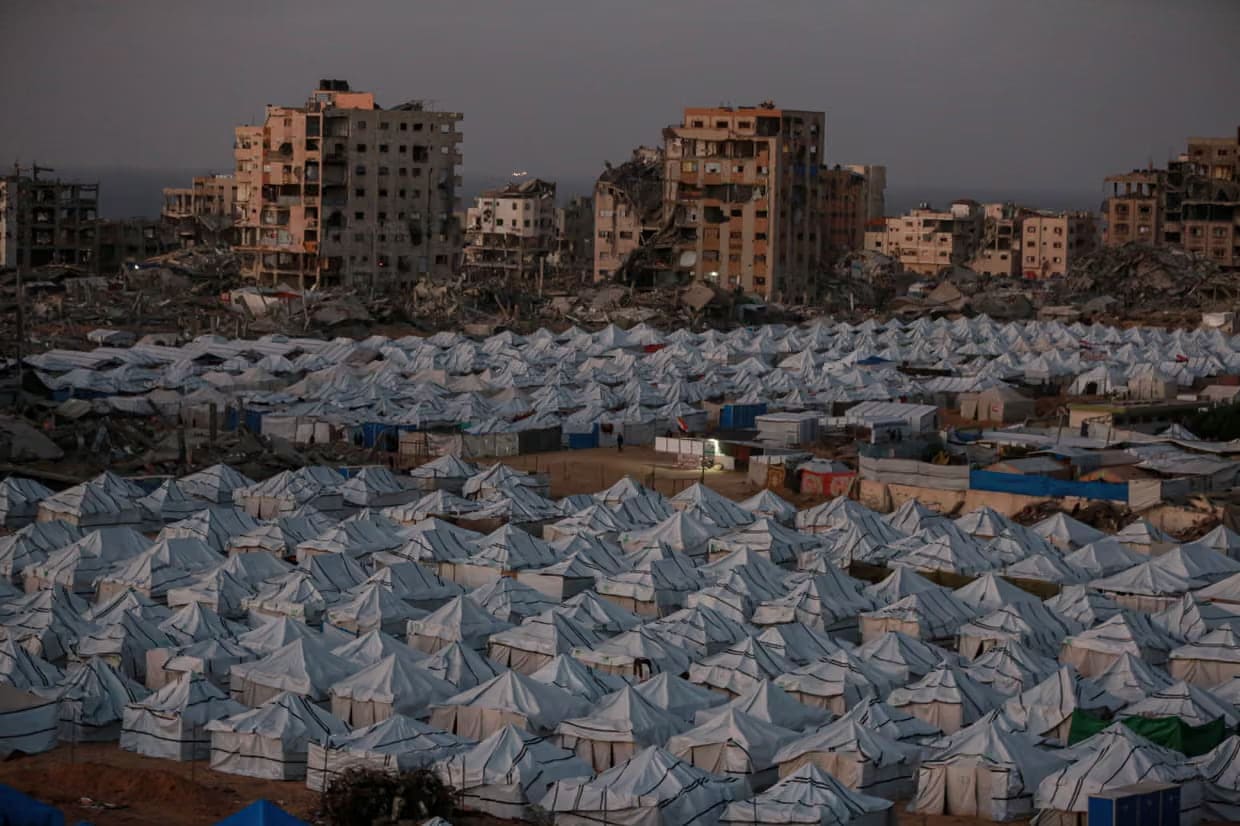
Meanwhile, the current ceasefire agreement leaves some 2.2 million Palestinians in Gaza trapped in just 42% of their former territory, and isolated in appalling conditions.
Palestinians are in no way safe from Israeli strikes, as many have targeted the "displacement zones" set aside for them, according to the Forensic Architecture analyst group.
Heavy rains that fell twice in November flooded the tent camps in Gaza, washing away hundreds, if not thousands, of shelters. In the latest flood, on 25 November, tents in Deir al-Balah collapsed under the pressure of water seeping in from all sides. Some people tried to dig channels to divert the water away, while most stayed huddled in their tents. Most of the floodwater came from sewage basins full near them.
"We are very concerned about waterborne diseases given the tragic health situation and the lack of adequate sanitation. We fear diseases such as cholera could emerge if conditions do not improve as quickly as possible," said Jonathan Crickx, spokesperson for the UN children's agency UNICEF in Palestine. He added: "We have seen a notable increase in cases of acute watery diarrhoea over the past four weeks, affecting children over the age of five."
Food supplies in Gaza have risen since the ceasefire was announced. Aid deliveries increased from an average of 91 trucks a day in the month before the truce on 10 October, to 133 trucks a day the following month.
A reduction in looting has also helped aid agencies reach the most vulnerable. Before the ceasefire, most aid was stolen by gangs or desperate Palestinians before reaching its destination.
At the same time, non-UN shipments, including commercial supplies and donations from Arab countries, have increased at a faster rate. According to World Food Programme figures, commercial shipments nearly doubled from 37 trucks a day in September to 144 trucks a day in the first week of November.
The flow of commercial goods has helped bring prices in the markets down after they had reached exorbitant levels during the war. Flour in the Deir al-Balah market costs four shekels (93p) a kilogram, one kilogram of sugar costs five shekels (£1.16), one egg four shekels, and a chicken 35 shekels (£8.11). A tent costs between 1,000 and 2,000 shekels (£231 to £462).
But even these prices remain out of reach for the vast majority of Palestinians, who have exhausted their savings after two years without work and now rely on aid.
Nevertheless, the total flow of goods remains below the pre-war average of 600 trucks a day, while the population's needs have grown substantially, as the war has robbed almost all Palestinians of shelter, livelihoods, schools and hospitals.
Sam Rose, acting director of UNRWA in Gaza, said: "We are not seeing significant increases in the volume of materials arriving." UNRWA is the largest relief agency in Gaza, but it has been barred from operating by Israel, which claims that some of its 13,000 staff in the territory took part in the October 2023 attack on Israel that sparked the war.
The world risks complicity
European and Arab states justified their support for Trump's proposals in the UN resolution that endorsed them as a way of keeping the United States engaged in peace efforts and giving his proposed steps some legitimacy, and also as a glimpse towards a possible future Palestinian state.
They justified their participation in the Civil-Military Coordination Center (CMCC) on a similar basis, pointing to modest improvements in aid delivery in the hope of containing the threat of famine.
The CMCC, established in a warehouse at Kiryat Gat in southern Israel, is run by the Israeli and US militaries, alongside liaison officers from other countries supporting the ceasefire, with no Palestinian representation.
Observers warn European and Arab states and aid agencies that without tangible progress in the peace process, the CMCC risks becoming complicit with the Israeli military in a status quo that keeps Palestinians in inhumane conditions, and in schemes such as the ASC plan, in violation of international humanitarian law.
Rose said: "There is not much international anger or pressure directed at Israel these days, but the reality is that people are living in miserable conditions and are continuing to be killed despite the ceasefire.
"Palestinians face these multiple futures over which they have no control. So the element of powerlessness, the psychological torture and the cruelty they have endured over the past two years – is still ongoing."
Fa'iq al-Sukkani cannot find a place to shelter his family of nine other than the ruins of their home in the Tuffah neighbourhood of Gaza, about 500 metres from the "yellow line." For the 37-year-old man, not a day passes without anxiety that his children could die.
He said on Thursday: "The situation is extremely tense. Every day we hear the sounds of tanks moving and firing shells and shooting in all directions. Just yesterday, a group of my relatives was targeted directly in the area; three of them were killed and several others seriously injured."
Al-Sukkani added: "It feels as if the war is still going on and there has been no ceasefire at all. The situation is unbearable; there is no sign of normal life at all."
The Guardian, UK.


